
Official statement
Other statements from this video 10 ▾
- □ Pourquoi vos requêtes de crawl tombent-elles à zéro dans Search Console ?
- □ Robots.txt en disallow bloque-t-il vraiment la génération de snippets dans les SERP ?
- □ Search Console suffit-il vraiment à détecter tous vos problèmes de crawl ?
- □ Search Console suffit-elle vraiment pour diagnostiquer vos problèmes d'indexation ?
- □ Quels outils Google faut-il vraiment utiliser pour auditer correctement un site ?
- □ Lighthouse peut-il vraiment remplacer un audit SEO professionnel ?
- □ Un robots.txt mal configuré peut-il vraiment bloquer vos snippets et votre crawl ?
- □ Faut-il vraiment monitorer votre robots.txt en continu ?
- □ Faut-il vraiment tester son robots.txt avant chaque modification ?
- □ Faut-il bloquer certaines sections de votre site dans le robots.txt ?
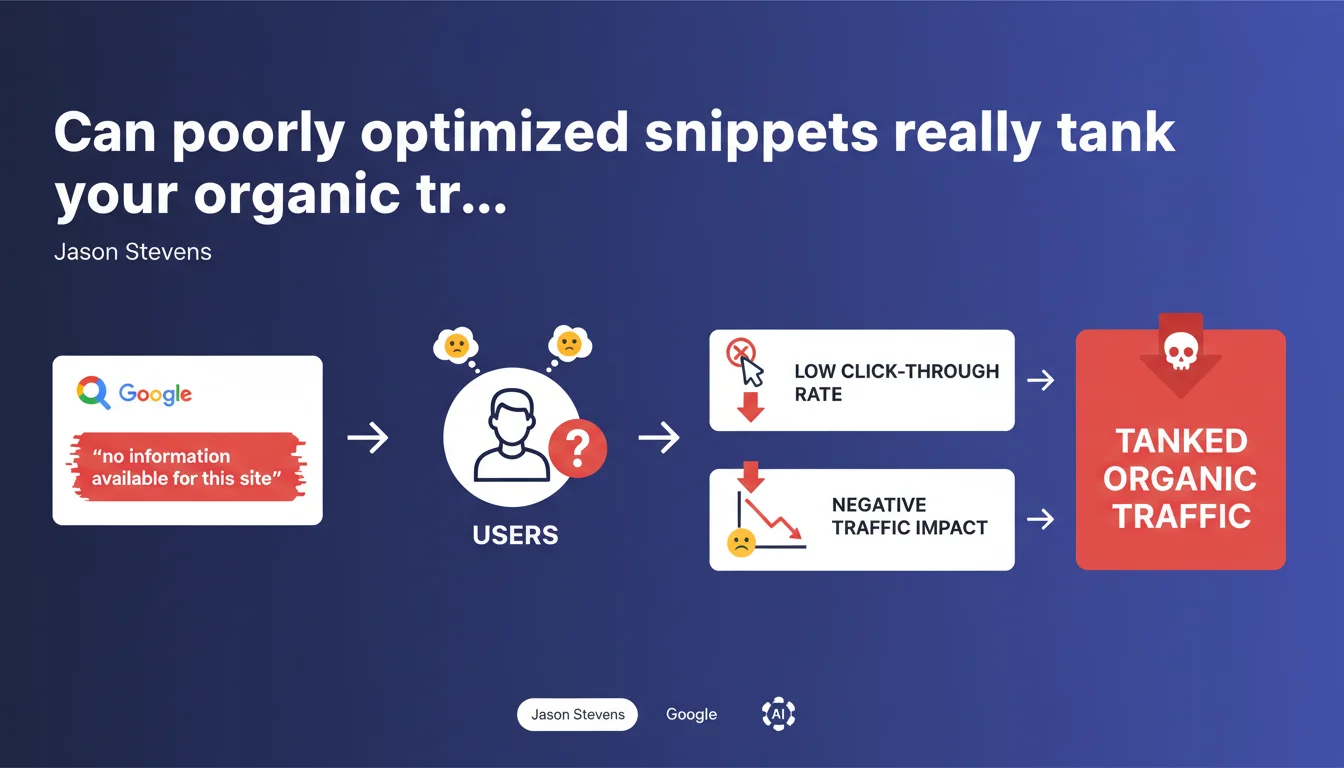
Google confirms that generic snippets like "no information available" discourage clicks and damage traffic. A poorly crafted snippet acts as a low-quality signal to users, even if your ranking position is strong. Optimizing meta descriptions and structured data therefore becomes a performance lever you can't afford to ignore.
What you need to understand
What is a generic snippet and why is it problematic?
A generic snippet appears when Google can't find relevant information to display in search results. The "no information available for this site" message or out-of-context excerpts are typical signs of this issue.
These snippets create immediate friction: the user hesitates, compares with competitor results that show clear descriptions, and ends up clicking elsewhere. Even with a good ranking position, you lose clicks.
How does Google generate the snippets displayed in SERPs?
Google pulls from multiple sources: the meta description, visible page content, structured markup (Schema.org), and sometimes text fragments from external links. The algorithm prioritizes what best matches the user's search query.
The engine may ignore your meta description if it deems it irrelevant or too vague. That's where the shoe pinches — you don't have absolute control, but you can strongly influence the outcome.
Why is this statement coming out now?
Google has always emphasized user experience, but this clarification comes at a time when organic CTR is structurally declining. Between featured snippets, ad blocks, and People Also Ask sections, the space to capture attention is shrinking.
A weak snippet becomes a major competitive handicap. Google is saying it openly: if your excerpt confuses the user, you lose traffic — regardless of your ranking position.
- Generic snippets act as a trust signal to users
- Google doesn't guarantee displaying your meta description, but it remains your best lever of influence
- A poorly optimized snippet can negate the effect of good ranking
- Snippet optimization becomes a matter of SERP conversion, not just SEO
SEO Expert opinion
Is this statement really a revelation for SEO professionals?
Let's be honest: any experienced practitioner already knows that snippets influence CTR. What's changing is that Google is explicitly verbalizing it and pointing out the direct impact on traffic.
However, the statement remains frustratingly vague. No threshold, no metrics, no concrete examples. How many clicks are lost? On what types of queries? Google doesn't say. [To verify]: it's impossible to quantify the exact scale of the phenomenon without ground-truth data.
In what cases do generic snippets appear most often?
Experience shows several recurring scenarios: orphaned pages without meta descriptions, overly technical or jargon-heavy content that Google struggles to summarize, dynamic pages with JavaScript-loaded content that isn't properly crawled.
Another classic case: e-commerce sites with nearly empty product pages or auto-generated descriptions with no added value. Google then displays text fragments from the footer, legal notices, or worse — nothing at all.
Does this rule apply to all query types?
No, and that's where it gets tricky. On navigational queries (brand searches), users will click anyway — snippet or not. The impact is minimal.
However, on informational or transactional queries with high competition, a weak snippet eliminates you from contention. The problem is amplified on mobile where display space is limited and users are less patient.
Practical impact and recommendations
What should you do concretely to avoid generic snippets?
First step: audit your strategic pages. Use Google Search Console to identify pages generating impressions but abnormally low CTR. This often signals a failing snippet.
Next, write specific meta descriptions for each important page. Forget generic formulas like "Discover our services". Include keywords, a clear user benefit, a differentiating element. Keep it to 155-160 characters to avoid truncation.
What technical errors amplify this problem?
Client-side JavaScript content loading remains a classic pitfall. If Google crawls your page before JS executes, it sees an empty shell — hence "no information available".
Another common mistake: duplicate meta descriptions across dozens of pages. Google then ignores these tags and generates its own excerpts, often poor quality. E-commerce sites are particularly exposed to this issue.
How do you measure the impact of these optimizations?
Track the CTR by page evolution in Search Console before/after optimization. A good snippet can improve CTR by 20 to 40% on certain queries — that's free traffic without changing your ranking position.
Test different approaches: direct vs. descriptive tone, with or without call-to-action, inclusion of numbers or dates. On key pages, these micro-optimizations generate measurable ROI.
- Audit pages with high impressions but low CTR in Search Console
- Write unique meta descriptions focused on user benefit (150-160 characters)
- Verify server-side rendering of main content (avoid late JS loading)
- Eliminate duplicate meta descriptions across your entire site
- Structure content with clear H2/H3 headings to facilitate snippet extraction
- Implement structured data (Schema.org) to enrich snippets (reviews, prices, FAQs)
- Monitor organic CTR page by page after each iteration
❓ Frequently Asked Questions
Google peut-il afficher un snippet différent de ma meta description ?
Un snippet générique peut-il faire baisser mon positionnement ?
Comment savoir si mon site affiche des snippets génériques ?
Les données structurées Schema.org améliorent-elles les snippets ?
Faut-il optimiser les snippets de toutes les pages ou seulement des principales ?
🎥 From the same video 10
Other SEO insights extracted from this same Google Search Central video · published on 10/01/2023
🎥 Watch the full video on YouTube →
💬 Comments (0)
Be the first to comment.