
Official statement
Other statements from this video 11 ▾
- □ Pourquoi Google avait-il tant de mal à comprendre les mots de liaison comme 'not' dans les requêtes ?
- □ La pertinence topique est-elle devenue un critère SEO dépassé ?
- □ Google applique-t-il vraiment un principe d'équilibre entre types de sites dans ses résultats ?
- □ Pourquoi vos stratégies de mots-clés longue traîne sont-elles dépassées depuis l'arrivée du NLU ?
- □ Google privilégie-t-il vraiment la promotion plutôt que la pénalité ?
- □ Pourquoi Google a-t-il conçu les Featured Snippets autour de la compréhension sémantique plutôt que du matching de mots-clés ?
- □ Comment Google mesure-t-il vraiment la satisfaction des utilisateurs dans ses résultats de recherche ?
- □ E-E-A-T est-il vraiment un facteur de ranking ou juste un mythe SEO ?
- □ Pourquoi Google se méfie-t-il du volume de requêtes comme indicateur de qualité ?
- □ Les Quality Rater Guidelines sont-elles vraiment un mode d'emploi pour le SEO ?
- □ Comment Google priorise-t-il les bugs de recherche et qu'est-ce que ça change pour le SEO ?
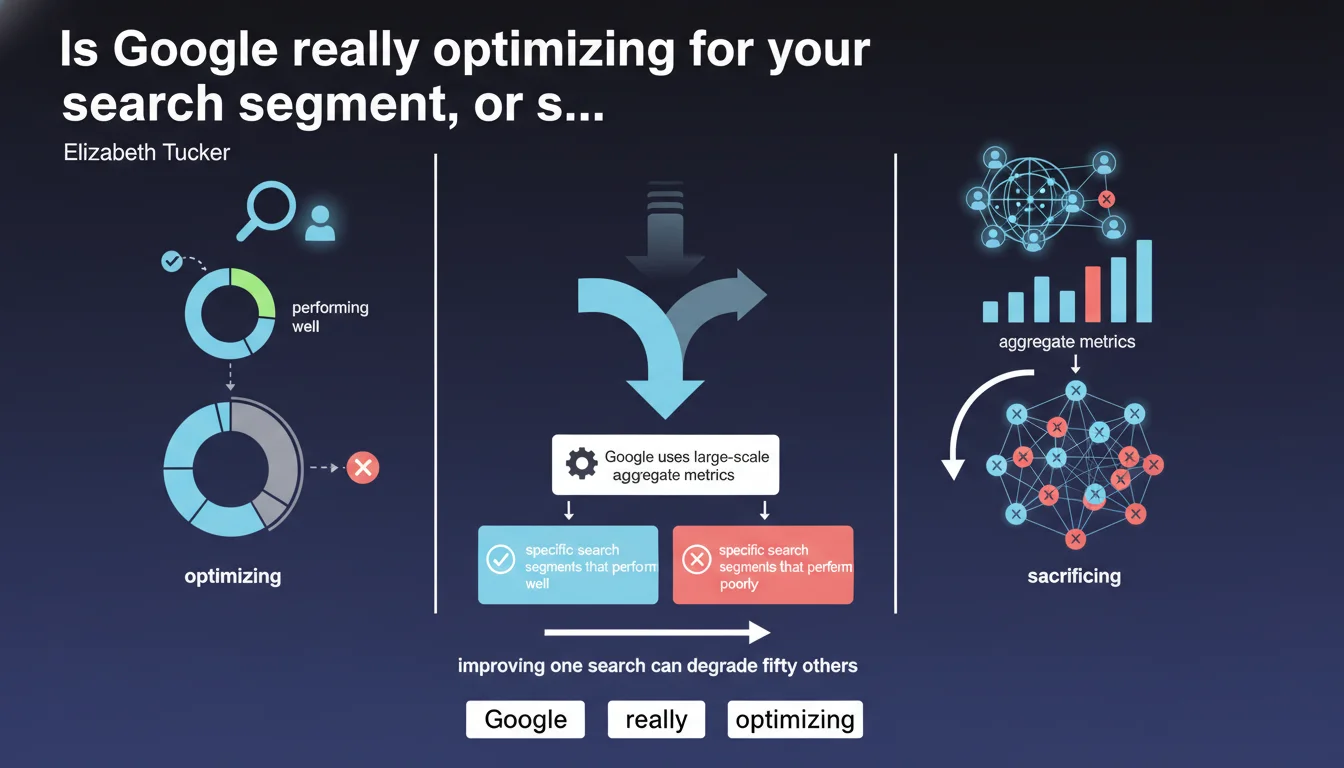
Google doesn't rely solely on aggregate measurements to judge search engine performance. It also identifies specific search segments — some perform well, others poorly. The trade-off is permanent: improving one type of query can degrade fifty others. This segmented balance logic explains why certain algorithm updates seem contradictory depending on your niche.
What you need to understand
What does "measuring quality at scale" concretely mean?
Google operates on billions of daily queries. Aggregate metrics allow it to track macro indicators: click-through rates, bounce time, query reformulations, overall satisfaction. These metrics provide an overview of search engine health.
But this global approach masks disparities. An average can be excellent while entire segments of queries — an industry, an intent, a format — underperform. Google must therefore zoom in on these pockets of mediocre quality to correct course.
Why segment analysis by search type?
Not all queries are equal. An informational search, a local query, a product question, or an image search don't use the same ranking signals. User expectations vary dramatically.
By isolating these segments, Google can adjust its algorithms in a surgical manner. For example, strengthen freshness for news without penalizing evergreen content. Or prioritize user reviews for commercial queries without polluting academic results.
Why does improving one search degrade fifty others?
This is the heart of the problem: ranking signals are interconnected. Changing the weight of one criterion for a segment creates side effects elsewhere. Favoring authoritative sites for medical queries can crush relevant niche content on other topics.
Google must arbitrate continuously. Each adjustment is a compromise between winning and losing segments. The goal isn't perfection everywhere, but acceptable balance across the entire search spectrum.
- Google combines global metrics (macro view) and segmented analysis (micro view)
- Each query type has its own quality criteria and priority signals
- Improving one segment can degrade other segments through side effects
- Algorithm updates are permanent arbitrations between sectoral gains and losses
- Perfect consistency across all segments is structurally impossible
SEO Expert opinion
Does this logic explain erratic post-update variations?
Absolutely. In the field, we regularly observe sites that gain 30% traffic on certain queries and lose 40% on others — during the same update. This isn't random, it's arbitration in action.
Google optimizes for search segments, not for sites. If your site covers multiple niches or intents, you can be a winner on one and a loser on another. Post-update analyses that simply say "my overall traffic dropped 10%" miss the point entirely: which segments moved, and why.
Can you anticipate which segments Google will arbitrate?
[To verify] — Google never communicates its segmental priorities in advance. You can observe trends: stronger E-E-A-T content on YMYL, richer product page prioritization, video content promotion on certain intents.
But predicting which segment will be sacrificed to improve another is pure speculation. The Quality Raters Guidelines provide clues, but they describe an ideal, not the technical compromises needed to achieve it at scale.
Should we conclude that Google favors certain segments over others?
Yes, but not out of malice — by technical necessity. Google cannot optimize all segments simultaneously with the same intensity. It prioritizes those where user satisfaction is most degraded, or those that generate the most volume.
Concretely? Commercial, local, and mainstream informational searches receive more attention than specialized niches or obscure long-tail queries. If your site operates on "secondary" segments for Google, expect more unexplained volatility — you're experiencing side effects of optimizations designed for other queries.
Practical impact and recommendations
What should you concretely do to adapt to this segmented logic?
Stop thinking "my site" and start thinking "my query segments". Break down your traffic by intent (informational, commercial, navigational), by format (article, product page, guide), by topic niche.
Identify which segments are strategically critical to your business. Concentrate your SEO efforts on those — content, E-E-A-T signals, technical optimizations. Other segments can run in "autopilot mode" with minimal effort.
How do you detect if an update favored or hurt you on a segment?
Don't just track overall traffic. Segment your Search Console data by query clusters. Compare impressions, clicks, and average positions before/after update for each cluster.
If a segment crashes while others stay stable or grow, Google has changed its criteria for this search type — and your content no longer meets the new standards. Investigate: new competitors ranking better? SERP format change? Missing signal?
What mistakes should you avoid facing this arbitration reality?
- Don't dilute your SEO efforts uniformly across all segments — prioritize high-ROI ones
- Don't panic if one segment loses traffic while others grow — it's the normal mechanics of updates
- Don't copy an SEO strategy that works on a different segment than yours — valued signals aren't the same
- Don't ignore secondary segments for long: a side effect can become structural if Google generalizes an adjustment
- Don't optimize for "Google in general" — optimize for intent and context of each segment
❓ Frequently Asked Questions
Google privilégie-t-il certains types de recherches au détriment d'autres ?
Pourquoi mon site gagne du trafic sur certaines requêtes et en perd sur d'autres lors d'une même mise à jour ?
Comment identifier quels segments de requêtes sont affectés par une mise à jour Google ?
Faut-il optimiser uniformément tout mon site ou prioriser certains segments ?
Les Quality Raters Guidelines reflètent-elles ces arbitrages entre segments ?
🎥 From the same video 11
Other SEO insights extracted from this same Google Search Central video · published on 27/06/2024
🎥 Watch the full video on YouTube →
💬 Comments (0)
Be the first to comment.