
Official statement
Other statements from this video 8 ▾
- □ Does Search Console Insights really only show Google Search traffic?
- □ Is an impression in Search Console really counted every single time your link appears in search results?
- □ What truly counts as a click in Search Console?
- □ What exactly is a query in Search Console, and why is Google clarifying its definition now?
- □ How is Google's Search Console now automatically grouping your search queries into semantic clusters?
- □ What is Google's actual definition of a brand query in Search Console?
- □ Is tracking brand searches the hidden metric that's sabotaging your entire SEO strategy?
- □ Are you really maximizing all the traffic breakdown data hidden in Search Console?
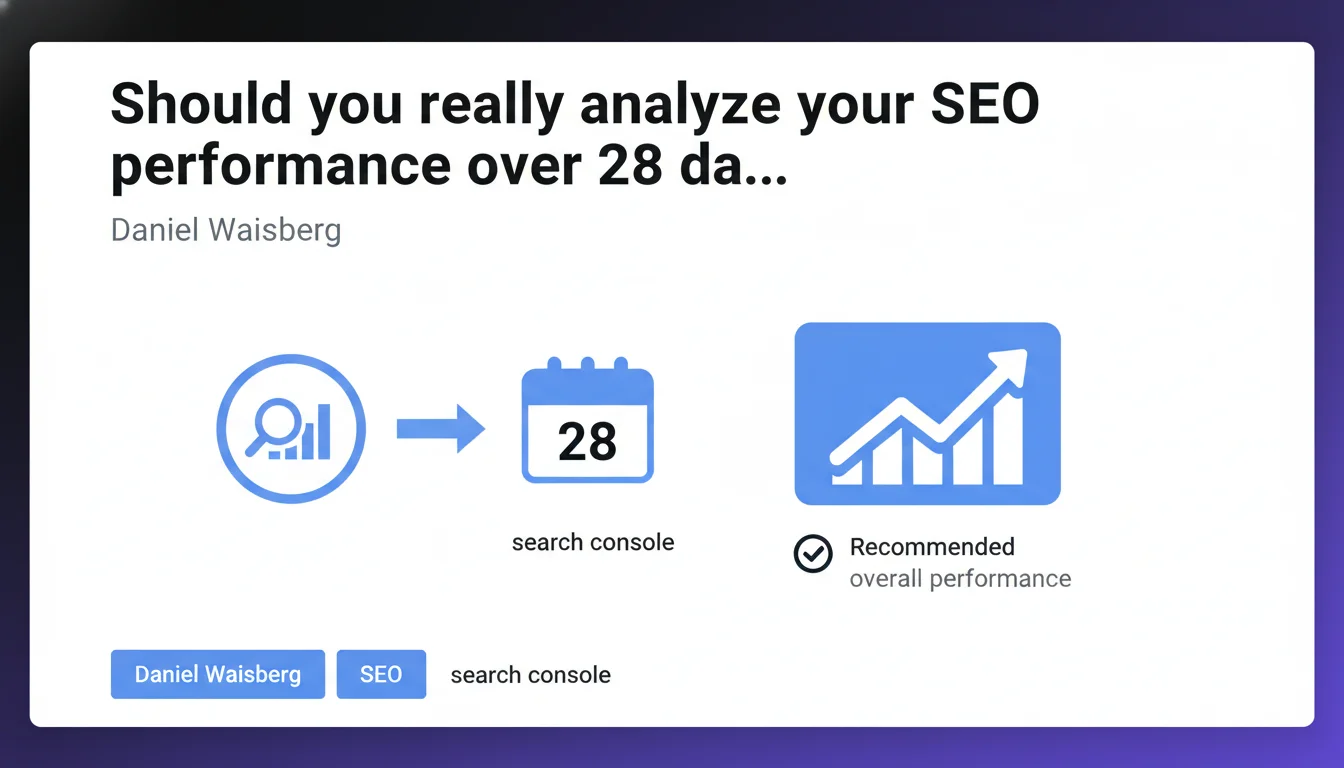
Google officially recommends a 28-day analysis period in Search Console Insights to evaluate a site's performance. This time window is said to provide a reliable overall view by smoothing out daily and weekly fluctuations. The key question: does this duration really work for all types of sites and all analysis situations?
What you need to understand
Why does Google insist on this 28-day period?
The recommendation of 28 days is not arbitrary. This duration corresponds to exactly 4 complete weeks, which captures every day of the week with equal frequency.
In practice, this avoids the bias of weekly variations — an e-commerce site might spike on weekends, a B2B media outlet during the week. Over 28 days, these variations balance out and provide a stabilized view of trends.
Does this duration match a Google algorithmic cycle?
Nothing in the statement explicitly indicates this, but 28 days also represents a sufficient duration for a minor algorithm update to produce measurable effects.
It's also the time needed for a site with average crawl budget to see the majority of its main pages re-crawled at least once — though this factor obviously depends on site size.
What exactly is Search Console Insights?
Search Console Insights is a separate tool from the classic Search Console, designed for content creators rather than SEO technicians.
The interface simplifies data readability and emphasizes high-performing content. The 28-day recommendation applies in this specific context, even though it can be extrapolated to more technical analyses.
- 28 days = 4 complete weeks, which smooths out weekly variations
- This duration allows you to capture a stable trend without being drowned in daily fluctuation noise
- Search Console Insights targets content creators, not just technical SEO professionals
- The recommendation comes from Daniel Waisberg, Developer Advocate at Google — so an official and credible source
SEO Expert opinion
Is this 28-day duration suitable for all contexts?
Let's be honest: no. For a news site that publishes 50 articles daily, 28 days can dilute the analysis of recent content. Conversely, for a corporate site with 2 publications per month, this window is too short to identify solid trends.
Google gives a generic recommendation — which makes sense, they can't customize for every vertical. But in practice, a site with strong seasonality (tourism, retail) should compare periods year-over-year, not just 28-day rolling windows.
What is the real limitation of this recommendation?
The real problem is that 28 days mask one-time events. A core update, a media spike, a technical bug — all of it can be absorbed into the average if you only look at 4 weeks.
A seasoned SEO expert never relies on a single time window. They cross-reference: 7 days to detect anomalies, 28 days for trend, 12 months for seasonality. Google gives you a starting point, not an absolute rule.
Is Google hiding something behind this recommendation?
Not necessarily, but it's worth noting that 28 days is also a duration that smooths out core updates. If a major update occurs mid-period, its impact will be diluted in the statistics.
Is this intentional to prevent creators from panicking too quickly? Maybe. In any case, it prevents pointing fingers at sharp fluctuations — which can be good or bad depending on your analysis needs.
Practical impact and recommendations
What analysis period should you really use daily?
For daily monitoring, stick with 7-day rolling windows — this lets you spot technical anomalies or immediate impacts from publishing. For client or leadership reporting, 28 days is indeed relevant: it avoids overreaction and provides a stable view.
For strategic analysis (semi-annual audit, annual review), switch to month-over-month or year-over-year comparison. The 28-day period is a good compromise for ongoing management, but it doesn't replace context-appropriate analysis tailored to your industry.
What mistakes should you avoid when interpreting data?
First mistake: treating 28 days as absolute truth. If your site has a 3-month buying cycle (complex B2B), 28 days capture only a fraction of the user journey.
Second mistake: ignoring external events. A decline over 28 days could be due to a holiday, a strike, a natural disaster — not necessarily your SEO. Always cross-check with business context and Analytics data to validate your hypotheses.
- Set up automatic alerts on 7 days to detect technical anomalies quickly
- Use 28 days for your regular reporting and general trend analysis
- Always compare with the same period the previous year to neutralize seasonality effects
- Cross-reference Search Console with Google Analytics and your business data — Google tools only tell part of the story
- Document external events (Google updates, marketing campaigns, technical changes) to contextualize variations
- Don't change your analysis period mid-stream — maintain consistent methodology to compare what's comparable
🎥 From the same video 8
Other SEO insights extracted from this same Google Search Central video · published on 02/12/2025
🎥 Watch the full video on YouTube →
💬 Comments (0)
Be the first to comment.