
Official statement
Other statements from this video 8 ▾
- □ Search Console Insights ne montre-t-il vraiment que le trafic Google Search ?
- □ Une impression dans Search Console, c'est vraiment à chaque fois qu'on voit un lien ?
- □ Qu'est-ce qui compte vraiment comme un clic dans Search Console ?
- □ Qu'est-ce qu'une requête exactement dans Search Console et pourquoi Google précise-t-il sa définition maintenant ?
- □ Faut-il vraiment analyser ses performances SEO sur 28 jours dans Search Console ?
- □ Comment Search Console regroupe-t-elle désormais vos requêtes par clusters thématiques ?
- □ Comment Google définit-il vraiment une requête de marque dans Search Console ?
- □ Comment exploiter réellement les données de trafic décomposées dans Search Console ?
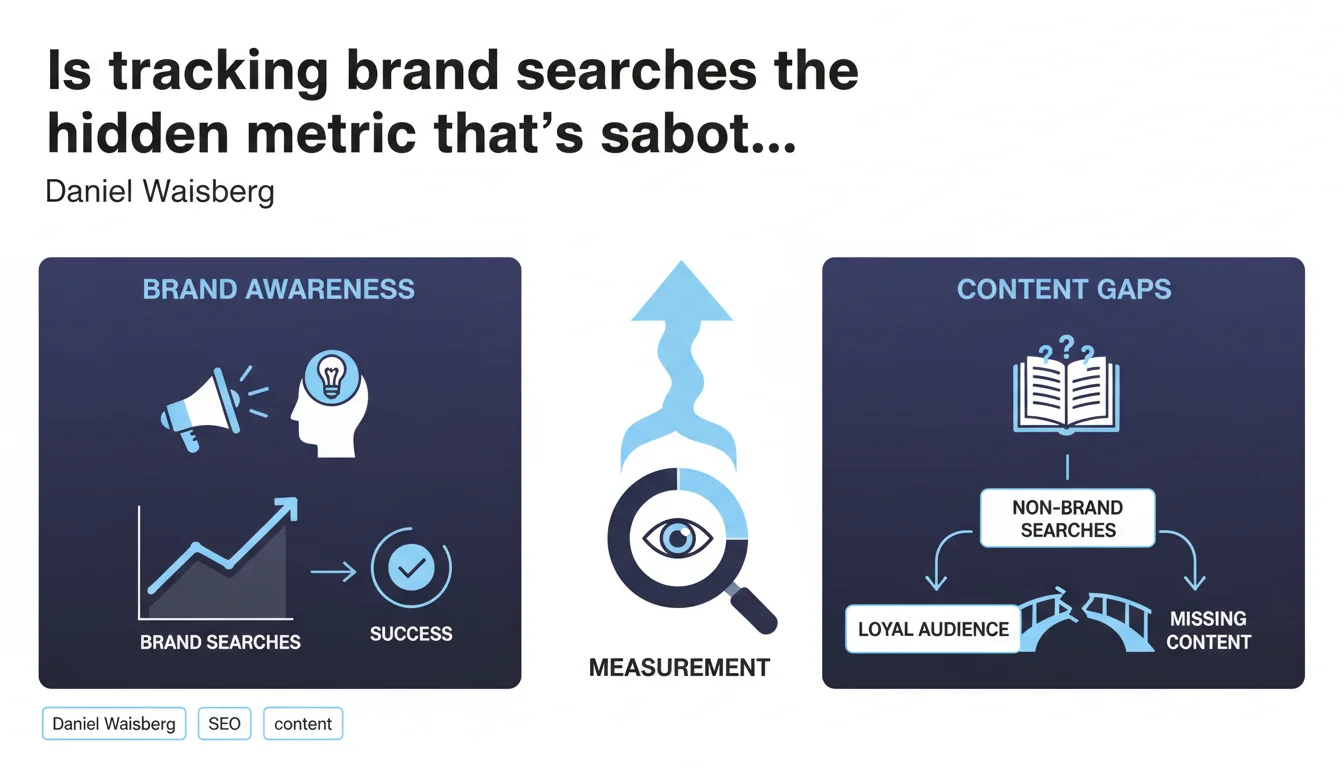
Google confirms that separately tracking brand versus non-brand search queries is a key indicator to measure the real effectiveness of your brand awareness efforts. This distinction also helps you identify blind spots in your content with your already-acquired audience — a lever that's often overlooked.
What you need to understand
What's the concrete difference between a brand search and a non-brand search?
A brand search explicitly contains your brand name, your flagship products, or your identifiable services. It reflects a direct search intent: the user already knows you, they're looking for you.
Conversely, a non-brand search expresses a need, problem, or generic question without mentioning your entity. This is where the conquest of new users who don't know you yet happens.
Why does Google emphasize this separate tracking?
Because mixing the two types completely distorts your analysis. A spike in traffic on brand searches signals that your offline campaigns, PR efforts, or brand awareness are working — but it says nothing about your ability to capture new segments.
Conversely, growth on non-brand searches proves you're gaining ground in competitive territories. It's a signal of conquest, not loyalty.
How does this distinction reveal content gaps?
Your loyal audience — those typing your brand name — has specific expectations. If brand searches explode but bounce rate remains high or conversions stagnate, it means your content isn't answering their real needs.
Google's underlying point here is that you need to analyze brand searches to understand what your already-acquired users are really looking for. Often, you discover support requests, advanced guides, or comparisons between your own products — content you've forgotten to create.
- Separate tracking is a maturity indicator of your overall SEO and marketing strategy
- Brand searches measure awareness and loyalty, not pure SEO performance
- Non-brand searches reflect your ability to conquer new semantic territories
- The gap between the two reveals whether your content meets your existing audience's expectations
SEO Expert opinion
Is this recommendation really applicable in all contexts?
Let's be honest: Google's advice is mainly relevant if you already have an established brand. For a new site, a project in its launch phase, or an ultra-niche activity, the volume of brand searches can be negligible for months.
In these cases, focusing on this metric becomes counterproductive. What matters first is building presence on non-brand searches to exist. Brand awareness will come later.
What nuances should we add about measuring brand awareness?
Google explicitly links brand searches here to the success of "brand awareness efforts." The problem is this metric is polluted by countless external variables — a TV campaign, bad press, a mention by an influencer.
A spike in brand searches doesn't necessarily mean your brand SEO has improved. It might just reflect temporary increased interest. You need to cross-reference with other indicators: session duration, page views, conversion rate.
Should you systematically create content for brand searches?
Not always. If your brand searches mostly lead to your homepage or well-optimized product pages, there's no need to overload. However, if you notice users searching "[your brand] + reviews," "[your brand] + alternative," or "[your brand] + how-to," there's an obvious gap here.
This is actually an underexploited lever: creating resources for your loyal audience improves retention, reduces churn, and boosts engagement — signals Google captures indirectly.
Practical impact and recommendations
How do you effectively segment brand searches in your analytics tools?
In Google Search Console, create search filters based on regular expressions that include all variations of your brand (with or without accents, common typos, abbreviations). Export this data separately each month to track evolution.
In Google Analytics 4, set up custom audiences based on organic traffic source and landing pages associated with brand searches. This lets you isolate the behavior of this specific cohort.
What errors should you avoid when analyzing this data?
Never directly compare the CTR of brand searches with non-brand searches. That's absurd: on a brand search, you're often in position 1 with naturally high CTR. What matters is the trend over time.
Another trap: interpreting a drop in brand searches as an SEO failure. It could be a brand awareness issue, a shift in user behavior (move to direct access), or even a successful migration to a mobile app.
What should you concretely do with these insights?
Start by auditing brand searches that drive traffic but have a low conversion rate. Often, you'll discover these users are seeking information you're not providing clearly — advanced FAQs, use cases, internal comparisons.
Then cross-reference this data with your support tickets and customer feedback. If the same questions keep coming up, that's a clear signal to produce dedicated content. This type of content improves experience, reduces support requests, and — bonus — often generates relevant internal linking.
- Set up dedicated segments in GSC and GA4 to isolate brand searches
- Track monthly evolution of the brand/non-brand ratio to detect trends
- Identify brand searches with high volume but low conversion
- Cross-reference search data with your CRM and customer support tools
- Create specific content to fill gaps identified in your loyal audience's expectations
- Monitor searches like "[brand] + reviews" or "[brand] + alternative" — they reveal friction zones
🎥 From the same video 8
Other SEO insights extracted from this same Google Search Central video · published on 02/12/2025
🎥 Watch the full video on YouTube →
💬 Comments (0)
Be the first to comment.