
Official statement
Other statements from this video 8 ▾
- □ Search Console Insights ne montre-t-il vraiment que le trafic Google Search ?
- □ Une impression dans Search Console, c'est vraiment à chaque fois qu'on voit un lien ?
- □ Qu'est-ce qui compte vraiment comme un clic dans Search Console ?
- □ Qu'est-ce qu'une requête exactement dans Search Console et pourquoi Google précise-t-il sa définition maintenant ?
- □ Faut-il vraiment analyser ses performances SEO sur 28 jours dans Search Console ?
- □ Comment Google définit-il vraiment une requête de marque dans Search Console ?
- □ Pourquoi traquer les requêtes de marque change-t-il radicalement votre stratégie SEO ?
- □ Comment exploiter réellement les données de trafic décomposées dans Search Console ?
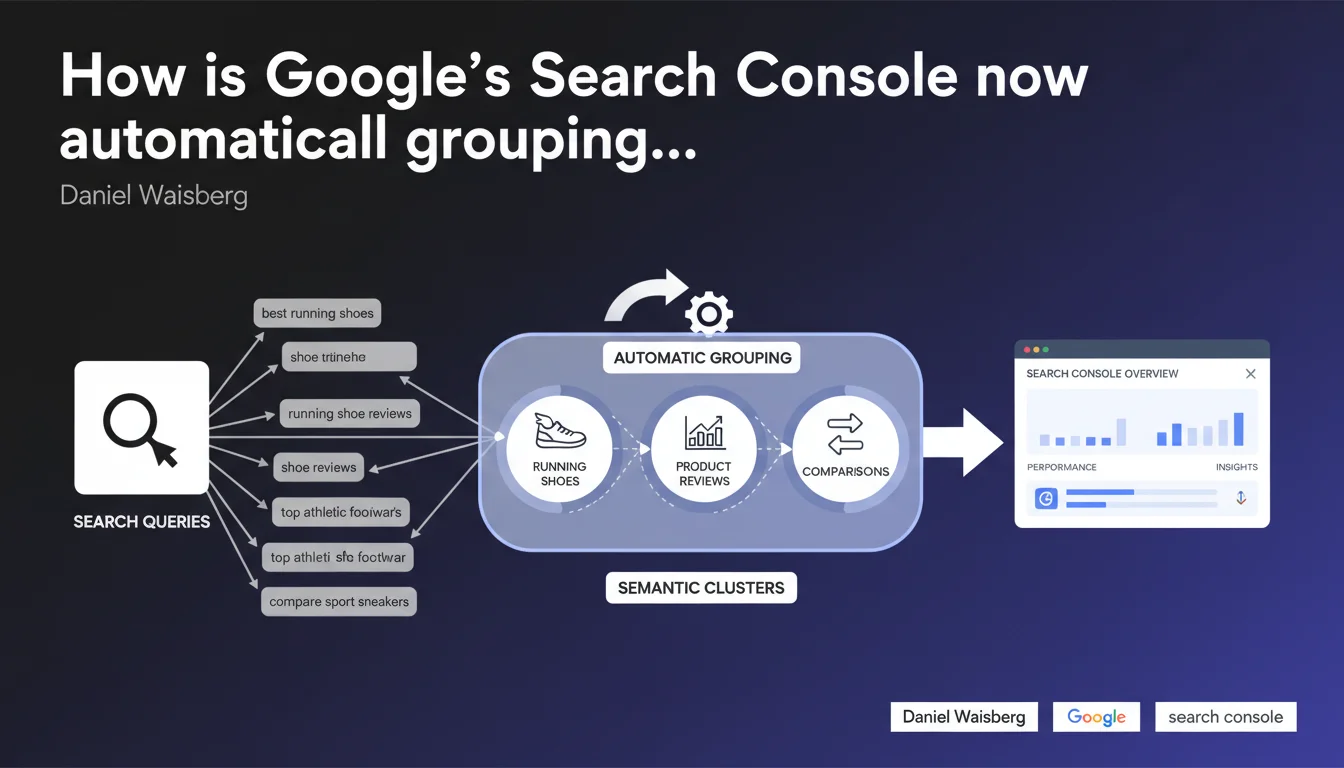
Search Console is deploying automatic clustering of search queries into themes or clusters based on the detection of common patterns. The goal: to provide a consolidated view rather than a raw list of thousands of keywords. This feature aims to simplify performance analysis and help you identify optimization opportunities more quickly.
What you need to understand
Why is Google introducing this thematic clustering now?
The multiplication of long-tail queries makes Search Console analysis unmanageable for many websites. Hundreds of variations of the same intent end up scattered everywhere, diluting your strategic vision.
Google is now automating semantic pattern detection to group these queries into cohesive clusters. The idea: to show you that "best smartphone 2024", "which smartphone to buy" and "top phone this year" all fall under the same exploitable theme.
How does this clustering system actually work in practice?
The algorithm scans the queries that generated impressions or clicks on your site, then identifies semantic, syntactic, and behavioral similarities. This isn't just a simple grouping by root keyword — the machine analyzes the underlying intent.
Clusters appear as an additional layer in the interface. You can still access individual queries, but the default view now prioritizes this thematic aggregation.
Which data is affected by this grouped view?
Classic metrics — impressions, clicks, CTR, average position — are now aggregated at the cluster level. This means you see the overall performance of a theme rather than that of each isolated variation.
Beware: this consolidation can mask nuances. A high-performing query buried in an average cluster risks going unnoticed if you don't dig deeper.
- Clustering relies on automatic pattern detection, not on your manual choices
- Performance metrics are consolidated by cluster, offering a macro view
- Access to individual queries remains possible, but requires additional manipulation
- This feature aims to simplify the identification of strategic opportunities
SEO Expert opinion
Does this approach truly reflect how Google understands queries?
Yes and no. Google does indeed use semantic clustering internally to match queries and content, particularly through language models. But what you see in Search Console remains a simplification.
The danger? Believing that Google treats all cluster variations identically. In reality, nuances of intent persist — "buy" vs "compare" vs "review" — and your content needs to cover them. Settling for the aggregated view can mask these subtleties.
What biases does this feature introduce into your analysis?
First pitfall: dilution of strong signals. A high-potential query buried in a mediocre cluster disappears from your radar if you no longer drill down to the granular level.
Second trap: the clustering algorithm isn't infallible. It may group queries that share words but target different intentions, or conversely artificially separate similar variations. You lose analytical control.
Does this evolution change keyword strategy?
Not fundamentally. For years, you've been told to think intent and thematically rather than exact keywords — this automatic clustering simply validates that approach.
However, it does confirm that Google evaluates your pages on their ability to cover a broad semantic spectrum around a topic, not just to match an exact term. If your content only answers one cluster variation, you're leaving traffic on the table.
Practical impact and recommendations
How can you best leverage this cluster view in Search Console?
Use it to quickly identify strong themes: which topics generate the most impressions but poorly convert into clicks? That's where your title and meta-description optimization opportunities hide.
But don't stop there. For each interesting cluster, drill down to the level of individual queries. You'll find intent variations that your current content may not yet cover — so many potential entry points to develop.
What adjustments should you make to your existing content?
Identify clusters where your average position is mediocre despite high impression volume. This signals that your page isn't authoritative or comprehensive enough on the topic.
Enhance this content by integrating the semantic variations from the cluster: subheadings, FAQs, concrete examples. The goal is to cover the entire thematic spectrum, not just the main keyword.
What should you watch out for to avoid misinterpretation?
Never take a cluster at face value without checking its coherence. Download the data, examine individual queries, and manually validate that the grouping makes sense.
Also keep an eye on orphaned queries — those not attached to any cluster. They can reveal unexploited niches or tracking anomalies.
- Identify clusters with high impression volume but low CTR to optimize tags
- Systematically drill down to the query level for each strategic cluster
- Enhance existing content with the semantic variations detected in clusters
- Manually verify the coherence of automatic groupings
- Monitor orphaned queries that escape clustering
- Cross-reference this data with your usual semantic analysis tools
- Never completely abandon granular query-by-query analysis
🎥 From the same video 8
Other SEO insights extracted from this same Google Search Central video · published on 02/12/2025
🎥 Watch the full video on YouTube →
💬 Comments (0)
Be the first to comment.