
Official statement
Other statements from this video 8 ▾
- □ Search Console Insights ne montre-t-il vraiment que le trafic Google Search ?
- □ Une impression dans Search Console, c'est vraiment à chaque fois qu'on voit un lien ?
- □ Qu'est-ce qui compte vraiment comme un clic dans Search Console ?
- □ Faut-il vraiment analyser ses performances SEO sur 28 jours dans Search Console ?
- □ Comment Search Console regroupe-t-elle désormais vos requêtes par clusters thématiques ?
- □ Comment Google définit-il vraiment une requête de marque dans Search Console ?
- □ Pourquoi traquer les requêtes de marque change-t-il radicalement votre stratégie SEO ?
- □ Comment exploiter réellement les données de trafic décomposées dans Search Console ?
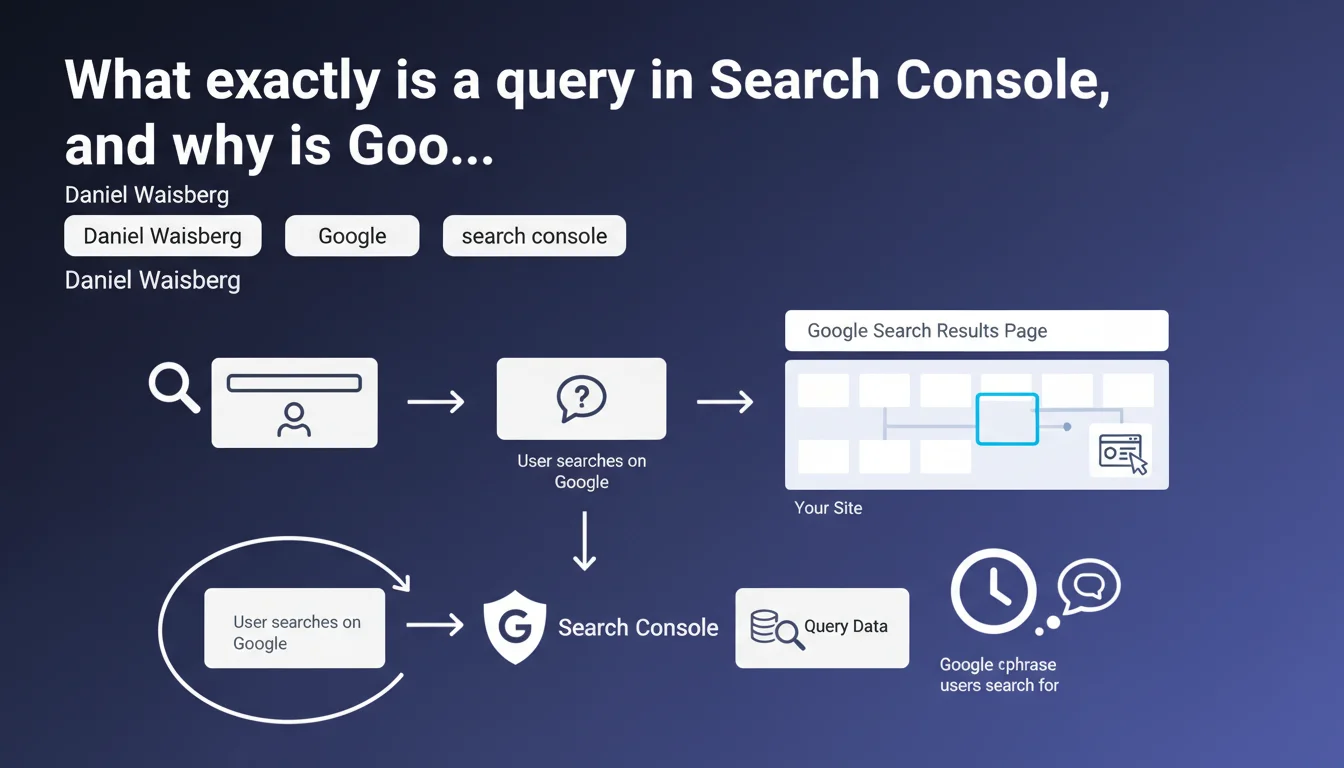
Google officially defines a query as a word or phrase typed into search when users find your site. This seemingly straightforward clarification masks important implications for how Search Console collects and presents performance data, particularly regarding keyword variations and impression metrics.
What you need to understand
Why does Google feel the need to define what a query is?
Because confusion reigns. Many SEO experts believe that a query in Search Console corresponds to any search performed on Google. Wrong.
Google explicitly clarifies: a query only appears in your Search Console data if it generated an impression for your site. In other words, if nobody saw your URL in the results for a given search, that search simply doesn't exist in your report.
Does this definition change anything about data analysis?
Absolutely. It means your performance reports never reflect the total search volume for an expression. You only see the tip of the iceberg: the queries where Google deemed your content relevant enough to display.
Concretely? If you optimize for "women's running shoes" but Google only ranks you for "women's running shoes on sale," only the latter will appear in your data — even if the former generates 50,000 searches per month.
What about query variations and grouping?
Google groups certain minor variations under the same query. Searches with typos, singular/plural, or accent marks may be consolidated.
But be careful: this grouping remains opaque. You never know precisely which variants are merged. And for long-tail phrases with different wording, each variant appears separately.
- One Search Console query = one search that generated at least one impression for your site
- Data never reflects total search volume, only your visibility
- Google groups certain minor variations but not all
- Counted impressions depend on scrolling and the type of result displayed
- Filters applied in Search Console modify query aggregation
SEO Expert opinion
Does this definition truly reflect what we observe in the field?
Yes and no. The definition is correct but incomplete. Daniel Waisberg doesn't mention a crucial point: the evolution of impression counting in recent years.
Historically, an impression was counted as soon as your result was present on the results page, even in position 50. Today, Google has refined this — but without ever clearly communicating the exact threshold. We know a result must be "sufficiently visible" but nobody can say precisely what that means.
What nuances should be added to leverage this data correctly?
First nuance: "(not provided)" or anonymized queries. Google filters certain searches to protect user privacy. Result? Your actual impressions are always higher than those displayed in Search Console.
Second nuance: differences between search types. A "maps" query isn't a "web" query even if it's the exact same phrase typed. Search Console separates these channels, and your analyses should do the same.
In which cases does this definition become misleading?
When you analyze sites with fragmented visibility. Imagine Google ranks you differently depending on the user's location.
A user in Paris searches "Italian restaurant" and sees your listing. Another in Lyon searches exactly the same thing and doesn't see you. Search Console counts "Italian restaurant" as a query, but it masks the fact that your visibility only exists for a geographic fraction of the searches. Aggregations by country or region don't solve everything — they remain too coarse.
Practical impact and recommendations
How can you leverage these queries to identify real opportunities?
Stop looking only at queries with high impressions. It's a trap. These queries are often already optimized or hyper-competitive.
Focus on queries with abnormally low CTR despite correct positioning. Position 5-8 with CTR under 2%? Your title and meta description probably need reworking, or Google is displaying features (PAA, featured snippets) that cannibalize clicks.
Another underexploited lever: queries with plenty of impressions but zero clicks. Either your snippet doesn't convince anyone, or the SERP is dominated by rich results. In this case, attacking head-on with standard content is useless — aim instead for the featured snippet or PAAs.
What errors should you avoid when analyzing this data?
Never compare Search Console volumes with those from third-party tools to deduce your market share. It's mathematically incorrect.
Third-party tools estimate (poorly) total search volume. Search Console gives you real impressions where you were visible. If SEMrush shows 10,000 searches/month and you have 500 impressions, that doesn't mean you have 5% of the market — it means Google showed you only 500 times, period.
Another frequent mistake: ignoring seasonality and trends. A query that disappears from your reports doesn't necessarily mean you've lost your ranking. Maybe nobody is searching for it anymore at this time of year.
- Filter queries by position AND CTR to identify quick wins (good position, poor CTR)
- Segment by search type (web, images, video) — optimization strategies differ radically
- Compare identical periods year-over-year, not month-by-month
- Export your data regularly: Google only keeps 16 months of history
- Cross Search Console with Google Analytics to identify queries that truly convert
- Don't overlook long-tail queries with few impressions — they often convert better
Google's definition seems basic but hides interpretation subtleties that can skew your entire SEO strategy if you ignore them.
Understanding that you only see a filtered fraction of actual searches fundamentally changes how you leverage this data. The challenge is no longer "tracking keywords" but identifying visibility blind spots and CTR opportunities.
These cross-analyses between positions, impressions, CTR, and conversions can quickly become complex, especially on sites with thousands of indexed pages. If you lack the time or expertise to fully unlock Search Console's potential, support from a specialized agency can save you months by precisely identifying where to concentrate your efforts for measurable impact.
🎥 From the same video 8
Other SEO insights extracted from this same Google Search Central video · published on 02/12/2025
🎥 Watch the full video on YouTube →
💬 Comments (0)
Be the first to comment.