
Official statement
Other statements from this video 11 ▾
- □ Pourquoi Google avait-il tant de mal à comprendre les mots de liaison comme 'not' dans les requêtes ?
- □ Comment Google évalue-t-il réellement la qualité de son moteur : mesures globales ou analyse segmentée ?
- □ La pertinence topique est-elle devenue un critère SEO dépassé ?
- □ Google applique-t-il vraiment un principe d'équilibre entre types de sites dans ses résultats ?
- □ Pourquoi vos stratégies de mots-clés longue traîne sont-elles dépassées depuis l'arrivée du NLU ?
- □ Google privilégie-t-il vraiment la promotion plutôt que la pénalité ?
- □ Comment Google mesure-t-il vraiment la satisfaction des utilisateurs dans ses résultats de recherche ?
- □ E-E-A-T est-il vraiment un facteur de ranking ou juste un mythe SEO ?
- □ Pourquoi Google se méfie-t-il du volume de requêtes comme indicateur de qualité ?
- □ Les Quality Rater Guidelines sont-elles vraiment un mode d'emploi pour le SEO ?
- □ Comment Google priorise-t-il les bugs de recherche et qu'est-ce que ça change pour le SEO ?
Google developed Featured Snippets to solve a fundamental problem: answering user questions rather than simply matching keywords. This approach, initiated about a decade ago, is based on semantic understanding of queries and content. For SEO practitioners, this means that optimizing for Featured Snippets requires thinking in terms of precise, structured answers—not keyword stuffing.
What you need to understand
What does this statement concretely mean for Featured Snippets architecture?
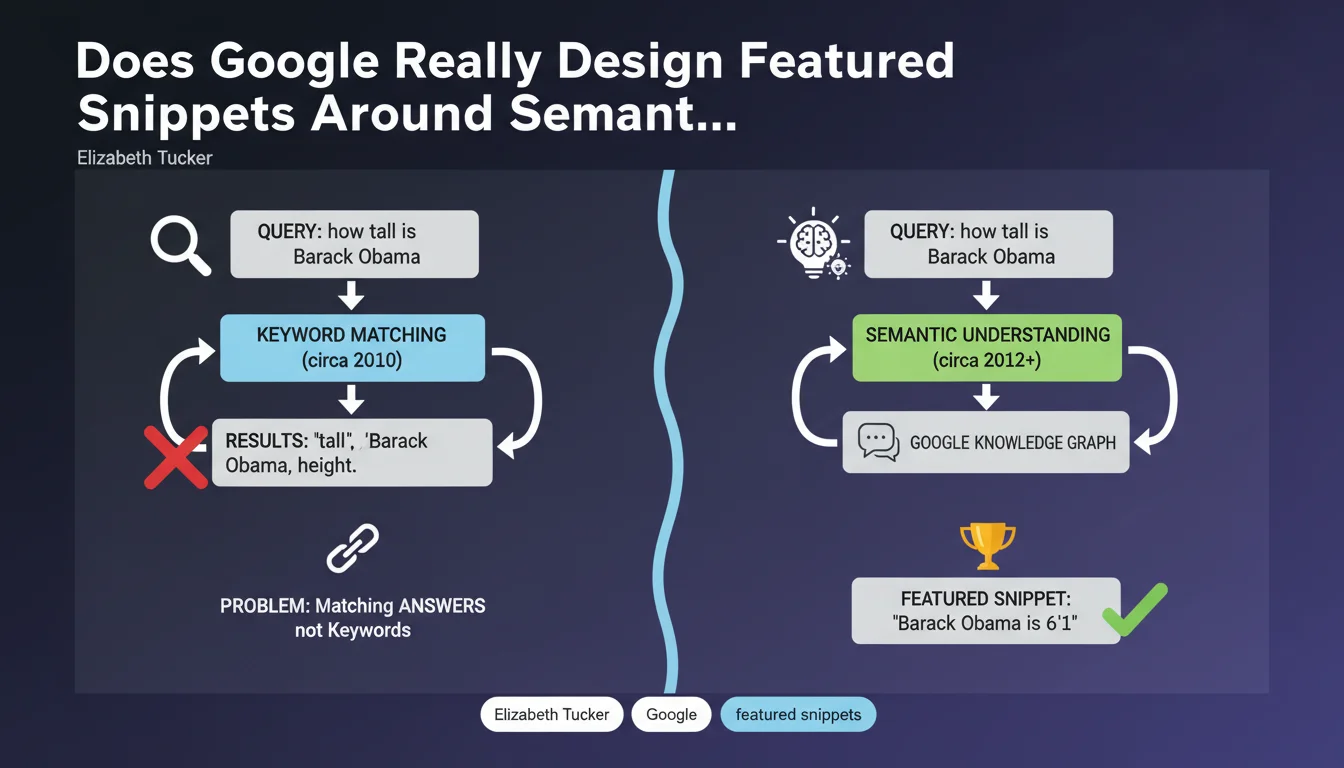
Elizabeth Tucker, a Google representative, reminds us of a point often overlooked: Featured Snippets are not simply a filter applied to traditional search results. They were designed from the outset to solve a different problem—that of answer matching rather than term matching.
The example given—"how tall is Barack Obama"—perfectly illustrates the challenge. A system based solely on lexical matching risks returning pages containing these words without necessarily providing the expected answer. The Featured Snippet aims to identify and extract the relevant factual data.
How does this approach differ from traditional ranking?
In standard organic ranking, Google evaluates the overall relevance of a page to a query. Signals are multiple: domain authority, backlinks, user engagement, freshness, and more.
For Featured Snippets, the algorithm primarily seeks to identify a content fragment that directly answers the question posed. The page hosting this fragment may not be in the first organic position. It simply needs to contain a clear, well-structured answer that is semantically aligned with search intent.
What are the technical implications for crawling and indexing?
Google must analyze content at a granular level to extract relevant passages. This requires contextual understanding of entities, semantic relationships, and document structure.
Tags like schema.org, structured lists, HTML tables, and well-delimited paragraphs facilitate this extraction. But structure alone is not enough: the content must factually answer a specific question.
- Featured Snippets rely on semantic understanding of queries and answers, not simply on keyword co-occurrence
- Content can be a Featured Snippet without being in organic position 1—eligibility criteria are distinct
- Content structure (lists, tables, short paragraphs) facilitates extraction by Google but does not guarantee snippet placement
- Google's historical approach to snippets dates back approximately 10 years, with gradual evolution toward greater semantic sophistication
SEO Expert opinion
Is this statement consistent with real-world observations?
Yes, largely. Empirical tests show that pages capturing Featured Snippets generally present direct, exploitable answers. A page stuffed with keywords but burying the answer in generic content has little chance of being selected.
However, we still observe cases where Google displays partially inadequate snippets or excerpts extracted from ambiguous contexts. Semantic understanding is not infallible—it remains probabilistic and depends on the quality of the language model's training.
What does Google mean by "answer matching"?
Concretely, this means the algorithm seeks to identify the text segment containing the requested factual data. For "how tall is Barack Obama," Google must recognize the entity "Barack Obama," understand that "how tall" corresponds to a question about physical height, and extract the relevant numerical value.
This approach relies on NLP (Natural Language Processing) and contextual understanding models like BERT or MUM. It goes far beyond simple TF-IDF or lexical proximity analysis. But be careful: this sophistication does not mean keywords are ignored. They remain signals, but insufficient on their own.
Should you abandon lexical optimization for Featured Snippets?
No, that would be a misinterpretation. Keywords remain linguistic anchors that Google uses to identify potentially relevant text zones. Simply, their presence must be accompanied by a clear and contextual answer.
The real issue is shifting from keyword density logic to semantic completeness logic. A page stating "Barack Obama is 1.85 meters tall" is more likely to be a Featured Snippet than a page repeating "Barack Obama height" 10 times without ever providing the exact measurement. [To verify]: Google has never published precise metrics on the respective weighting of structure, semantics, and domain authority in snippet selection.
Practical impact and recommendations
How should you structure content to favor Featured Snippet eligibility?
First rule: identify the specific questions your audience asks. Use tools like Answer The Public, Google Search Console (interrogative query filters), or search suggestions. Each question should have a dedicated answer.
Next, format these answers in an exploitable way. A short paragraph (40-60 words) answering directly, a numbered list if it's a process, a table if it's a comparison. Place this answer at the beginning of the relevant section, ideally just after an H2 or H3 heading formulated as a question.
What mistakes should you avoid in Featured Snippet optimization?
Don't fall into the trap of disguised keyword stuffing. Repeating the question word-for-word in the answer might seem logical, but if it harms fluency or clarity, Google may ignore it. Human readability comes first.
Another common mistake: burying the answer in unnecessary context. If the question is "What is the capital of France?", the answer should be "Paris" or "The capital of France is Paris." Not a 200-word paragraph on Paris's history before mentioning it's the capital.
How can you verify that your content is optimized for Google's semantic understanding?
Test your pages with tools like Google Cloud's Natural Language API. You'll see which entities are recognized and how text is segmented. If Google doesn't detect your topic's key entities, your content probably lacks semantic clarity.
Also use Google Search Console to track queries generating impressions in position 0. If you have a snippet, analyze the query context and verify that your answer remains relevant across lexical variants.
- Identify specific questions in your niche and create dedicated answers for each
- Structure your answers: short paragraph (40-60 words), lists, tables depending on question type
- Place the answer at the beginning of the section, just after an H2/H3 heading formulated as a question
- Avoid keyword stuffing—prioritize clarity and natural fluency
- Test semantic recognition of your content with the Natural Language API
- Track your snippets in Search Console and adjust based on actual performance
❓ Frequently Asked Questions
Les Featured Snippets utilisent-ils les mêmes critères de ranking que les résultats organiques classiques ?
Est-ce que structurer son contenu avec des balises HTML spécifiques garantit l'obtention d'un Featured Snippet ?
Peut-on perdre un Featured Snippet même si on ne change rien sur sa page ?
Faut-il utiliser le schema.org FAQPage pour maximiser ses chances d'obtenir un snippet ?
Les Featured Snippets impactent-ils le trafic organique global ?
🎥 From the same video 11
Other SEO insights extracted from this same Google Search Central video · published on 27/06/2024
🎥 Watch the full video on YouTube →
💬 Comments (0)
Be the first to comment.