
Official statement
Other statements from this video 11 ▾
- □ Pourquoi Google avait-il tant de mal à comprendre les mots de liaison comme 'not' dans les requêtes ?
- □ Comment Google évalue-t-il réellement la qualité de son moteur : mesures globales ou analyse segmentée ?
- □ La pertinence topique est-elle devenue un critère SEO dépassé ?
- □ Google applique-t-il vraiment un principe d'équilibre entre types de sites dans ses résultats ?
- □ Pourquoi vos stratégies de mots-clés longue traîne sont-elles dépassées depuis l'arrivée du NLU ?
- □ Pourquoi Google a-t-il conçu les Featured Snippets autour de la compréhension sémantique plutôt que du matching de mots-clés ?
- □ Comment Google mesure-t-il vraiment la satisfaction des utilisateurs dans ses résultats de recherche ?
- □ E-E-A-T est-il vraiment un facteur de ranking ou juste un mythe SEO ?
- □ Pourquoi Google se méfie-t-il du volume de requêtes comme indicateur de qualité ?
- □ Les Quality Rater Guidelines sont-elles vraiment un mode d'emploi pour le SEO ?
- □ Comment Google priorise-t-il les bugs de recherche et qu'est-ce que ça change pour le SEO ?
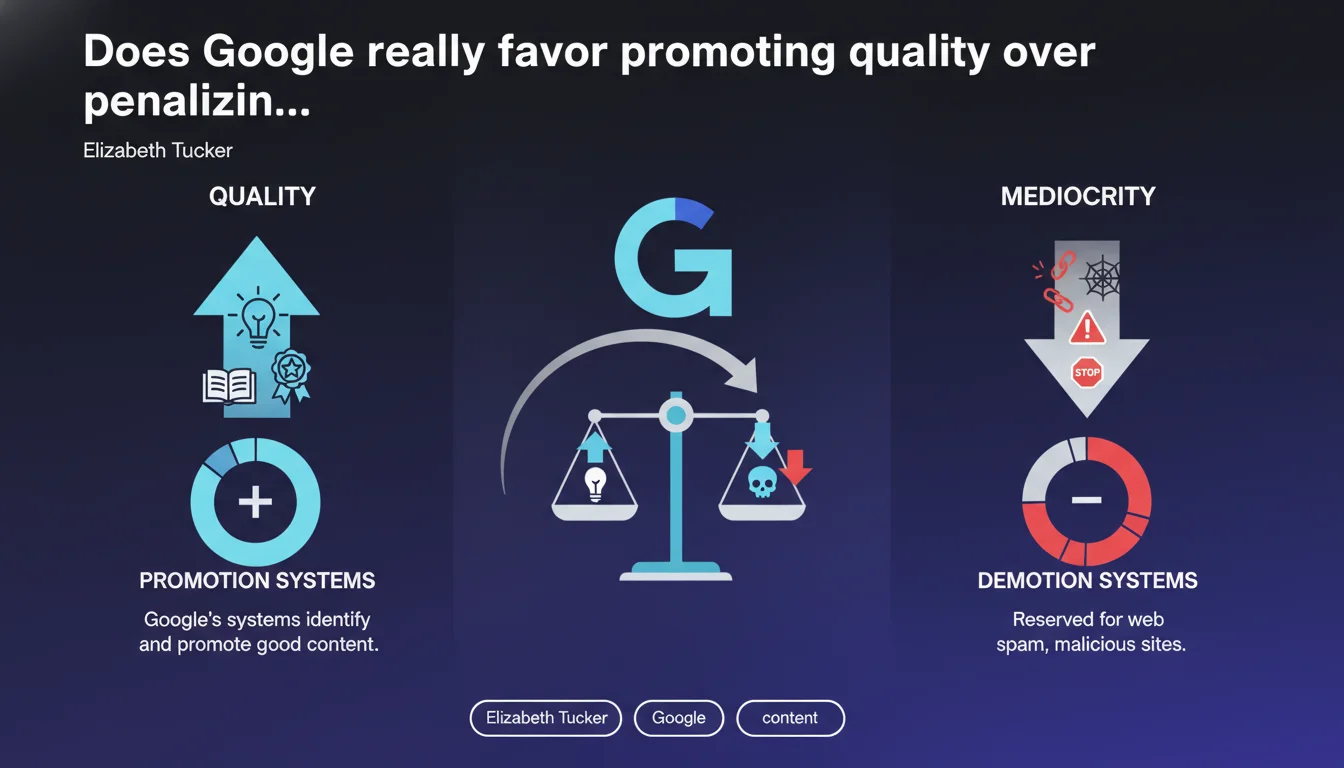
Google claims that its systems focus primarily on identifying and promoting quality content rather than demoting it. Punitive actions would be reserved for specific cases: web spam, malicious sites, or clear violations. This official stance contrasts with the on-the-ground perception of many SEOs who observe unexplained sudden traffic drops.
What you need to understand
What is Google's stated philosophy?
Google presents an optimistic vision of its ecosystem: rather than actively punishing bad actors, the algorithm would first seek to bring the best content to the forefront. This approach is based on the idea that promoting what works is more effective — and less risky — than multiplying punitive filters.
In concrete terms, this means that most signals (links, content, user experience, authority) would be positive levers. If your site isn't performing well, it's not necessarily because it's penalized, but rather because other sites are sending stronger signals.
Which demotion systems actually exist?
Google openly acknowledges a few punitive systems. Web spam (automatically generated content, cloaking, link farms) triggers corrective actions via SpamBrain. Malicious sites (phishing, malware) are excluded via Safe Browsing.
Beyond these cases, Google remains vague. Can Core Updates be considered demotions? Officially no — they're adjustments of positive signals. But if your traffic drops 60% after a Core Update, the semantic nuance offers little comfort.
Why is this distinction between promotion and penalty important?
This distinction influences how you diagnose a drop in visibility. If Google truly prioritizes promotion over penalty, then a drop in rankings doesn't necessarily mean you've done something wrong — just that others are sending stronger signals.
It also changes your optimization strategy. Rather than frantically hunting for a « hidden penalty, » you should focus on improving positive signals: relevance, user experience, topical authority, editorial quality.
- Google claims to prioritize promotion systems over demotion systems
- Explicit penalties only concern clear violations: spam, malware, gross manipulations
- A drop in visibility may simply mean that other sites are sending stronger signals
- This logic implies focusing on continuous improvement rather than hunting for penalties
SEO Expert opinion
Is this statement consistent with on-the-ground observations?
Partially. On paper, Google is right: most sites never face manual action. But this sanitized vision ignores the dramatic post-Core Update crashes that look, in every way, like algorithmic penalties. Call it « adjustment of positive signals » if you like — for the site that loses 70% of its traffic overnight, the distinction is purely cosmetic.
In practice, we also observe undocumented filters. Sites that stagnate on page 2-3 without apparent reason, domains that seem capped despite solid signals. Google doesn't talk about these gray zones — and that's precisely where the official narrative becomes suspect.
What nuances should be added to this claim?
Google plays with words. It's true that most systems seek to identify the best content. But if these systems constantly reassess who deserves to rank, then sites that drop are indeed « demoted » — even if that's not the official terminology.
Another nuance: manual actions are rare, certainly, but algorithmic filters (Penguin, Panda before their integration into Core) historically had devastating effects. Today, these filters are integrated into the Core Algorithm — but their punitive logic hasn't disappeared. [To verify]: Google claims these adjustments are merely rebalancings, but no public data allows us to confirm this.
In which cases does this logic fail to apply?
This statement crumbles in certain scenarios. A site that abuses purchased backlinks can see its positions plummet — and that's not because other sites are « better promoted, » it's because Google detects and neutralizes the manipulation. Same for sites that over-optimize their link anchors or that publish duplicated content at industrial scale.
Google also doesn't mention automated anti-spam filters that act in real-time. SpamBrain doesn't just « promote the good » — it actively disables manipulated signals. That's a form of demotion, even if Google avoids the term.
Practical impact and recommendations
What should you do concretely to maximize your chances of being promoted?
If Google truly prioritizes promoting good content, then your strategy should focus on accumulating strong positive signals. This means investing in editorial quality, user experience, topical authority, and semantic consistency.
Forget the obsession with « hidden penalties » — unless you have a manual action in Search Console, concentrate on continuous improvement. Analyze pages that perform well with your competitors, identify content gaps, improve your internal linking, strengthen your E-E-A-T.
Which mistakes should you avoid to not trigger the rare demotion systems?
Even though Google claims penalties are rare, they exist. Avoid anything that could be detected as obvious spam: mass-generated content from AI without human oversight, private link networks (PBN), cloaking, deceptive redirects, aggressive keyword stuffing.
Also monitor your backlink profile. If you've accumulated toxic links (low-quality directories, spammed blog comments, paid links from unrelated sites), disavow them. Google claims to ignore bad links — but no one really knows to what extent.
How do you verify that your site is sending the right signals?
Use Google Search Console to detect any manual actions. If nothing appears, then your visibility problem is likely related to insufficient positive signals, not a penalty.
Next, audit your Core Web Vitals, your bounce rate, your session duration. If these metrics are low, that can explain why other sites are better promoted. Also analyze your semantic coverage: do your pages truly answer search intentions better than those of your competitors?
- Focus on improving positive signals: content, UX, authority
- Avoid gross manipulations: PBN, mass-generated content, cloaking
- Monitor your backlinks and disavow toxic links if necessary
- Analyze your Core Web Vitals and user behavior
- Compare your semantic coverage with that of the top 3 in your niche
- Check Search Console regularly to detect any manual actions
❓ Frequently Asked Questions
Si Google privilégie la promotion, pourquoi mon site a-t-il chuté après une Core Update ?
Les actions manuelles sont-elles la seule forme de pénalité chez Google ?
Dois-je désavouer mes mauvais backlinks si Google dit les ignorer ?
Comment savoir si ma baisse de trafic est due à un problème de signaux positifs ou à un filtre caché ?
Cette déclaration change-t-elle ma stratégie SEO au quotidien ?
🎥 From the same video 11
Other SEO insights extracted from this same Google Search Central video · published on 27/06/2024
🎥 Watch the full video on YouTube →
💬 Comments (0)
Be the first to comment.