
Official statement
Other statements from this video 11 ▾
- □ Pourquoi Google avait-il tant de mal à comprendre les mots de liaison comme 'not' dans les requêtes ?
- □ Comment Google évalue-t-il réellement la qualité de son moteur : mesures globales ou analyse segmentée ?
- □ La pertinence topique est-elle devenue un critère SEO dépassé ?
- □ Google applique-t-il vraiment un principe d'équilibre entre types de sites dans ses résultats ?
- □ Google privilégie-t-il vraiment la promotion plutôt que la pénalité ?
- □ Pourquoi Google a-t-il conçu les Featured Snippets autour de la compréhension sémantique plutôt que du matching de mots-clés ?
- □ Comment Google mesure-t-il vraiment la satisfaction des utilisateurs dans ses résultats de recherche ?
- □ E-E-A-T est-il vraiment un facteur de ranking ou juste un mythe SEO ?
- □ Pourquoi Google se méfie-t-il du volume de requêtes comme indicateur de qualité ?
- □ Les Quality Rater Guidelines sont-elles vraiment un mode d'emploi pour le SEO ?
- □ Comment Google priorise-t-il les bugs de recherche et qu'est-ce que ça change pour le SEO ?
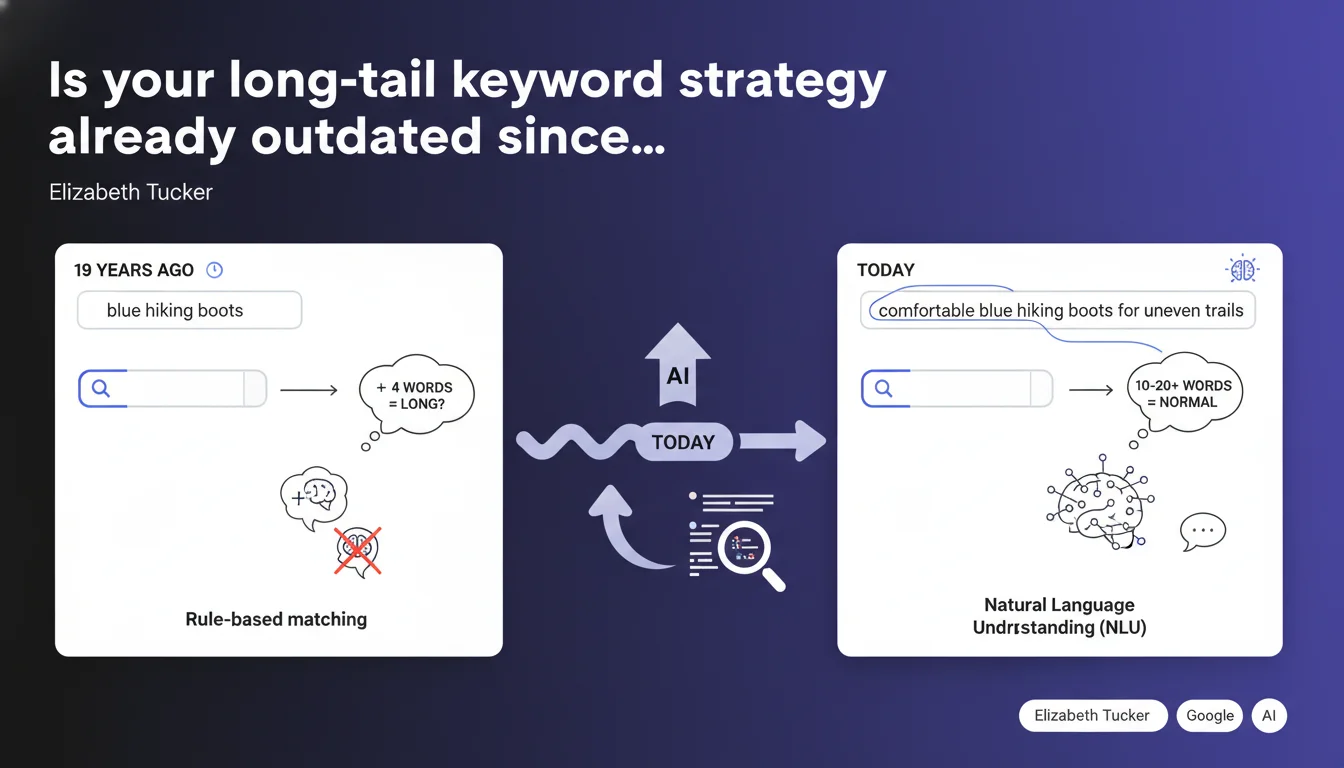
Google now regularly processes queries of 10 to 20 words or more, compared to a maximum of 4 words 19 years ago. This massive shift, driven by advances in natural language understanding (NLU), is reshuffling the cards of semantic strategy. The very concept of 'long tail' as we knew it is becoming obsolete.
What you need to understand
What has changed in user search behavior?
Users have radically transformed how they query Google. The democratization of voice search and the rise of conversational interfaces have normalized queries formulated in complete natural language.
In practical terms? We've shifted from "hotel Paris 15th" to "what is the best cheap hotel in the 15th arrondissement of Paris with breakfast included". This change is far from marginal — it's redefining the statistical distribution of organic traffic.
How does Google's NLU handle these long queries?
The Natural Language Understanding capability allows Google to break down and interpret complex sentences. The algorithm identifies intent, entities, contextual modifiers, and relationships between concepts.
MUM and BERT have accelerated this capacity. Google is no longer simply searching for keyword matches — it reconstructs the meaning of the query to match it with the most relevant content, even if the wording differs.
What is the current definition of a "long" query?
The bar has risen dramatically. What once constituted a classic long tail (4-5 words) is now standard. True long tails now sit between 10 and 20 words or even beyond.
This semantic inflation further fragments search volume. The long-tail curve stretches, with an increasing proportion of unique or near-unique queries that will never be repeated identically.
- Behavioral evolution: shift from keyword stuffing to complete conversational sentences
- Role of NLU: contextual and intentional understanding rather than lexical matching
- Redefinition of long tail: threshold moved from 4 to 10-20 words or more
- Increased fragmentation: rise in unique queries impossible to anticipate
SEO Expert opinion
Does this statement truly reflect what we observe in the field?
Yes, but with important sectoral nuances. In mainstream B2C verticals (travel, health, e-commerce), the trend is clear: long conversational queries dominate, especially on mobile and via voice assistants.
Conversely, in certain technical B2B sectors or on desktop, short and precise queries remain dominant. An engineer looking for technical documentation will type "API GraphQL pagination" rather than a 15-word sentence. [To verify]: Google provides no breakdown data on the sectoral distribution of this evolution.
Can you still optimize for short queries effectively?
Absolutely. Let's be honest: the majority of search volume remains concentrated on 2 to 5-word queries in many verticals. Abandoning this foundation would be a strategic mistake.
The problem is that this statement implicitly pushes toward a "purely conversational semantic" approach. Yet short, high-volume queries still generate the bulk of qualified traffic in many cases. The trade-off must therefore be made case by case, based on your actual analytics.
Should you overhaul your entire content strategy following this evolution?
Not necessarily everything, but rebalance. If your current strategy relies solely on optimizing short and medium keywords, you're leaving a growing portion of traffic on the table.
And that's where it gets tricky: producing content that effectively answers ultra-long and varied queries requires a radically different approach. We're talking about exhaustive thematic coverage, semantic clusters, extended FAQs — in short, a non-negligible content investment.
Practical impact and recommendations
How can you adapt content production concretely?
First step: analyze your Search Console data to identify the actual proportion of long queries in your current traffic. Filter by word count, cross-reference with click-through rates and positions — you'll see where your opportunity lies.
Next, structure your content in thematic clusters rather than isolated pages. A pillar page covers the general intent, satellite pages address long and specific variations. Internal linking becomes critical for signaling these relationships to Google.
Which formats should you prioritize to capture these conversational queries?
FAQs structured in schema.org remain a powerful lever. Each question-answer pair can match a specific long query while strengthening your overall topical authority.
"Complete guide" content, detailed lists, and exhaustive comparisons also perform well — provided they're truly exhaustive, not just superficial 800-word aggregations.
Should you abandon traditional keyword research?
No, you should complement it. Traditional keyword tools remain useful for your foundation, but they only capture a fraction of actual long queries. Supplement with:
- Search Console data analysis to identify real long queries generating impressions
- Exploitation of "People Also Ask" and "Related Searches" suggestions
- Use of NLP tools to map semantic entities and relationships within your topic
- Integration of FAQ sections based on actual user questions (customer support, forums, social media)
- Content structure in thematic clusters with coherent internal linking
- Continuous monitoring of performance by query length to adjust strategy
These adjustments represent a fundamental methodological shift. Advanced semantic search, cluster-based information architecture, and optimization for complex conversational intents require specialized expertise and dedicated resources. If your internal team lacks bandwidth or NLP/semantic skills, partnering with a SEO agency experienced in these new approaches can significantly accelerate your results while avoiding costly transition errors.
❓ Frequently Asked Questions
Les requêtes de 10 à 20 mots représentent-elles vraiment un volume significatif de trafic ?
Faut-il réécrire tout mon contenu existant en langage conversationnel ?
Le NLU de Google comprend-il toutes les nuances des requêtes longues ?
Comment mesurer l'impact réel de l'optimisation pour requêtes longues ?
Les outils de recherche de mots-clés classiques deviennent-ils obsolètes ?
🎥 From the same video 11
Other SEO insights extracted from this same Google Search Central video · published on 27/06/2024
🎥 Watch the full video on YouTube →
💬 Comments (0)
Be the first to comment.