
Official statement
Other statements from this video 11 ▾
- □ Is Google really optimizing for your search segment, or sacrificing it for others?
- □ Is topical relevance becoming an outdated SEO criterion?
- □ Does Google really apply a balance principle between different site types in its search results?
- □ Is your long-tail keyword strategy already outdated since natural language understanding arrived?
- □ Does Google really favor promoting quality over penalizing mediocrity?
- □ Does Google Really Design Featured Snippets Around Semantic Understanding Rather Than Keyword Matching?
- □ How does Google really measure user satisfaction in its search results?
- □ Is E-E-A-T really a ranking factor or just an SEO myth?
- □ Why does Google distrust query volume as a quality indicator?
- □ Are Google's Quality Rater Guidelines really the secret manual for SEO success?
- □ Does Google really prioritize search bugs based on frequency and severity, and what does this mean for your SEO strategy?
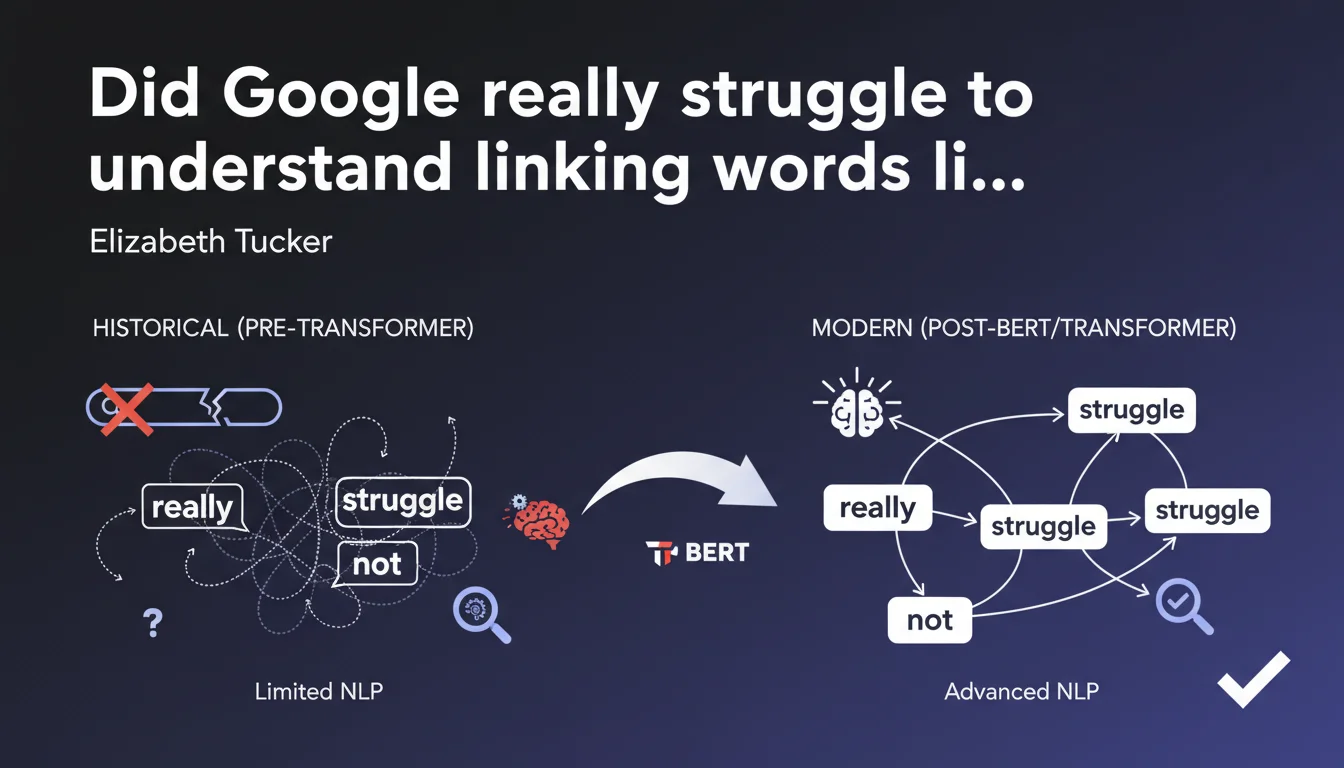
Prepositions and linking words (like 'not') have long been the Achilles' heel of Google's algorithms. The arrival of Transformer models and BERT revolutionized natural language understanding, finally making it possible to grasp nuances and negations. For SEO professionals, this changes the game when it comes to semantic optimization and search intent.
What you need to understand
Why did linking words pose problems for older Google systems?
Google's early algorithms relied on a keyword matching approach. A word like 'not' was often ignored or misinterpreted, because systems lacked the capacity to understand negation or the overall context of a sentence.
Concrete result: a query like "restaurants not expensive" could return results for "restaurants expensive", because the algorithm focused on main terms and dismissed prepositions as non-significant.
What changed with Transformer and BERT?
Transformer models introduce an architecture that processes words in their complete context, not in isolation. BERT (Bidirectional Encoder Representations from Transformers) goes even further: it analyzes words in both directions — before and after — to grasp nuances.
Concretely? Google can now distinguish "car without a license" from "car with a license", or "gluten-free recipe" from "gluten recipe". Linking words finally become determining factors in intent interpretation.
What's the direct implication for content optimization?
Content must now reflect the semantic variations that real users actually search for. If your target audience searches "freelancer without degree", writing just "freelancer" won't be enough anymore — the qualifier fundamentally changes the intent.
Long-tail strategies take on a new dimension: every word counts, including those we once overlooked.
- Linking words (not, without, with, for, against, etc.) are now correctly interpreted by Google
- Transformer architecture enables bidirectional understanding of context
- BERT marked a turning point in handling nuances and negations in queries
- Semantic optimization must integrate these variations to match actual user intent
- Generic or overly broad content loses relevance compared to precise and contextualized content
SEO Expert opinion
Does this explanation really account for why certain content is losing ground?
Yes, and it's a crucial point often underestimated. Sites producing generic content by targeting only main terms find themselves outpaced. If your "recipes" page ignores qualifiers ("sugar-free", "no-cook", "for beginners"), it loses against more specific content.
We've observed for several years that featured snippets favor answers that precisely integrate the query's nuances. This is no accident — it's BERT in action.
Should you multiply variations infinitely?
No, and that's where it gets tricky. Some SEO professionals fall into the semantic over-optimization trap: creating 50 pages to cover every combination of prepositions. Bad idea.
Google understands synonyms and variations — no need to create a "shoes without laces" page, another "shoes without velcro", etc. A single well-structured page, with targeted sections, does the job better. [To verify]: Google has never specified the threshold at which two variations justify two distinct pages.
Does this evolution really change keyword research strategy?
Absolutely. Traditional tools (search volume, CPC) don't capture nuanced intentions. "Loan without down payment" and "loan with down payment" have similar volumes, but radically different intentions.
SEO professionals must now cross-reference multiple sources: Search Console (actual queries), People Also Ask (natural variations), and NLP tools to identify relevant semantic clusters. Content strategies based solely on search volumes are becoming obsolete.
Practical impact and recommendations
What needs reviewing in your existing content architecture?
Start by auditing your pillar pages. Identify queries with qualifiers ("without", "with", "for", "against") that generate traffic but land on generic pages. That's where you're losing engagement.
Then restructure: create dedicated sections or FAQs that explicitly address these nuances. A "Digital Marketing Training" page should include sections like "Training with no prerequisites", "Training with certification", etc.
How do you identify high-potential content opportunities?
Leverage Search Console: filter queries by impressions (>100) with low CTR (
❓ Frequently Asked Questions
BERT a-t-il remplacé tous les anciens algorithmes de Google ?
Faut-il créer une page séparée pour chaque variation avec préposition ?
Les outils de recherche de mots-clés traditionnels sont-ils obsolètes ?
Comment vérifier si mon contenu est optimisé pour BERT ?
Cette évolution favorise-t-elle les contenus longs ou courts ?
🎥 From the same video 11
Other SEO insights extracted from this same Google Search Central video · published on 27/06/2024
🎥 Watch the full video on YouTube →
💬 Comments (0)
Be the first to comment.