
Official statement
Other statements from this video 11 ▾
- □ Did Google really struggle to understand linking words like 'not' in search queries?
- □ Is Google really optimizing for your search segment, or sacrificing it for others?
- □ Is topical relevance becoming an outdated SEO criterion?
- □ Does Google really apply a balance principle between different site types in its search results?
- □ Is your long-tail keyword strategy already outdated since natural language understanding arrived?
- □ Does Google really favor promoting quality over penalizing mediocrity?
- □ Does Google Really Design Featured Snippets Around Semantic Understanding Rather Than Keyword Matching?
- □ How does Google really measure user satisfaction in its search results?
- □ Is E-E-A-T really a ranking factor or just an SEO myth?
- □ Are Google's Quality Rater Guidelines really the secret manual for SEO success?
- □ Does Google really prioritize search bugs based on frequency and severity, and what does this mean for your SEO strategy?
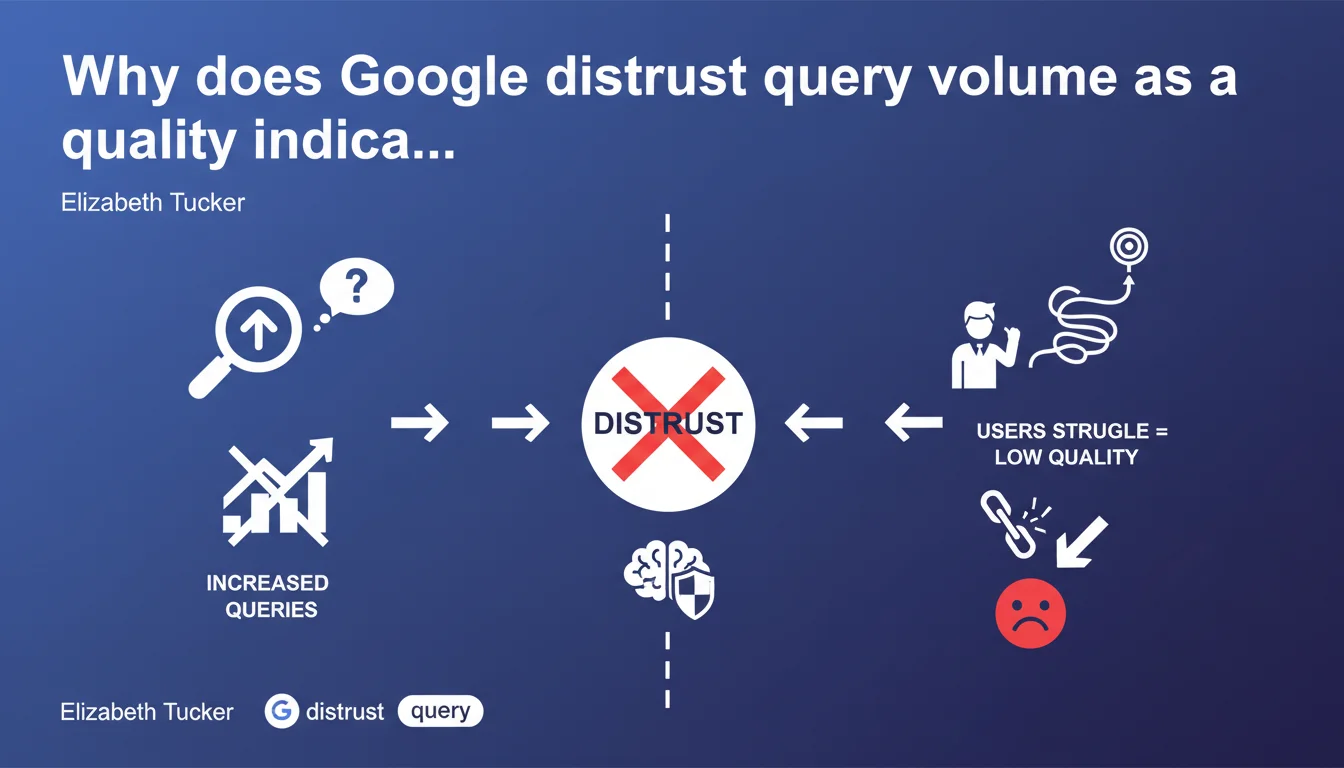
Google never measures query volume in the short term to evaluate the quality of its search results during experiments. The reason: an increase in the number of searches can signal that users are not finding what they're looking for on the first try and are reformulating their queries repeatedly. It's a signal of failure, not success.
What you need to understand
What logic underlies Google's decision?
Google's position is based on a counter-intuitive observation: more activity doesn't always mean more satisfaction. If a user performs 5 queries instead of one to find the right information, the search engine has failed.
In an A/B experiment, measuring only query volume would amount to rewarding results that frustrate the user — they reformulate, click on multiple pages, go back. Plenty of activity, but zero efficiency.
What metrics does Google prioritize instead?
Google focuses on indicators of task success rather than raw activity. Long click-through rate, time before search abandonment, declared satisfaction after interaction are all more reliable signals.
The goal: measure whether the user got what they wanted quickly, not how many times they had to search. It's an approach centered on journey efficiency.
Why the precision about the "short term"?
The temporal nuance is crucial. Over the long term, an increase in query volume can indeed signal growing adoption of the search engine or the emergence of new search intentions.
But within the framework of a rapid experiment — testing a new algorithm over a week, for example — a sudden spike is suspicious. It can mask a qualitative decline.
- Query volume ≠ quality of results over short periods
- Google prefers to measure user satisfaction and journey efficiency
- A sudden increase in volume can indicate difficulty finding information
- Real engagement metrics (long click, abandonment) are more reliable for evaluating an algorithmic change
SEO Expert opinion
Does this statement really reflect observed practices in the field?
Yes, and it's consistent with what we observe. Sites that generate high traffic on vague informational queries are not necessarily ranked better than those that answer directly and completely to a specific intent.
Google increasingly values content that prevents users from having to search elsewhere. The famous "zero-click" — when the answer appears directly in the SERPs — is the ultimate proof. Fewer clicks, fewer queries, but mission accomplished.
What limitations should be placed on this claim?
Let's be honest: this statement concerns Google's internal experiments, not directly the ranking of your pages. It reveals how Google evaluates its own algorithms, not how it judges your site.
However, [To be verified] to what extent this philosophy translates concretely into ranking signals. Google says it prioritizes user satisfaction, but are engagement metrics really integrated into PageRank or are they confined to internal A/B tests? The boundary is blurry.
Furthermore, we know that Google observes post-click behavior — bounce rate, pogo-sticking, time on site. This data likely feeds quality systems, even if Google never admits it outright.
Should we rethink our approach to performance metrics?
Absolutely. Too many SEO professionals remain obsessed with raw traffic volume without questioning the quality of that traffic. A page that generates 10,000 visits but an 85% bounce rate is no match for a page that receives 2,000 visits with solid engagement.
This statement invites us to measure success differently: did the user find what they were looking for? Did they convert, spend time, browse other pages? Or did they flee in 10 seconds to reformulate their query elsewhere?
Practical impact and recommendations
How should you adjust your content strategy as a result?
Focus on answer completeness. Good content should exhaust the search intention without forcing the user to perform multiple queries. Anticipate secondary questions, address related angles on the same page.
Avoid content that only partially answers the question. If your page on "how to install a CMS" only covers WordPress and forces the user to search separately for Drupal or Joomla, you're creating frustration — and likely pogo-sticking.
What metrics should you monitor in your analytics tools?
Forget vanity metrics. Pages per session can be misleading: is it qualitative exploration or desperate navigation? Prioritize indicators of real engagement.
Look at contextual bounce rate: if the user arrives, reads, and leaves without clicking elsewhere, it might be because they found their answer. Conversely, if they return to the SERPs in less than 30 seconds, that's a failure.
- Audit your high-traffic content with low engagement — it attracts without satisfying
- Measure actual reading time (scroll depth, active time) rather than raw page duration
- Identify queries that generate immediate reformulations in your logs
- Test the clarity of your titles and introductions: does the user know in 5 seconds they're in the right place?
- Enrich high-intent pages with FAQs, comparison tables, concrete examples
- Monitor the rate of return to SERPs using tools like Google Search Console (if available)
Should you revise your SEO performance objectives?
Yes, by integrating user satisfaction KPIs beyond simple volume. A mature SEO strategy doesn't just aim to rank, but to efficiently solve audience problems.
Concretely: segment your objectives by intent type. For an informational page, aim for high reading time and low return to SERPs. For a transactional page, prioritize conversion rate. For a navigational page, optimize speed of access to key information.
❓ Frequently Asked Questions
Google utilise-t-il les données de Google Analytics pour évaluer la qualité d'un site ?
Un taux de rebond élevé pénalise-t-il mon référencement ?
Comment savoir si mes contenus répondent bien à l'intention de recherche ?
Faut-il créer des contenus plus longs pour éviter que l'utilisateur cherche ailleurs ?
Cette logique s'applique-t-elle aussi aux requêtes commerciales ?
🎥 From the same video 11
Other SEO insights extracted from this same Google Search Central video · published on 27/06/2024
🎥 Watch the full video on YouTube →
💬 Comments (0)
Be the first to comment.