
Official statement
Other statements from this video 11 ▾
- □ Pourquoi Google avait-il tant de mal à comprendre les mots de liaison comme 'not' dans les requêtes ?
- □ Comment Google évalue-t-il réellement la qualité de son moteur : mesures globales ou analyse segmentée ?
- □ La pertinence topique est-elle devenue un critère SEO dépassé ?
- □ Google applique-t-il vraiment un principe d'équilibre entre types de sites dans ses résultats ?
- □ Pourquoi vos stratégies de mots-clés longue traîne sont-elles dépassées depuis l'arrivée du NLU ?
- □ Google privilégie-t-il vraiment la promotion plutôt que la pénalité ?
- □ Pourquoi Google a-t-il conçu les Featured Snippets autour de la compréhension sémantique plutôt que du matching de mots-clés ?
- □ Comment Google mesure-t-il vraiment la satisfaction des utilisateurs dans ses résultats de recherche ?
- □ E-E-A-T est-il vraiment un facteur de ranking ou juste un mythe SEO ?
- □ Pourquoi Google se méfie-t-il du volume de requêtes comme indicateur de qualité ?
- □ Comment Google priorise-t-il les bugs de recherche et qu'est-ce que ça change pour le SEO ?
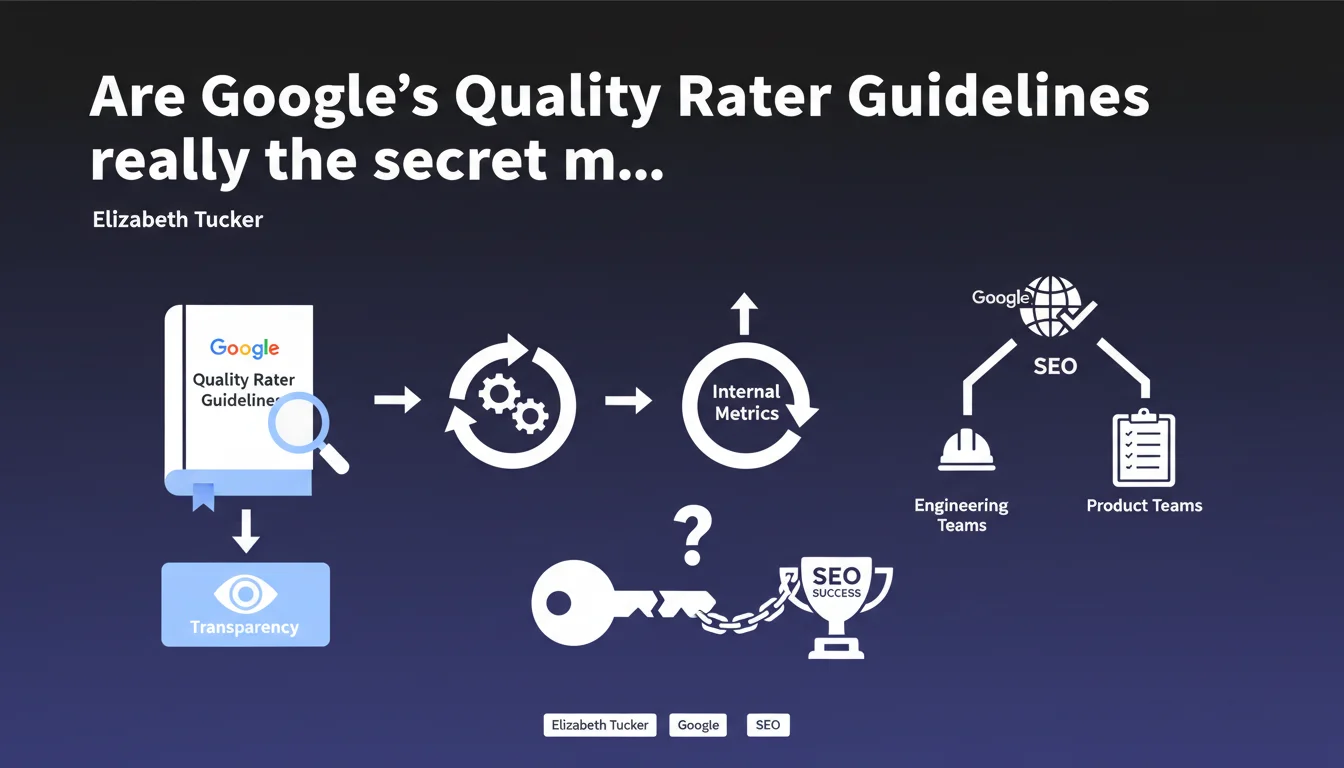
Google confirms that Quality Rater Guidelines primarily serve to provide transparency and validate that internal metrics correctly guide product and engineering teams. Concretely: these guidelines show what Google wants to accomplish, but are not directly injected into the algorithm. For SEOs, they remain a strategic direction indicator, not an optimization manual.
What you need to understand
What is the real purpose of Quality Rater Guidelines?
Quality Rater Guidelines (QRG) are a public document used by Google's human evaluators to rate the quality of search results. Elizabeth Tucker clarifies their dual role here: first, to provide transparency on what Google is trying to accomplish — showing web stakeholders what matters to the search engine. Second, to validate that internal metrics used by product and engineering teams correctly guide algorithm development.
In other words, these guidelines are not the algorithm itself. They serve to verify that automated signals truly reflect what humans consider a quality result. If an algorithm change degrades rater scores, that's a warning signal for Google.
Why does Google publish these guidelines publicly?
Publishing the QRG is not an act of charity. It's a communication strategy: demonstrating that Google has explicit standards and that these standards are consistent with what it displays publicly. It also prevents certain accusations of opacity — it's hard to claim Google hides everything when 175 pages of guidelines are freely accessible.
For SEOs, it's a window into the engine's strategic priorities: E-E-A-T, user intent, main content quality, reputation. These pillars don't change overnight, and the QRG allows them to be clearly identified.
How do these guidelines concretely influence the algorithm?
Raters never directly modify a site's ranking. Their job is to evaluate samples of search results before and after an algorithm change. If scores improve, the change is validated. If they drop, it's back to the drawing board.
This means the QRG reflects what Google wants the algorithm to accomplish — but there's always a gap between intention and execution. The algorithm doesn't always detect what a human spots easily: the depth of expertise, the nuance of tone, the actual reliability of a source.
- QRG are a direction indicator, not a technical how-to manual
- They serve to validate Google's internal metrics, not to directly influence ranking
- Their publication aims at transparency and allows SEOs to align their strategies with Google's priorities
- There is an unavoidable gap between what Google wants to measure (QRG) and what it actually measures (algorithm)
SEO Expert opinion
Is this statement consistent with what we observe in practice?
Overall, yes. We've observed for years that sites respecting E-E-A-T principles — as described in the QRG — tend to better withstand updates. But there's a but: the algorithm doesn't always detect these signals correctly. How many mediocre sites, stuffed with generic AI content, still squat the top 3 for commercial queries? Many.
The reality is that Google aims to reward quality according to QRG criteria, but its automated tools are far from infallible. Raters validate the direction, not daily execution. If you optimize solely by the QRG without accounting for technical signals (backlinks, anchors, structure), you risk missing the mark.
Should you really place so much importance on QRG in an SEO strategy?
QRG are valuable for one thing: understanding Google's strategic direction. They allow you to anticipate what the algorithm will seek to detect in 6 months, 12 months. They provide a framework for structuring quality content, displaying credible expertise, and building reputation.
But don't make the mistake of thinking they're sufficient. A site can check all E-E-A-T boxes and remain invisible if it lacks backlinks, if its crawl budget is mismanaged, if its internal structure is catastrophic. QRG don't replace technique, they complement it. [To verify]: Google claims these guidelines correctly orient teams — but how much time does it take for these orientations to translate into reliable algorithm signals?
What nuances should be added to this statement?
Elizabeth Tucker speaks of transparency. It's a comfortable word. In reality, QRG show what Google wants to accomplish, but reveal nothing about how the algorithm achieves it. What's the weight of backlinks? How does Google measure the expertise of an unknown author? No answers there.
Another nuance: QRG evolve, but not at the same speed as the algorithm. Some major updates (Helpful Content Update, Core Updates) impact thousands of sites before QRG are adjusted. There's always a gap between displayed theory and ground reality.
Practical impact and recommendations
What should you concretely do with this information?
First, read the QRG. Not skimming. All 175 pages. It's tedious, but it's the only way to understand how Google defines quality. Then, use them as a content audit: for each strategic page, ask yourself if it would pass a rater's test. Is the author clearly identified? Does the main content provide real value? Is the site's reputation verifiable?
Next, cross this vision with technical signals. Perfect E-E-A-T content is useless if it's not crawled, indexed, and supported by coherent internal linking. QRG tell you where to go; technique tells you how to get there.
What mistakes should you avoid?
Classic mistake: believing QRG are a direct how-to manual. They're not. They'll never tell you "add 5 backlinks from DA 50+ sites to rank." They tell you what Google wants to measure, not how it measures it. If you optimize solely by QRG, you risk neglecting essential technical levers.
Another mistake: ignoring QRG on the grounds that they're "only" for raters. That's missing a goldmine of information about Google's priorities. Core Updates rely on criteria that largely align with QRG — it's no coincidence.
How do you verify your site aligns with QRG expectations?
Conduct a serious E-E-A-T audit. For each important page: identify the author, display their credentials, verify that main content is substantive and useful, seek external mentions that attest to your reputation. Compare with competitor pages that rank well — what do they have that you don't?
Then cross-reference with behavioral metrics: session time, bounce rate, organic clicks. If users leave your page quickly, something's wrong — and raters would see it too.
- Read the Quality Rater Guidelines in full to understand Google's quality criteria
- Audit strategic pages by E-E-A-T criteria: identified author, demonstrated expertise, verifiable reputation
- Cross this analysis with technical signals: crawl, indexation, internal linking, backlinks
- Don't neglect technical levers by focusing solely on content
- Monitor user behavior metrics to detect gaps between stated intent and ground reality
- Compare with well-ranking competitors to identify gaps and adjust strategy
❓ Frequently Asked Questions
Les Quality Rater Guidelines influencent-elles directement le classement de mon site ?
Est-ce que respecter les QRG garantit un meilleur positionnement ?
À quelle fréquence Google met-il à jour les Quality Rater Guidelines ?
Dois-je vraiment lire les 175 pages des QRG ?
Les QRG sont-elles utiles pour des sites e-commerce ou seulement pour du contenu éditorial ?
🎥 From the same video 11
Other SEO insights extracted from this same Google Search Central video · published on 27/06/2024
🎥 Watch the full video on YouTube →
💬 Comments (0)
Be the first to comment.