
Official statement
Other statements from this video 11 ▾
- □ Did Google really struggle to understand linking words like 'not' in search queries?
- □ Is Google really optimizing for your search segment, or sacrificing it for others?
- □ Is topical relevance becoming an outdated SEO criterion?
- □ Does Google really apply a balance principle between different site types in its search results?
- □ Is your long-tail keyword strategy already outdated since natural language understanding arrived?
- □ Does Google really favor promoting quality over penalizing mediocrity?
- □ Does Google Really Design Featured Snippets Around Semantic Understanding Rather Than Keyword Matching?
- □ How does Google really measure user satisfaction in its search results?
- □ Why does Google distrust query volume as a quality indicator?
- □ Are Google's Quality Rater Guidelines really the secret manual for SEO success?
- □ Does Google really prioritize search bugs based on frequency and severity, and what does this mean for your SEO strategy?
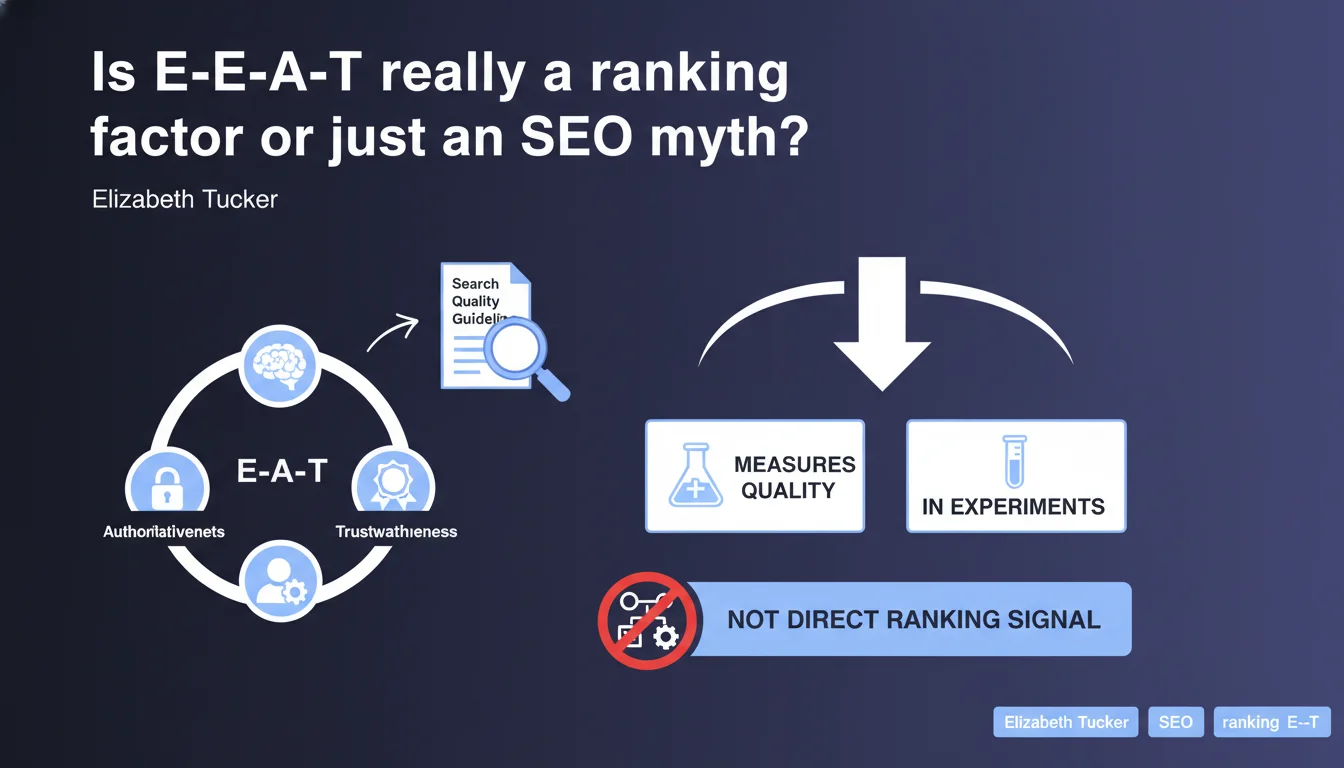
Google claims that E-E-A-T is not a direct ranking signal in its algorithm. It's an evaluation framework derived from the Search Quality Rater Guidelines, used to test the quality of results during experiments — not a technical factor that the algorithm measures directly. But that doesn't mean you should ignore it.
What you need to understand
Does E-E-A-T really come from Google's algorithm?
No, and that's precisely what Google clarifies here. E-E-A-T (Expertise, Experience, Authoritativeness, Trustworthiness) doesn't correspond to any technical signal in the ranking algorithm code.
This concept comes from the Search Quality Rater Guidelines — a manual that Google provides to its human evaluators to rate the quality of pages. These evaluators never directly modify rankings. They test algorithm changes upstream to determine whether an update improves or degrades the perceived quality of results.
Why is there confusion between E-E-A-T and ranking factors?
Because Google regularly talks about E-E-A-T in its official communications, particularly in the context of Core Updates and YMYL content (Your Money Your Life). As a result, most SEO professionals believe E-E-A-T is a measurable ranking factor — like page load speed or backlinks.
In reality, it's a qualitative evaluation concept. The algorithm uses hundreds of signals (domain authority, backlinks, user behavior, content quality) that, when combined, can produce an effect similar to what a human evaluator would consider as E-E-A-T.
Practically speaking, what does this change for an SEO practitioner?
It changes the conceptual framework, not necessarily the actions to take. If you optimize your site to be perceived as expert, trustworthy and authoritative, you're indirectly working on the signals that Google actually measures: brand mentions, quality backlinks, detailed and sourced content, credible authors.
Google doesn't « scan » your site looking for an E-E-A-T score. But it measures signals that, in aggregate, reflect these qualities. The distinction is important to avoid falling into naive optimizations or waiting for an « E-E-A-T boost ».
- E-E-A-T is not a technical ranking factor in Google's algorithm
- It serves as a framework for human evaluation when testing quality on search results
- The algorithm uses indirect signals (backlinks, mentions, authority, user behavior) that produce a similar effect
- Optimizing for E-E-A-T remains relevant, but by understanding that you're working on underlying measurable indicators
SEO Expert opinion
Is this statement consistent with what we observe in the field?
Yes and no. Technically, Google is right: there's no « E-E-A-T score » calculated somewhere in the algorithm code. But the effects observed during Core Updates show that certain sites gain or lose massively based on criteria aligned with E-E-A-T.
YMYL sites (health, finance) that add identifiable authors, mentions of qualifications, credible external references often recover traffic after drops. Coincidence? No. Google optimizes its algorithm so that results match the quality expectations defined in the Guidelines — and thus the E-E-A-T criteria.
Is Google playing with words to avoid being too precise?
Probably. Saying « E-E-A-T is not a direct factor » is technically accurate, but it avoids acknowledging that the algorithm is trained to reproduce the E-E-A-T judgments of human evaluators.
It's like saying « we don't directly measure customer satisfaction, just return rate, reviews, average order value and NPS ». Sure, but ultimately, you're optimizing for customer satisfaction. [To verify]: Google could use machine learning to detect « trustworthiness » patterns without ever naming them explicitly in the code.
Should we continue optimizing for E-E-A-T despite this statement?
Absolutely. This statement doesn't change practical recommendations. The measurable signals that translate E-E-A-T remain crucial: backlinks from authority sites, author mentions, publishing history, demonstrated expertise.
Let's be honest: saying « it's not a direct factor » is a semantic pirouette. If all the signals Google measures to evaluate quality correspond to what the Guidelines call E-E-A-T, then optimizing for E-E-A-T amounts to optimizing for these signals. The only difference is that we stop looking for a « magic E-E-A-T button » that doesn't exist.
Practical impact and recommendations
What should you do concretely on your site?
Stop trying to « optimize E-E-A-T » like an isolated KPI. Instead, focus on the measurable signals that Google actually uses and that translate expertise, authority and trust.
First priority: make your authors' expertise visible. Add detailed bios, links to their LinkedIn profiles or professional websites, mention their qualifications. On YMYL content, this is non-negotiable.
Second axis: increase the density of credible references. Cite studies, official sources, recognized institutions. Google detects these citations and outbound links to authority sites can strengthen the perception of trustworthiness.
- Add complete author bios with qualifications and verifiable external links
- Integrate citations and references to institutional or academic sources
- Structure pages with clear author mentions (schema.org Author)
- Develop a digital PR strategy to gain brand mentions and backlinks from reference media
- Create a detailed and transparent « About » section (team, history, mission)
- Highlight relevant certifications, labels or professional partnerships
What mistakes should you avoid after this statement?
Don't fall into SEO nihilism by telling yourself « since E-E-A-T isn't a direct factor, I can ignore it ». It's precisely the opposite: you must work on measurable fundamentals (domain authority, content quality, trust signals) even more seriously.
Another trap: believing that adding a « secure site » logo or a generic bio is enough. Google measures complex signals — editorial consistency, content depth, backlink diversity. Cosmetic optimizations are useless if the foundation isn't solid.
How do you measure the impact of these optimizations?
Difficult, precisely. Since E-E-A-T isn't a score displayed anywhere, you must track indirect metrics: evolution of organic traffic on competitive keywords, click-through rate, domain authority (via third-party tools), acquisition of quality backlinks.
Pay particular attention to Core Updates: these are the moments when Google adjusts its algorithm to better reflect E-E-A-T criteria. If your site gains during these updates, it's a signal that your optimizations are working.
❓ Frequently Asked Questions
Si E-E-A-T n'est pas un facteur de ranking, pourquoi Google en parle autant ?
Dois-je arrêter d'optimiser pour E-E-A-T après cette déclaration ?
Comment Google mesure-t-il l'expertise si E-E-A-T n'est pas un facteur direct ?
Les Quality Raters influencent-ils directement le classement de mon site ?
Est-ce que les sites YMYL sont plus impactés par E-E-A-T que les autres ?
🎥 From the same video 11
Other SEO insights extracted from this same Google Search Central video · published on 27/06/2024
🎥 Watch the full video on YouTube →
💬 Comments (0)
Be the first to comment.