
Official statement
Other statements from this video 9 ▾
- □ Does the Search Console API really give you access to data that the interface hides?
- □ Why does Google Search Console cap your indexing reports at 1000 rows?
- □ Did Google just give SEOs the data superpower they've been begging for?
- □ Why is Google refusing to index some of your pages?
- □ Should you really fix every Google Search Console notification?
- □ Should you really fix every single 404 error detected in Search Console?
- □ Can the URL Inspection API truly replace manual inspections at scale?
- □ Does Google finally have an SEO tool for non-technical users with Search Console Insights?
- □ How is the BigQuery integration transforming advanced SEO analysis beyond Search Console's standard limitations?
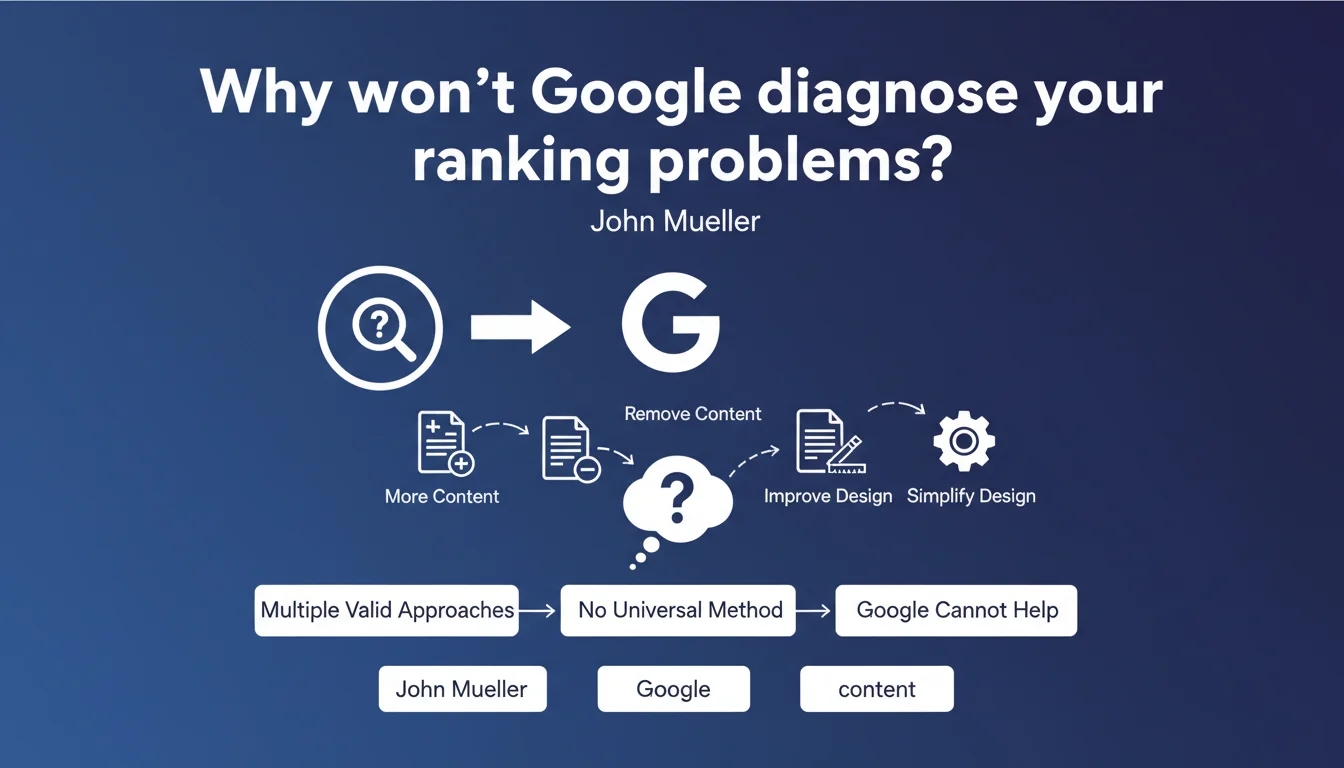
Google claims it cannot provide a universal diagnosis for ranking issues because multiple contradictory approaches can be valid depending on context: adding content or removing it, complicating design or simplifying it. No method is universally correct, making generic recommendations from their teams impossible.
What you need to understand
This statement from John Mueller touches on a recurring frustration among SEO professionals: the lack of clear answers from Google when facing traffic drops. Rather than pointing to a technical shortcoming, Mueller acknowledges a structural reality — the algorithm evaluates hundreds of signals, and what works for one site can harm another.
The underlying message is twofold. First, Google doesn't want (or can't) play free SEO consultant at scale. Second, it implicitly admits that its own system is too complex for a support team to extract actionable diagnostics without deep analysis.
Why can't Google provide a universal answer?
Google's algorithm is built on hundreds of ranking factors that interact differently depending on industry, search intent, local competition, and site profile. A strategy that boosts a B2C e-commerce site can destroy an informational website.
Mueller cites deliberately contradictory examples: creating more content versus removing it, improving design versus simplifying it. These oppositions aren't theoretical — they reflect real cases where Google favored radically different approaches depending on context.
What does this reveal about how the algorithm works?
This statement confirms that Google prioritizes contextual adaptation over rigid rules. A site with 10,000 low-quality pages can benefit from massive pruning, while a direct competitor with the same content volume can dominate through exhaustive coverage.
It also means that SEO audits must integrate advanced competitive sector analysis. What looks like a generic best practice can be completely misaligned with your specific SERP.
- Google cannot diagnose ranking problems universally
- Multiple contradictory approaches can be valid depending on context
- The algorithm evaluates signals differently depending on industry and search intent
- Generic recommendations are often ineffective, even counterproductive
- Contextual and competitive analysis is essential for any SEO strategy
In which cases does this limitation cause problems?
For sites suffering a sharp drop after a Core Update, this lack of official diagnosis can extend uncertainty for months. Teams test hypotheses, invest resources — often without knowing if they're addressing the right variable.
The real risk? Applying a fix valid for a competitor but misaligned with your situation. Removing content because a viral case study did it can destroy your semantic coverage if your actual challenge was topic depth.
SEO Expert opinion
Is this statement consistent with patterns observed in practice?
Absolutely. Case studies regularly show opposite trajectories for comparable sites. One site can recover traffic by reducing content volume by 40%, while another in the same sector explodes after tripling editorial output.
The problem is that this theoretical consistency doesn't change operational reality: practitioners need diagnostic methodologies, even imperfect ones. That's where Mueller's statement becomes frustrating — it validates impossibility without proposing an exploitable alternative.
What nuances should be added to this position?
Mueller discusses universal diagnosis, but recurring patterns do exist. Sites affected by Helpful Content Update often share common traits: mass-generated content, weak demonstrated expertise, catastrophic engagement signals.
The crucial nuance? Google cannot diagnose remotely, without context, through a generic form. But their own internal analyses — which they obviously don't share — do identify dominant causes among clusters of affected sites.
[To verify] Mueller implies even Google's teams couldn't diagnose effectively. That's probably overstated — their engineers have access to granular data and predictive models unavailable publicly. The real message is probably: "We won't do it for you," dressed up as "We can't."
In which cases doesn't this rule apply?
Some situations allow near-certain diagnosis. If your site disappears suddenly after a manual action notification in Search Console, the cause is documented. Similarly, a botched technical migration with thousands of 404s doesn't require complex multifactorial analysis.
Algorithmic penalty problems remain most opaque. But even there, third-party tools (traffic evolution by keyword cluster, SERP distribution analysis, rising competitor study) allow solid hypotheses — far more than what Google officially shares.
Practical impact and recommendations
What should you actually do when facing a ranking problem?
Forget waiting for official Google diagnosis. Build your own comparative analysis methodology: identify 5 to 10 direct competitors performing on your target queries, dissect their content strategy, technical structure, authority signals.
Seek common patterns among rising sites — and those shared by sites dropping alongside you. If three competitors gaining ground all have high expert content/generic content ratios, that's probably a lever for your sector.
Test only one major variable at a time. Removing content AND redesigning simultaneously makes results attribution impossible. Prioritize by estimated impact and implementation ease.
Which mistakes must you absolutely avoid?
Don't blindly copy a strategy that worked elsewhere. A viral case study about "how I recovered traffic by cutting 50% of pages" doesn't mean your site has the same problem. First validate that your diagnosis matches theirs.
Avoid cosmetic fixes if the problem is structural. Improving meta descriptions or tweaking some titles won't save a site hit by Helpful Content Update if the core issue is weak editorial value add.
Don't scatter yourself across hypotheses without data. If your traffic drops across 200 different keywords, segment analysis: did informational and transactional queries drop the same way? Did recent and old pages get hit equally?
How do you structure effective diagnosis without Google's help?
Implement a sequential analysis framework:
- Pinpoint the exact timing of the drop (correlation with Core Update, migration, editorial change)
- Segment impact by query type, page template, content age
- Analyze your top 10 competitors on your key queries: which signals do they have that you don't?
- Audit perceived quality: have external users test your key pages without SEO context
- Verify basic technical signals (crawlability, speed, mobile-first) to eliminate obvious causes
- Test one major hypothesis on a sample of pages (10-20 URLs) before deploying at scale
- Measure evolution over 4 to 8 weeks minimum before concluding on a fix's effectiveness
❓ Frequently Asked Questions
Google peut-il quand même donner des indices sur les problèmes de ranking dans certains cas ?
Si plusieurs approches contradictoires peuvent fonctionner, comment choisir la bonne pour mon site ?
Cette déclaration signifie-t-elle que les best practices SEO sont inutiles ?
Combien de temps faut-il attendre après une correction pour voir un impact sur le ranking ?
Pourquoi Google refuse-t-il de donner des diagnostics alors qu'ils ont toutes les données ?
🎥 From the same video 9
Other SEO insights extracted from this same Google Search Central video · published on 22/08/2024
🎥 Watch the full video on YouTube →
💬 Comments (0)
Be the first to comment.