
Official statement
Other statements from this video 4 ▾
Gary Illyes reminds us that HTTP status codes are essential signals for Google. They enable you to diagnose how the search engine interacts with your pages and quickly identify technical issues that drain your crawl budget and indexation.
What you need to understand
What makes HTTP status codes so strategic for Google?
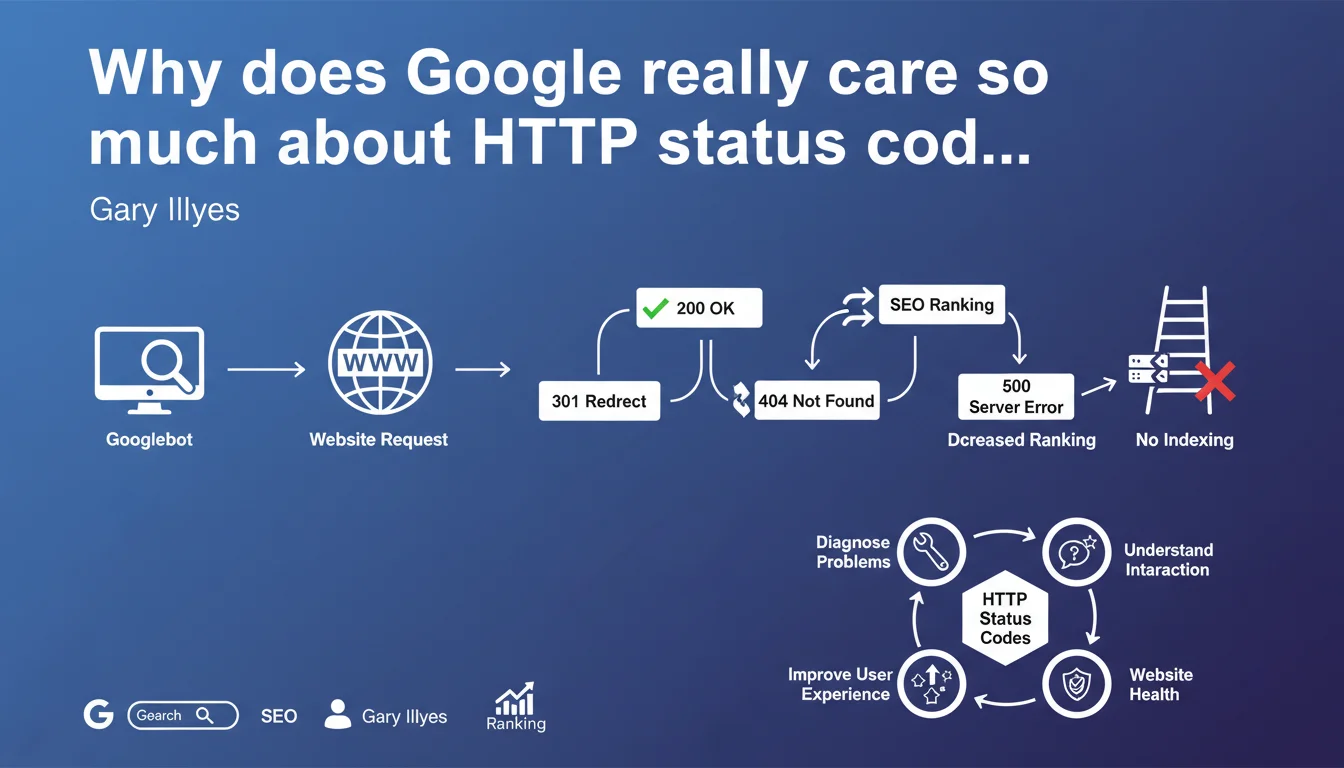
HTTP status codes represent the first level of communication between Googlebot and a server. Before even analyzing a page's content, the crawler receives a code that tells it whether the resource is accessible, moved, not found, or temporarily unavailable.
This information directly determines Google's behavior: indexation, caching, crawl frequency. A 200 code signals an accessible page, a 404 a missing resource, a 301 a permanent redirect — and each one triggers a specific action from the search engine.
Why does Gary Illyes talk about the "story" told by these codes?
Because HTTP status codes are not isolated signals — they reveal the technical health of a site and its ability to communicate properly with crawlers. An accumulation of 5xx errors (server errors) indicates a stability problem. Poorly managed redirect chains suggest a disorganized architecture.
Google uses these signals to adjust its crawl budget and prioritize resources worth exploring. A site that consistently returns clean codes gains crawl efficiency, while a chaotic site sees its exploration frequency drop.
Which HTTP status codes directly influence SEO?
- 200 (OK): page accessible, normally indexable
- 301 (Moved Permanently): permanent redirect, transfers PageRank
- 302/307 (Temporary Redirect): temporary redirect, does not transfer SEO value
- 404 (Not Found): page not found, progressively deindexed
- 410 (Gone): resource permanently deleted, accelerated deindexation
- 503 (Service Unavailable): temporary unavailability, Google will retry without penalizing
- Recurring 5xx: chronic server problem, can slow down crawl and harm indexation
SEO Expert opinion
Does this statement really bring anything new to the table?
No — and that's precisely what's troubling. Gary Illyes is reformulating a basic principle known for 15 years. No figures, no precise thresholds, no data on the real impact of a mishandled code. Just a generic statement about the importance of HTTP codes.
What's critically missing: clarification on tolerance thresholds. How many 404s before Google starts reducing crawl budget? What frequency of 5xx errors triggers a loss of trust? [To verify] — Google remains silent on these metrics, which are crucial for calibrating corrective actions.
What nuances need to be applied in practice?
Some HTTP codes have immediate impact, others don't. A single 404 error is no problem — it's actually healthy for a live site where pages naturally disappear. However, a sudden spike of 404s following a redesign signals a poorly managed migration.
302 redirects officially don't transfer PageRank, but in practice, Google often treats them like 301s if they remain in place for a long time. Except nothing guarantees this behavior — it's therefore better to systematically favor a 301 for permanent URL changes.
In which cases does this rule not apply?
503 codes are sometimes used strategically during planned maintenance, with a Retry-After header to tell Google when to come back. In this specific case, the search engine doesn't penalize — it waits and retries as requested.
Another exception: certain intentionally ephemeral sites (temporary marketing campaigns, seasonal landing pages) can afford massive 410 Gone responses at the end of their cycle without harming the main domain. But be careful — this assumes well-compartmentalized architecture.
Practical impact and recommendations
What should you audit first regarding your HTTP codes?
Start by analyzing the distribution of codes in your server logs and in Search Console. Identify strategic pages that return recurring errors and unnecessary redirect chains that waste crawl budget.
Next, verify the consistency between what your server returns and what Google understands. Use the URL inspection tool in Search Console to compare the HTTP code received by Googlebot with what's displayed in a regular browser — differences often reveal unintended cloaking problems or user-agent handling issues.
Which critical errors should you fix immediately?
- Replace all 302 redirects with 301s when the change is permanent
- Eliminate redirect chains (A → B → C) by pointing directly to the final destination
- Fix soft 404s (pages returning 200 with "page not found" content) by changing them to actual 404s or 410s
- Treat recurring 5xx errors as emergencies — they signal a server problem that degrades user experience and Google's crawl ability
- Monitor unusual 404 spikes after each deployment or redesign
How should you monitor these codes long-term?
Set up automatic alerts for unusual variations in HTTP codes: sudden 404 increases, appearance of 5xx in volume, multiplication of temporary redirects. Tools like Screaming Frog, OnCrawl, or Botify allow you to track these metrics over time.
Document each major change (redesign, migration) with a snapshot of HTTP codes before/after. This facilitates diagnosis in case of traffic drops and proves to Google that redirects are intentional and well-managed.
❓ Frequently Asked Questions
Un code 404 pénalise-t-il le référencement de mon site ?
Quelle différence entre un 301 et un 302 pour Google ?
Comment Google réagit-il face à des erreurs 5xx récurrentes ?
Faut-il utiliser un code 410 plutôt qu'un 404 ?
Les soft 404 sont-ils vraiment problématiques ?
🎥 From the same video 4
Other SEO insights extracted from this same Google Search Central video · published on 15/05/2025
🎥 Watch the full video on YouTube →
💬 Comments (0)
Be the first to comment.