
Official statement
Other statements from this video 4 ▾
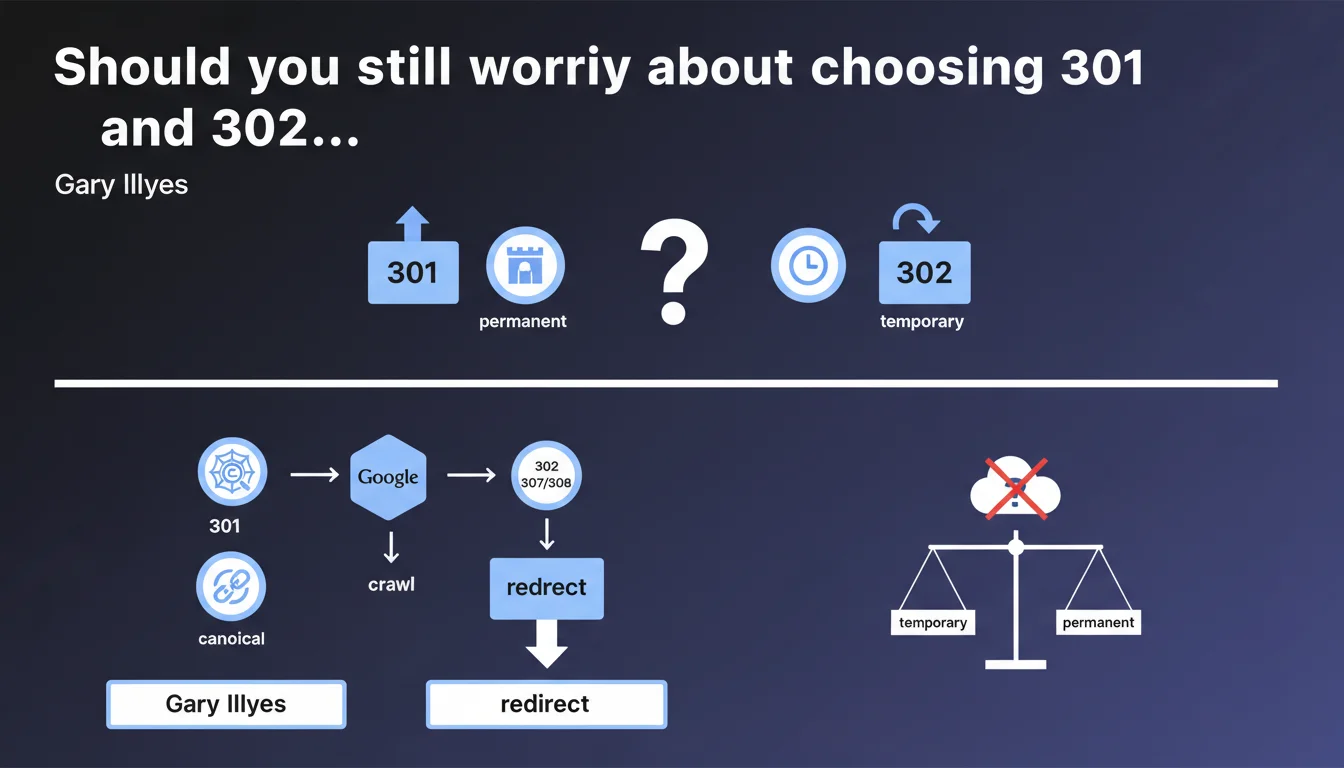
Google treats all 3xx codes (301, 302, 307, 308) in a nearly identical manner during crawling. The distinction between temporary and permanent only marginally influences canonicalization. In practice, the choice of redirect code has almost no impact on SEO.
What you need to understand
Why does Google simplify redirect handling?
For years, SEO doctrine imposed an iron rule: 301 for permanent redirects, 302 for temporary ones. The logic? A 301 transferred PageRank, a 302 did not. This technical distinction made sense at a time when search engines struggled to interpret intentions.
Today, Google says this nuance no longer really matters for its crawler. All 3xx codes trigger the same behavior: follow the redirect and index the target page. The temporary/permanent distinction persists only for canonicalization, that is, the choice of which URL to display in search results.
What does "slightly taken into account" concretely mean for canonicalization?
This is where artistic ambiguity begins. Google doesn't quantify this "slightly." In practice, if you use a 302 instead of a 301 for a permanent redesign, Google can continue to favor the old URL in its index for an indefinite period.
But this is only one signal among many others. Sitemaps, internal links, redirect age, and other factors weigh into the balance. A 301 probably speeds up the switching process, without any absolute guarantee.
Do codes 307 and 308 really change anything?
These codes are HTTP/1.1 variants meant to be stricter: 307 preserves the HTTP method (GET stays GET, POST stays POST), just like 308. In theory, they prevent implementation bugs on the client side.
For Google? No difference. The crawler treats them like standard 302s or 301s. Their use is more about technical compliance than pure SEO.
- All 3xx codes are followed in the same way by Googlebot during crawling
- PageRank transfer works with any 3xx code, not just 301
- The temporary/permanent distinction marginally influences canonical URL selection
- 307/308 codes provide no specific SEO advantage compared to 301/302
- Google still recommends using a 301 for permanent redirects, for clarity of intent
SEO Expert opinion
Is this statement consistent with field observations?
Let's be honest: this statement validates what many practitioners have observed for years. Site migrations with "temporary" 302s eventually transfer their popularity, albeit more slowly. Documented tests show that PageRank flows through any 3xx code.
But — and this is where it gets tricky — the difference in consolidation speed remains observable. A 301 typically allows canonical switching in days or weeks. A 302 can leave both URLs coexisting in the index for months. [To verify]: Google has never published quantified data on this time gap.
What nuances should be added to this statement?
Gary Illyes is talking about crawler behavior, not webmaster tools or canonicalization systems. Search Console, for example, continues to indicate 301s as the recommended method for migrations. So there is a gap between technical discourse and operational advice.
Furthermore, some CMSes and CDNs handle redirect chains poorly. Mixing different 3xx codes can create inconsistencies that Google interprets with difficulty. Simplicity therefore remains a golden rule: one code, one objective, one target.
In what cases does this rule not apply?
JavaScript redirects or meta-refresh are not 3xx codes and don't benefit from the same treatment. Google must execute the JavaScript to detect them, which delays crawling and weakens the redirect signal.
Temporary redirects with UTM parameters or tracking also create issues. If Google sees hundreds of URL variants pointing to the same target via 302s, it can interpret this as a soft 404 or duplicate content. The 3xx code alone isn't enough — architectural consistency takes priority.
Practical impact and recommendations
What should you do concretely after this statement?
First, don't discard your current conventions. If your technical stack systematically uses 301s for permanent redirects, keep this logic. It remains the most explicit for teams, audits, and future developers.
Next, audit your existing redirects. Identify the 302s installed "temporarily" three years ago that should be 301s. Google will eventually understand, but why slow down consolidation?
Finally, simplify your redirect chains. If A redirects to B which redirects to C, Googlebot follows the chain but wastes time and crawl budget. Two hops maximum, otherwise fix it.
What errors should you avoid when implementing redirects?
The classic mistake: using a 302 "to test" a migration, then forgetting to switch to 301. Google will follow the redirect, but your old URL will stay in the index longer than necessary. Test in pre-production, then deploy directly with the correct code.
Another pitfall: redirect loops. A → B → A. Google gives up after a few hops and can deindex both pages. Check with a tool like Screaming Frog or server logs.
Finally, don't mix codes in the same chain without solid technical reason. A 301 followed by a 302 muddies intent and complicates diagnosis if problems arise.
- Systematically favor 301s for permanent redirects, even if Google treats them similarly
- Audit old 302s and convert them to 301s if the redirect has become permanent
- Limit redirect chains to 2 hops maximum
- Check for redirect loops with a crawler
- Avoid JavaScript or meta-refresh redirects for critical migrations
- Document each 3xx code choice in your internal processes to avoid inconsistencies
- Monitor redirected URLs in Search Console to detect canonicalization slowdowns
❓ Frequently Asked Questions
Un 302 transfère-t-il désormais autant de PageRank qu'un 301 ?
Dois-je corriger tous mes 302 en 301 sur un vieux site ?
Les redirections 307 et 308 ont-elles un avantage SEO ?
Combien de temps Google met-il à consolider une redirection 302 versus 301 ?
Puis-je mélanger différents codes 3xx dans une même chaîne de redirections ?
🎥 From the same video 4
Other SEO insights extracted from this same Google Search Central video · published on 15/05/2025
🎥 Watch the full video on YouTube →
💬 Comments (0)
Be the first to comment.