
Official statement
Other statements from this video 10 ▾
- □ Should you markup your loyalty program to unlock rich results in Google Search?
- □ Why is Google discontinuing 7 structured data types, and what should you do about it now?
- □ Should you keep maintaining structured data if Google stops displaying certain types?
- 4:56 Why is Google refusing to commit to a clear future roadmap for AI Overviews?
- 6:24 Why doesn't Google index all your pages and how can you prepare for it?
- 8:48 Can you really stop Google from ranking your site for specific keywords?
- 9:56 Is page quality alone enough to guarantee indexing by Google?
- 9:56 How long does Google really take to recognize your SEO changes?
- 12:00 How does Google actually discover all the URLs on your website?
- 15:15 Do you really need to submit your sitemap every single day?
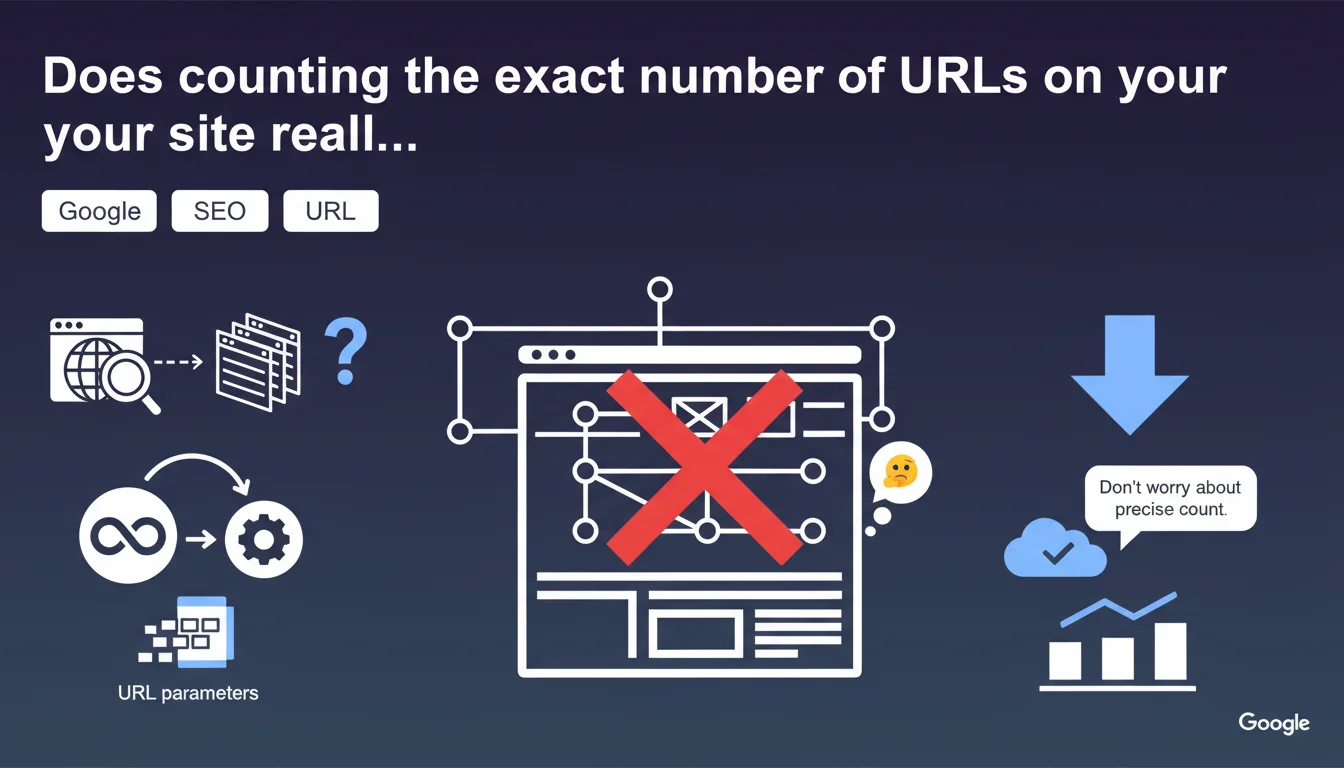
Google states that precisely counting URLs on large websites is unnecessary and even misleading because parameters create technically different pages. The exact number isn't what matters—what counts is the quality and structure of your indexation. Focus on strategically important pages rather than exhaustive inventory management.
What you need to understand
Why does Google advise against counting exact URLs?
URL parameters automatically generate technical variants of the same page: sorting, filters, sessions, UTM codes. On an e-commerce site with 1,000 products and 5 possible filters, you can easily end up with tens of thousands of distinct URL combinations.
Google considers this exact counting a false problem. What matters is knowing which pages have real SEO value and which ones are just technical variants with no unique content.
What does this reveal about Google's vision?
This statement reflects a qualitative rather than quantitative approach. Google wants SEOs to focus on logical content organization, information hierarchy, and crawl prioritization.
The search engine knows that modern websites generate thousands of technical URLs. It doesn't expect you to master every single one individually—it wants you to control what actually matters.
What are the implications for crawl budget?
If Google itself recommends not obsessing over exact URL counts, it's because crawl budget isn't managed by counting URLs but by directing Googlebot toward the right resources.
- Use your robots.txt file to block parameterized URLs with no SEO value
- Define canonical URLs to consolidate technical variants
- Configure URL parameters in Search Console to indicate which ones create duplicate content
- Monitor coverage reports instead of manually counting pages
- Focus on strategic information architecture: categories, main product pages, editorial content
SEO Expert opinion
Is this statement aligned with real-world observations?
Absolutely. On websites with tens of thousands of pages, counting URLs precisely is practically impossible—and more importantly, it's counterproductive. Tools like Screaming Frog or OnCrawl easily surface 50,000 URLs on a site that "officially" has only 5,000.
The problem is many junior SEOs panic when they see Search Console reporting 80,000 discovered URLs when they thought they had 10,000. Google is clearly saying: stop worrying about that.
What nuances should we add to this advice?
Google is right for dynamic sites with filters, facets, and sessions. But here's the catch: not counting doesn't mean not mapping. You need to know what types of URLs exist on your site, even if you can't list them exhaustively.
Another nuance: on a site with 200 well-defined static pages, counting URLs remains relevant. [To verify] Google's recommendation clearly targets "large-size" sites, but it doesn't specify the threshold. Starting from how many pages does this logic apply? 1,000? 10,000? Google is deliberately vague.
In what cases could this advice be misinterpreted?
Some might understand "don't worry about your URL count" as a green light to let unnecessary URLs proliferate. It's the opposite: Google says don't count because it wants you to control URL generation at the source.
Practical impact and recommendations
What should you concretely do to manage URLs without counting them?
Adopt a URL governance logic rather than exhaustive inventory. Identify the URL typologies generated by your site: product pages, filters, sorts, sessions, UTM codes, internal search results.
For each typology, decide: is it indexable? Should we canonicalize it? Block it in robots.txt? Exclude it from the XML sitemap? This rules-based approach beats manual counting.
What mistakes should you avoid when managing multiple URLs?
Don't let tracking parameters (UTM, fbclid, gclid) create indexable URLs. Use canonicals or configure Search Console to tell Google to ignore these parameters.
Avoid mass-blocking in robots.txt without thinking it through: you might prevent Google from seeing canonicals and understanding your structure. It's better to let it crawl and canonicalize than to block blindly.
How can you verify that your URL structure is under control?
Regularly check the coverage report in Search Console. If you see thousands of "Excluded" pages with the reason "Alternative page with appropriate canonical tag", that's a good sign: Google understands your structure.
Analyze your server logs to spot which URLs Googlebot crawls most. If those are parameterized pages with no real value, that's a red flag. Use a tool like OnCrawl or Botify to cross-reference crawl and indexation data.
- Map the URL typologies generated by your CMS or platform
- Define clear canonicalization rules for each typology
- Configure URL parameters in Search Console if needed
- Block in robots.txt only URLs with zero SEO value (admin, checkout, irrelevant internal search)
- Monitor coverage reports instead of manual counting
- Analyze server logs to identify inefficient crawl patterns
- Prioritize internal linking to strategic pages to guide crawl behavior
❓ Frequently Asked Questions
À partir de combien de pages doit-on arrêter de compter les URLs exactes ?
Comment savoir si mes URLs paramétrées posent problème pour le crawl ?
Dois-je bloquer toutes les URLs avec paramètres dans robots.txt ?
Les paramètres UTM créent-ils des problèmes de duplicate content ?
Le nombre d'URLs dans le sitemap XML doit-il correspondre au nombre réel de pages ?
🎥 From the same video 10
Other SEO insights extracted from this same Google Search Central video · published on 26/06/2025
🎥 Watch the full video on YouTube →
💬 Comments (0)
Be the first to comment.