
Official statement
Other statements from this video 10 ▾
- □ Faut-il baliser les programmes de fidélité pour améliorer ses résultats enrichis ?
- □ Faut-il maintenir les données structurées si Google arrête d'en afficher certaines ?
- 4:56 Pourquoi Google refuse-t-il de s'engager sur l'avenir des AI Overviews ?
- 6:24 Pourquoi Google n'indexe-t-il pas toutes vos pages et comment l'anticiper ?
- 8:48 Peut-on empêcher Google de nous positionner sur certains mots-clés ?
- 9:56 La qualité d'une page suffit-elle pour garantir son indexation ?
- 9:56 Combien de temps Google met-il vraiment à reconnaître les changements SEO ?
- 12:00 Comment Google découvre-t-il vraiment les URLs de votre site ?
- 12:00 Faut-il vraiment compter le nombre exact d'URLs de son site ?
- 15:15 Faut-il vraiment soumettre son sitemap tous les jours ?
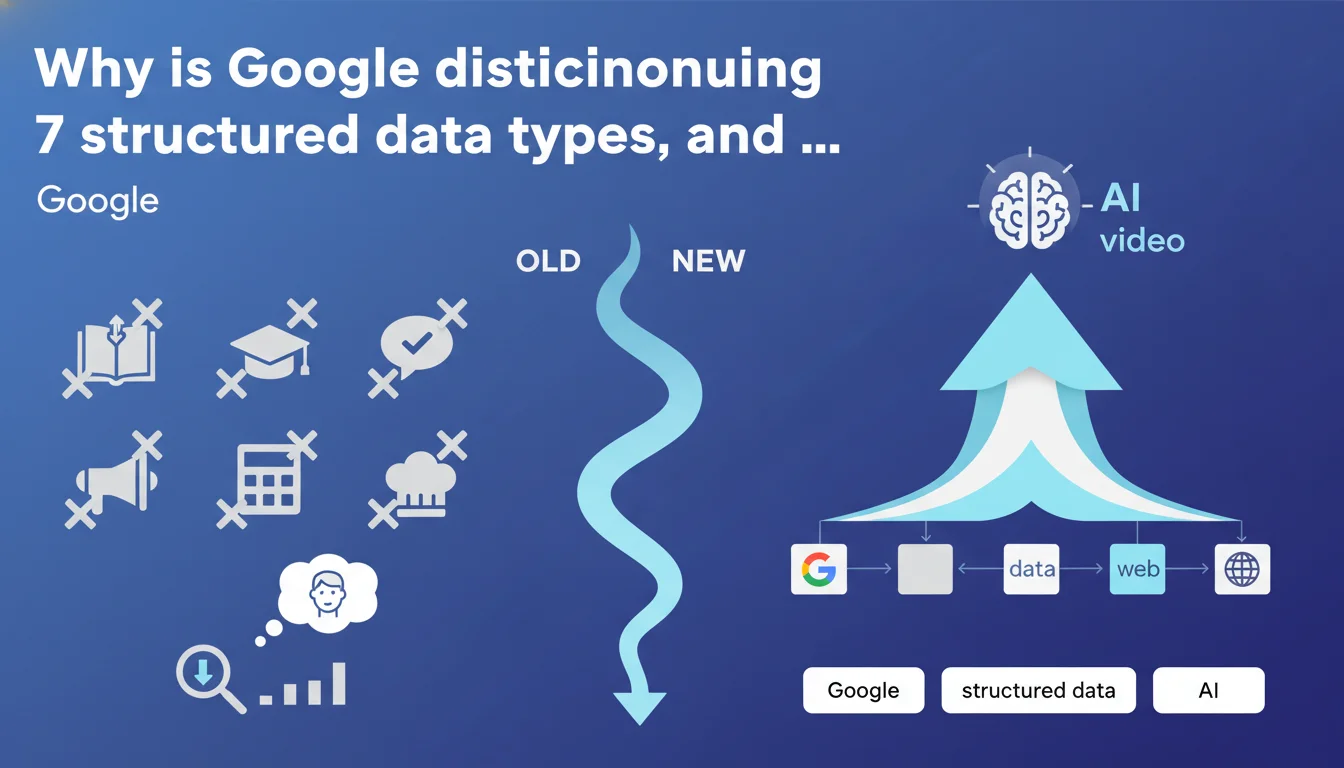
Google is gradually phasing out support for 7 structured data types deemed underutilized and offering minimal added value: Book Actions, Course, Claim Review, Estimate Summary, Learning Video, Special Announcement, and Recipe Testing. This decision reflects a strategy to streamline the rich snippet catalog, but raises questions about the longevity of technical implementations already in place.
What you need to understand
Which structured data types is Google exactly discontinuing?
Google is ending support for seven structured data formats: Book Actions, Course, Claim Review, Estimate Summary, Learning Video, Special Announcement, and Recipe Testing. These formats had been introduced to enrich search results in specific contexts—online courses, fact-checking, educational videos, and so on.
The discontinuation will happen gradually, with no specific deadline announced. Google justifies this decision by pointing to low adoption rates and insufficient user value. In other words: few sites were using them, and when they did, the impact on search experience remained marginal.
Will this discontinuation affect the SEO performance of affected sites?
No, not directly. Structured data has never been a ranking factor—Google has stated this repeatedly. Their role is limited to displaying enriched results (rich snippets, cards, knowledge panels).
If your site used one of these formats, you won't lose organic rankings. However, you will lose potential visual enhancements in the SERPs, which can indirectly affect click-through rate if these elements were generating appeal.
Why is Google conducting this cleanup?
The search engine is rationalizing its structured data catalog to focus on formats that deliver genuine user value at scale. Maintaining dozens of underutilized types represents a significant technical and documentation cost.
This approach aligns with a broader strategy: Google prefers universal, widely-adopted formats (Product, Article, FAQ, HowTo, etc.) over a myriad of niche implementations. It's also a signal about what really matters to the engine—and what doesn't.
- Seven structured data types being discontinued: Book Actions, Course, Claim Review, Estimate Summary, Learning Video, Special Announcement, Recipe Testing
- Justification: low adoption and limited user value
- No direct impact on organic ranking
- Potential loss of visual enhancements in SERPs
- Strategy to simplify and rationalize the Schema.org catalog supported by Google
SEO Expert opinion
Was this decision foreseeable?
Yes, very much so. Some of these formats never really gained traction. The Special Announcement type, for example, was introduced hastily during the pandemic to handle urgent health announcements—a very specific context that no longer warranted structural integration into the search engine.
Similarly, Claim Review targeted fact-checking sites, an ultra-niche segment with few eligible players. Book Actions and Learning Video? Nearly invisible in SERPs since their launch. Google has simply acknowledged an adoption failure and pruned the dead branches.
Should we expect more discontinuations?
Probably. Google continuously tests structured data formats, and not all survive. If a type doesn't generate enough implementations or fails to demonstrate measurable user impact, it eventually gets abandoned. [To verify] on the ground, but formats like SoftwareApplication or MusicGroup also appear underutilized.
The real criterion is critical mass: if thousands of quality sites adopt a format and Google observes a positive signal on user engagement, the format survives. Otherwise, it gets cut. It's pragmatic, not sentimental.
Should sites with existing implementations panic?
No. Obsolete structured data will simply be ignored by the search engine—they won't cause errors or penalties. Technically, you can leave them in place without direct risk.
That said, keeping dead code in your pages unnecessarily bloats your HTML and complicates maintenance. It's better to clean it up, especially if you use a tag manager or CMS with dedicated plugins that will continue generating these formats for nothing.
Practical impact and recommendations
What should you concretely do with these obsolete formats?
Start by auditing your current implementations. Use Google Search Console ("Enhancements" section) or an SEO crawler (Screaming Frog, OnCrawl, Sitebulk) to identify pages containing the seven affected types.
Once identified, you have two options: either remove them immediately if your deployment process is agile, or plan a cleanup during your next technical overhaul. The urgency is low—these formats will be ignored, not penalized.
Which structured data types should you prioritize instead?
Focus your efforts on formats with high visual and documentary ROI: Product, Article, FAQ, HowTo, Event, Recipe (the real Recipe, not Recipe Testing), VideoObject, BreadcrumbList, Organization.
These types generate stable rich snippets, are widely displayed in SERPs, and benefit from active Google support. If you had implemented Course, switch to Article with educational properties or to VideoObject if your content is multimedia.
How can you verify your site remains compliant after cleanup?
After removal, test your pages with Google's Rich Results Test and the Schema.org validator. Verify that the remaining structured types are properly recognized and free of errors.
Monitor Search Console in the following weeks: if errors appear in the "Enhancements" section, it means a dependency broke during cleanup. Fix immediately to prevent any display regression.
- Audit your pages to identify the 7 obsolete types (Search Console, SEO crawler)
- Plan their progressive or immediate removal depending on your technical resources
- Replace discontinued types with viable alternatives (Article, VideoObject, etc.)
- Test modified pages with Rich Results Test and Schema.org validator
- Monitor Search Console to detect any post-cleanup errors
- Document changes to prevent regressions during future updates
❓ Frequently Asked Questions
Les données structurées obsolètes vont-elles casser mon référencement ?
Combien de temps ai-je pour supprimer ces formats de mon site ?
Puis-je remplacer le type Course par un autre format ?
Comment savoir si mon site utilise ces types de données structurées ?
Google va-t-il supprimer d'autres types de données structurées à l'avenir ?
🎥 From the same video 10
Other SEO insights extracted from this same Google Search Central video · published on 26/06/2025
🎥 Watch the full video on YouTube →
💬 Comments (0)
Be the first to comment.