
Official statement
Other statements from this video 10 ▾
- □ Faut-il baliser les programmes de fidélité pour améliorer ses résultats enrichis ?
- □ Pourquoi Google abandonne-t-il 7 types de données structurées et que faut-il faire maintenant ?
- □ Faut-il maintenir les données structurées si Google arrête d'en afficher certaines ?
- 6:24 Pourquoi Google n'indexe-t-il pas toutes vos pages et comment l'anticiper ?
- 8:48 Peut-on empêcher Google de nous positionner sur certains mots-clés ?
- 9:56 La qualité d'une page suffit-elle pour garantir son indexation ?
- 9:56 Combien de temps Google met-il vraiment à reconnaître les changements SEO ?
- 12:00 Comment Google découvre-t-il vraiment les URLs de votre site ?
- 12:00 Faut-il vraiment compter le nombre exact d'URLs de son site ?
- 15:15 Faut-il vraiment soumettre son sitemap tous les jours ?
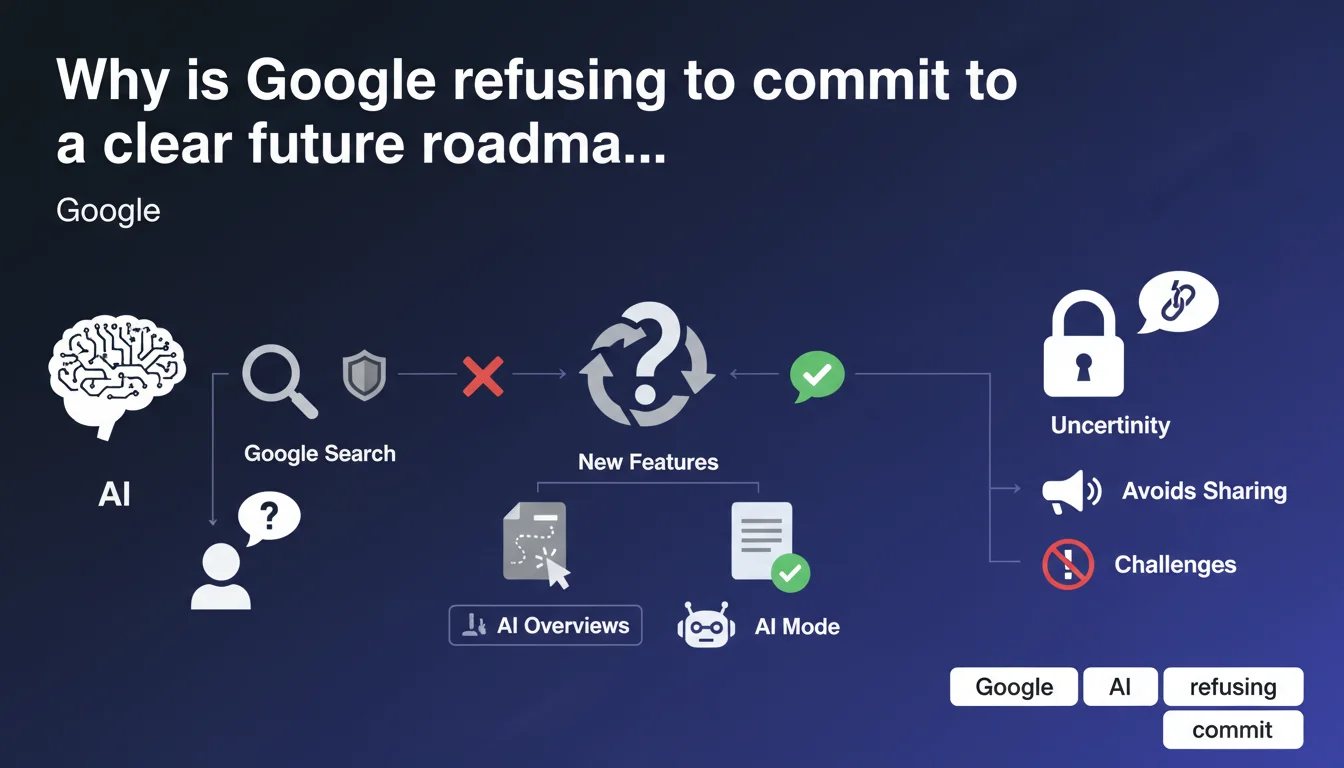
Google refuses to provide a clear roadmap for AI Overviews and AI Mode, arguing that these features are still too new. The official position: silence is better than uncertain promises that would complicate things for SEO professionals. A cautious stance that doesn't help you plan a strategy.
What you need to understand
What is Google really saying in this statement?
Google explicitly acknowledges that it cannot guarantee any future trajectory for AI Overviews and AI Mode. The reason given? These features are still in the experimental phase, and any projection would be speculative.
The official argument boils down to one line: sharing uncertain information would create more problems than it would solve. Translation: Google prefers to say nothing rather than have to backtrack or publicly adjust course later.
Why does this position pose a problem for SEO professionals?
The lack of visibility into how AI Overviews will evolve makes it harder to allocate resources. Should you optimize for these formats? Invest in structured content that's compatible? Adjust editorial strategies?
Without any guarantee of continuity, it's difficult to justify budget decisions or prioritize certain projects. SEO professionals are navigating blind, caught between hands-on experimentation and the complete absence of clear guidance.
Is this cautious approach new for Google?
No. Google has always avoided committing to specific timelines or precise changes — whether it's Core Updates, new result formats, or ranking criteria. The difference here: the admission is explicit.
But with AI Overviews, the stakes are different. These features structurally change the SERP and shift traffic distribution. The uncertainty is no longer just technical — it's strategic.
- Google refuses any projection about the future of AI Overviews and AI Mode
- Official argument: avoid uncertain promises that would create additional difficulties
- SEO professionals are forced to operate without medium-term visibility
- This caution reflects an internal experimental phase that remains unstable
SEO Expert opinion
Is this statement consistent with what we're observing in the field?
Yes and no. In practice, AI Overviews appear very irregularly depending on search queries, languages, and geographic locations. Some sectors are heavily covered, others completely ignored. This instability does align with a testing phase — but it's been ongoing for several months.
Where it breaks down: Google continues actively deploying these features, adjusting formats, and testing new presentations. A product in such an aggressive experimental phase should normally benefit from at least some communication about strategic intentions. The complete silence is unusual. [To verify]: is this really editorial caution or internal strategic ambiguity?
What nuances should we add to this official position?
Google says it doesn't want to create "additional difficulties" with uncertain information. But the complete absence of information creates difficulties in itself: SEO professionals must allocate budgets, prioritize projects, and advise clients.
The real problem isn't uncertainty — it's the inability to calibrate risk. A "we're still testing, here are our current hypotheses" would be infinitely more useful than "we can't say anything."
In what cases does this rule not apply?
If your traffic comes heavily from generic informational queries (health, finance, DIY), you're already being impacted by AI Overviews. Waiting for official communication before reacting means losing time.
In practice: track your zero-click traffic, analyze lost featured snippets, and trace which queries trigger AI Overviews in your vertical. The weak signals are already there — you don't need a Google announcement to adjust.
Practical impact and recommendations
What should you do concretely in the face of this uncertainty?
First rule: don't put all your eggs in the AI Overviews basket. Diversify your levers: featured snippets, People Also Ask, videos, images, Google Discover. A resilient mix is worth more than dependence on a volatile format.
Second action: actively monitor SERP changes across your key queries. Rank tracking tools, regular scraping, alerts on traffic variations. If AI Overviews impact your rankings, you need to detect it in real time.
What mistakes should you avoid in this context?
Don't wait for official approval to start testing. Google will never release a public roadmap on this topic — that's settled. Early movers who experiment now are gaining a competitive advantage.
Also avoid over-optimizing for a format that could disappear or change radically. Structured content, editorial clarity, and concise answers remain valuable — but don't sacrifice depth or user experience for a hypothetical AI trigger.
How do you measure the real impact on your traffic?
Compare your impressions versus clicks on queries where AI Overviews appear. If your impressions stay steady but CTR drops, you're being directly impacted. Segment by query type (informational, navigational, transactional) to identify risk areas.
Also analyze session duration and bounce rates on landing pages from Google searches. If fewer users arrive but convert better, the impact could be neutral or positive. Raw volume doesn't tell the whole story.
- Diversify SERP optimizations (snippets, PAA, videos, images)
- Track SERP changes daily on your strategic queries
- Measure CTR and impressions to detect AI Overviews impacts
- Don't sacrifice editorial quality for an unstable format
- Experiment without waiting for official Google validation
- Segment analysis by intent to calibrate real risk
❓ Frequently Asked Questions
Google va-t-il généraliser AI Overviews à toutes les requêtes ?
Faut-il optimiser spécifiquement pour AI Overviews dès maintenant ?
Cette absence de garantie signifie-t-elle qu'AI Overviews pourrait disparaître ?
Comment savoir si mon site est impacté par AI Overviews ?
Quels secteurs sont les plus exposés à AI Overviews ?
🎥 From the same video 10
Other SEO insights extracted from this same Google Search Central video · published on 26/06/2025
🎥 Watch the full video on YouTube →
💬 Comments (0)
Be the first to comment.