
Official statement
Other statements from this video 10 ▾
- □ Faut-il baliser les programmes de fidélité pour améliorer ses résultats enrichis ?
- □ Pourquoi Google abandonne-t-il 7 types de données structurées et que faut-il faire maintenant ?
- □ Faut-il maintenir les données structurées si Google arrête d'en afficher certaines ?
- 4:56 Pourquoi Google refuse-t-il de s'engager sur l'avenir des AI Overviews ?
- 6:24 Pourquoi Google n'indexe-t-il pas toutes vos pages et comment l'anticiper ?
- 8:48 Peut-on empêcher Google de nous positionner sur certains mots-clés ?
- 9:56 La qualité d'une page suffit-elle pour garantir son indexation ?
- 12:00 Comment Google découvre-t-il vraiment les URLs de votre site ?
- 12:00 Faut-il vraiment compter le nombre exact d'URLs de son site ?
- 15:15 Faut-il vraiment soumettre son sitemap tous les jours ?
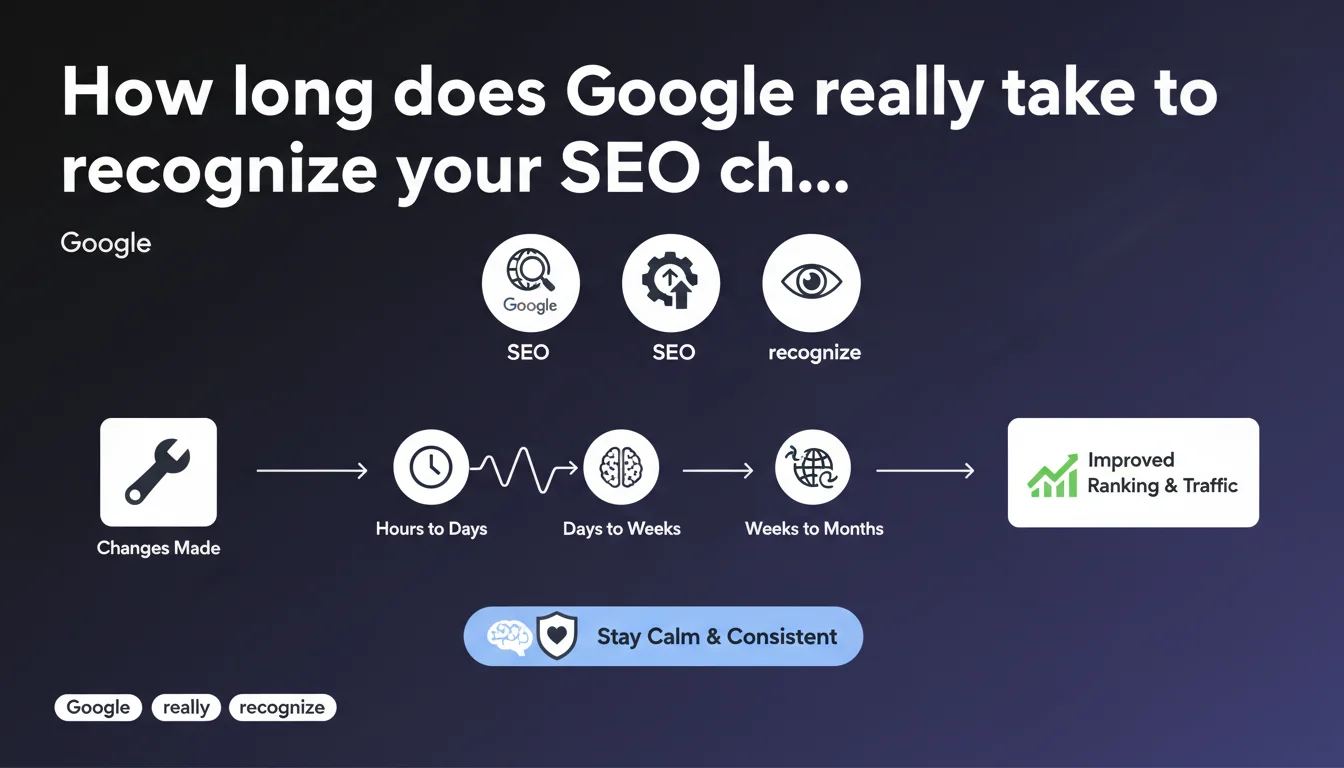
Google states that its systems need time to recognize and understand modifications made to a website. This technical latency requires SEO professionals to adopt a methodical and patient approach, avoiding hasty readjustments that could distort the analysis of results.
What you need to understand
What technical latency does Google really impose?
This official statement confirms what practitioners observe in the field: Google does not react instantly to modifications made to a website. Mountain View's systems must first crawl the modified pages, analyze the changes, then recalculate relevance signals.
The duration of this latency varies according to several factors — site crawl frequency, depth of changes, type of content modified. A simple title adjustment can be taken into account within a few days, while a structural overhaul may require several weeks or even months.
Why does Google insist on SEO professionals being "patient"?
The phrase "stay calm in your future actions" is not without significance. Google is clearly attempting to curb the impatience of SEOs who adjust their optimizations too quickly, before the first modifications have even produced their full effect.
This recommendation also aims to prevent hasty conclusions. If you modify a page on Monday and traffic drops on Thursday, the correlation does not necessarily imply causality — Google may not have even integrated your changes yet.
What are the technical mechanisms behind this latency?
Several processing layers explain this delay. First, crawling: Googlebot must revisit the page. Then indexing: the new version replaces the old one in the index. Finally, signal recalculation: algorithms re-evaluate relevance based on new elements.
Each step imposes its own pace. A low-authority site crawled monthly will necessarily wait longer than a news outlet crawled multiple times per hour.
- Crawling is not instantaneous — frequency depends on site authority and editorial freshness
- Indexing follows a complex pipeline — multiple processing steps before effective update
- Algorithms recalculate progressively — some signals update faster than others
- Patience is a strategy — premature adjustments distort causal analysis
SEO Expert opinion
Does this statement hide a more complex reality?
Let's be honest: Google remains deliberately vague about concrete timeframes. "Some time" doesn't mean much for a professional who needs to report to a client. Three days? Three weeks? Three months? The answer varies so much depending on contexts that it becomes almost useless. [To verify]
What's missing here is an actionable framework. Which types of changes are quick to integrate? Which ones require a full crawl cycle? Google has this data but prefers generic wording that commits to nothing.
In which cases does this "latency" become problematic?
Field observation reveals inconsistencies. Some sites see their title modifications taken into account in 48 hours, others wait three weeks for the same type of adjustment. The main explanatory variable remains the crawl budget — but Google doesn't mention it in this statement.
Another blind spot: algorithmic or manual penalties. When Google detects spam, the reaction can sometimes be nearly instantaneous. But when you fix that spam, lifting the penalty can drag on for months. This asymmetry is never explicitly explained.
What does this communication reveal about Google's strategy?
This statement fits into a broader trend: Google wants to slow down the pace of SEO professionals. By insisting on patience, Mountain View discourages aggressive testing, rapid adjustments—exactly what allows empirical understanding of algorithm mechanics.
It's consistent with other recent communications — less data in Search Console, less transparency on Core Updates, increasingly generic recommendations. Google prefers passive SEOs waiting around rather than experimenters dissecting its mechanisms.
Practical impact and recommendations
What should you do concretely after an SEO modification?
First, document each change with precision: date, nature of the modification, affected pages. Without this traceability, it's impossible to isolate variables and identify what actually works. Use an SEO log or versioning tool.
Next, define a minimum observation period before any adjustment. For light modifications (tags, meta), count 2-3 weeks. For structural changes (architecture, internal linking), wait 6-8 weeks minimum before drawing any conclusions.
How can you accelerate Google's recognition of changes?
Several levers allow you to reduce latency without absolute guarantee. Force crawling via Search Console ("Request indexing" function) for critical pages. Improve crawl budget by cleaning up obsolete content, optimizing server response time, adjusting crawl-delay.
Produce fresh content regularly signals to Google that the site is evolving and deserves more frequent visits. A well-structured XML sitemap with up-to-date lastmod tags also helps Googlebot prioritize modified pages.
What mistakes should you avoid during this waiting period?
Don't make multiple modifications simultaneously. If you change titles, content, and structure all at once, you'll never be able to isolate the impact of each variable. Test sequentially, await results, then iterate.
Also avoid panicking over temporary fluctuations. SERPs move constantly — a drop of three positions over five days doesn't necessarily mean your optimization failed. Wait for stabilization before drawing conclusions.
- Document each SEO modification with date and technical details
- Define a minimum observation period (2-8 weeks depending on change depth)
- Use "Request indexing" in Search Console for priority pages
- Optimize crawl budget: response time, cleanup of obsolete URLs
- Test one variable at a time to isolate impacts
- Monitor metrics over a rolling window, not in real-time
- Don't confuse normal fluctuation with signal of failure
❓ Frequently Asked Questions
Combien de temps faut-il attendre avant de modifier à nouveau une page optimisée ?
Peut-on accélérer la prise en compte des changements par Google ?
Comment savoir si Google a bien pris en compte mes modifications ?
Cette latence s'applique-t-elle de la même manière à tous les types de sites ?
Que faire si aucun changement n'est visible après 90 jours ?
🎥 From the same video 10
Other SEO insights extracted from this same Google Search Central video · published on 26/06/2025
🎥 Watch the full video on YouTube →
💬 Comments (0)
Be the first to comment.