
Official statement
Other statements from this video 11 ▾
- □ Does broken HTML really hurt your search rankings?
- □ Are broken metadata silently sabotaging your SEO without triggering indexation failures?
- □ Should you still use the meta keywords tag for SEO in 2025?
- □ Do HTML comments really have any impact on your Google rankings?
- □ Do CSS class names really affect your search rankings?
- □ Is your WordPress theme silently destroying your SEO without you knowing it?
- □ Is your JavaScript content actually being indexed by Google, or is it invisible to Googlebot?
- □ Why does Google's Indexing API remain locked down to only two content types?
- □ Does Google really give Angular special treatment in search rankings?
- □ Are you really leaving all those Google scripts slowing down your site?
- □ Does semantic HTML structure really matter for Google's content understanding?
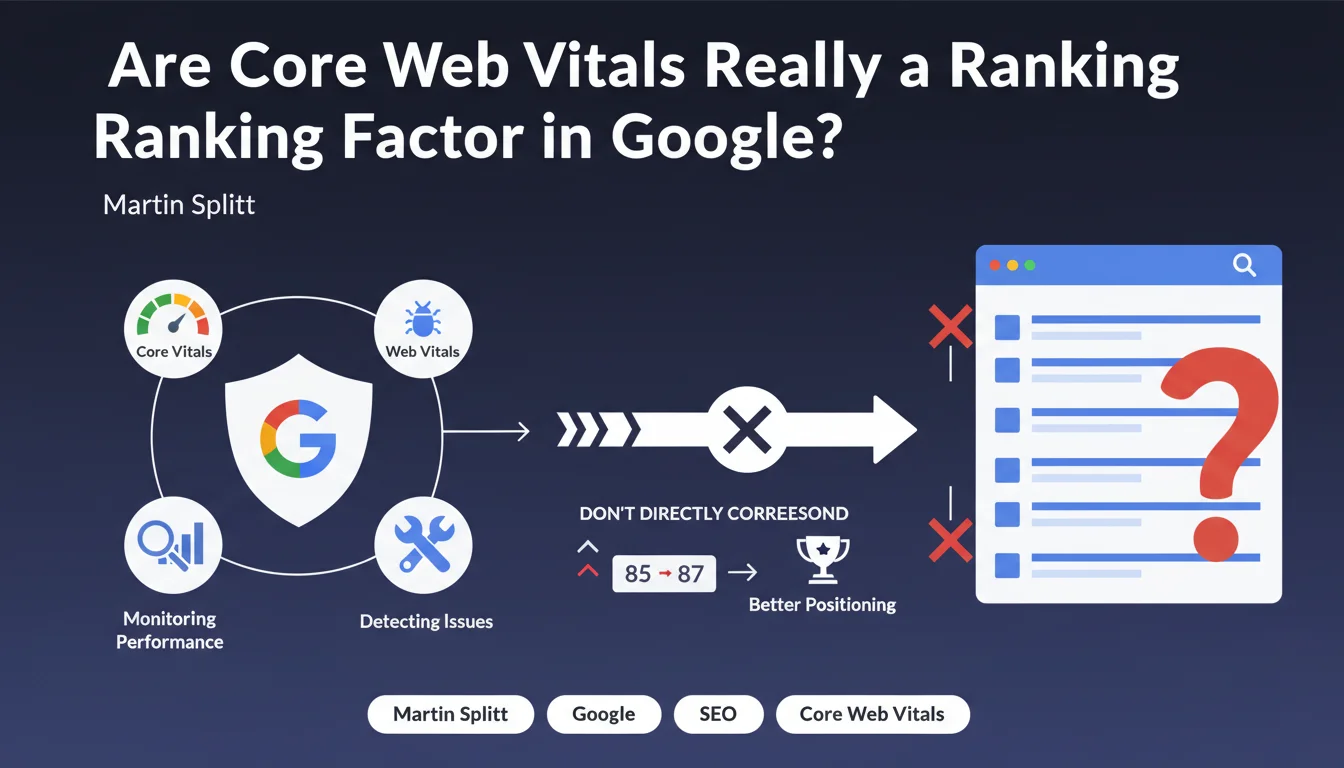
Martin Splitt sets the record straight: Core Web Vitals are not a direct and proportional ranking factor. Moving from 85 to 87 changes nothing in your positioning. Their role is limited to detecting critical performance issues, not mechanically boosting rankings.
What you need to understand
What is the true function of Core Web Vitals according to Google?
Martin Splitt says it plainly: Core Web Vitals are a diagnostic tool, not a direct ranking lever. Their usefulness is concentrated on identifying performance issues that degrade user experience.
Contrary to what many imagine, improving a CWV score by a few points triggers no automatic algorithmic reward. There is no linear correlation between a CWV score and a SERP position.
Why does this confusion persist in the SEO community?
The initial announcement of the Page Experience Update created a major misunderstanding. Google presented Core Web Vitals as a "ranking signal", which naturally led people to believe it had direct weight in the algorithm.
The reality? This signal functions more like a negative filter than a positive multiplier. A catastrophic site can be penalized, but a site that goes from good to excellent gains nothing in terms of pure ranking.
How should you interpret the "good," "needs improvement," and "poor" thresholds?
These thresholds are qualitative indicators for monitoring a site's technical health. Moving from green to dark green changes absolutely nothing on the SEO side.
Google uses these metrics to detect frankly degraded experiences — ones that would make a user leave. Everything else falls under UX optimization, not ranking.
- Core Web Vitals are not proportional to ranking — improving a score by a few points changes nothing in your positions
- Their primary function is diagnostic: spotting critical performance issues
- The thresholds serve to identify degraded experiences, not reward marginal optimizations
- Unlike backlinks or content, there is no "SEO premium" for an ultra-fast site vs a simply fast site
- The confusion stems from the initial announcement that spoke of a "ranking signal" without clarifying its real weight
SEO Expert opinion
Is this statement consistent with what we observe in the field?
Absolutely. Large-scale A/B tests have never demonstrated direct, measurable SEO impact from marginal CWV optimizations. A site that goes from 85 to 95 in LCP sees no statistically significant movement in the SERPs.
On the other hand — and this is where it gets tricky — sites with catastrophic CWV scores (systematically red scores) can indeed suffer a visible penalty. The signal works as a minimum threshold, not as a gradual ladder.
What nuances should be applied to Google's position?
Let's be honest: Martin Splitt simplifies to avoid misunderstandings, but reality is more complex. CWV impacts SEO indirectly through behavioral signals.
A slow site generates more bounces, less session time, less engagement — all signals that Google can interpret as a lack of relevance. [To verify]: Google officially denies using bounce rate, but real-world correlations suggest that something in that direction exists.
Another point: in ultra-competitive sectors where the top 10 results are evenly matched on content, even the smallest differentiating signal counts. Saying CWV serve no purpose in these cases would be a strategic error.
In what contexts does this rule not apply?
First case: e-commerce sites with ultra-competitive product pages. If 50 sites sell exactly the same product with similar descriptions, user experience becomes the only real differentiator. CWV then play an indirect but crucial role.
Second case: mobile searches in geographic areas with poor connectivity. Google has confirmed that mobile speed carries more weight in these contexts — even if it's not strictly related to CWV.
Practical impact and recommendations
What should you concretely do with Core Web Vitals?
Stop chasing micro-optimizations to eke out 2 score points. Focus your efforts on blocking issues: pages that far exceed thresholds, frankly degraded experiences, massive technical errors.
Use CWV as a health dashboard, not as an SEO KPI. If a page turns red, investigate. If it stays green, move on — your time will be better spent on content or internal linking.
What mistakes should you avoid in managing Core Web Vitals?
First common mistake: sacrificing UX or functionality to improve a CWV score. Removing a carousel because it impacts CLS, when it converts, is absurd.
Second mistake: believing that a perfect lab score will translate to a perfect field score. Field data (CrUX) is the only data that matters to Google, and it's unpredictable — you don't control your users' connections.
Third mistake: completely ignoring CWV under the pretext that "it does nothing for SEO." Poor UX = poor conversion rate = business problem, even if Google leaves you alone.
How can you verify that your CWV strategy is balanced?
Ask yourself this question: am I optimizing for Google or for my users? If the answer leans too much toward Google, you're on the wrong track.
Regularly check CrUX data (not local Lighthouse scores). If you're in the green on most of your traffic, move on to something else. If you're in the red, investigate root causes — but don't aim for perfection.
- Monitor Core Web Vitals through Google Search Console and CrUX — not Lighthouse locally
- Identify and fix pages with frankly degraded scores (red)
- Don't waste time optimizing a score from 85 to 95 — no measurable SEO impact
- Prioritize issues that affect real user experience, not theoretical scores
- Use CWV as a diagnostic tool, not as a ranking objective
- Balance CWV and functionality — never sacrifice a conversion for 2 score points
- Focus your SEO resources on content, backlinks, and authority — not marginal CWV micro-optimizations
❓ Frequently Asked Questions
Améliorer mes Core Web Vitals va-t-il améliorer mon classement Google ?
Quel score CWV faut-il viser pour être bien positionné dans Google ?
Les Core Web Vitals sont-ils plus importants sur mobile que sur desktop ?
Dois-je ignorer les Core Web Vitals si je fais du SEO ?
Les données Lighthouse sont-elles fiables pour le SEO ?
🎥 From the same video 11
Other SEO insights extracted from this same Google Search Central video · published on 26/06/2025
🎥 Watch the full video on YouTube →
💬 Comments (0)
Be the first to comment.