
Official statement
Other statements from this video 11 ▾
- □ Le HTML invalide nuit-il vraiment au référencement naturel ?
- □ Pourquoi vos métadonnées cassées sabotent-elles votre SEO sans bloquer l'indexation ?
- □ Les commentaires HTML ont-ils un impact sur le référencement Google ?
- □ Les noms de classes CSS influencent-ils vraiment votre référencement naturel ?
- □ Votre thème WordPress sabote-t-il votre référencement sans que vous le sachiez ?
- □ Les Core Web Vitals sont-ils vraiment un levier de classement dans Google ?
- □ Comment vérifier que JavaScript ne bloque pas l'indexation de votre contenu ?
- □ Pourquoi l'API d'indexation Google reste-t-elle bloquée sur deux types de contenus ?
- □ Angular bénéficie-t-il d'un traitement de faveur chez Google ?
- □ Faut-il vraiment virer tous ces scripts Google de votre site ?
- □ La structure HTML sémantique est-elle vraiment un facteur de compréhension pour Google ?
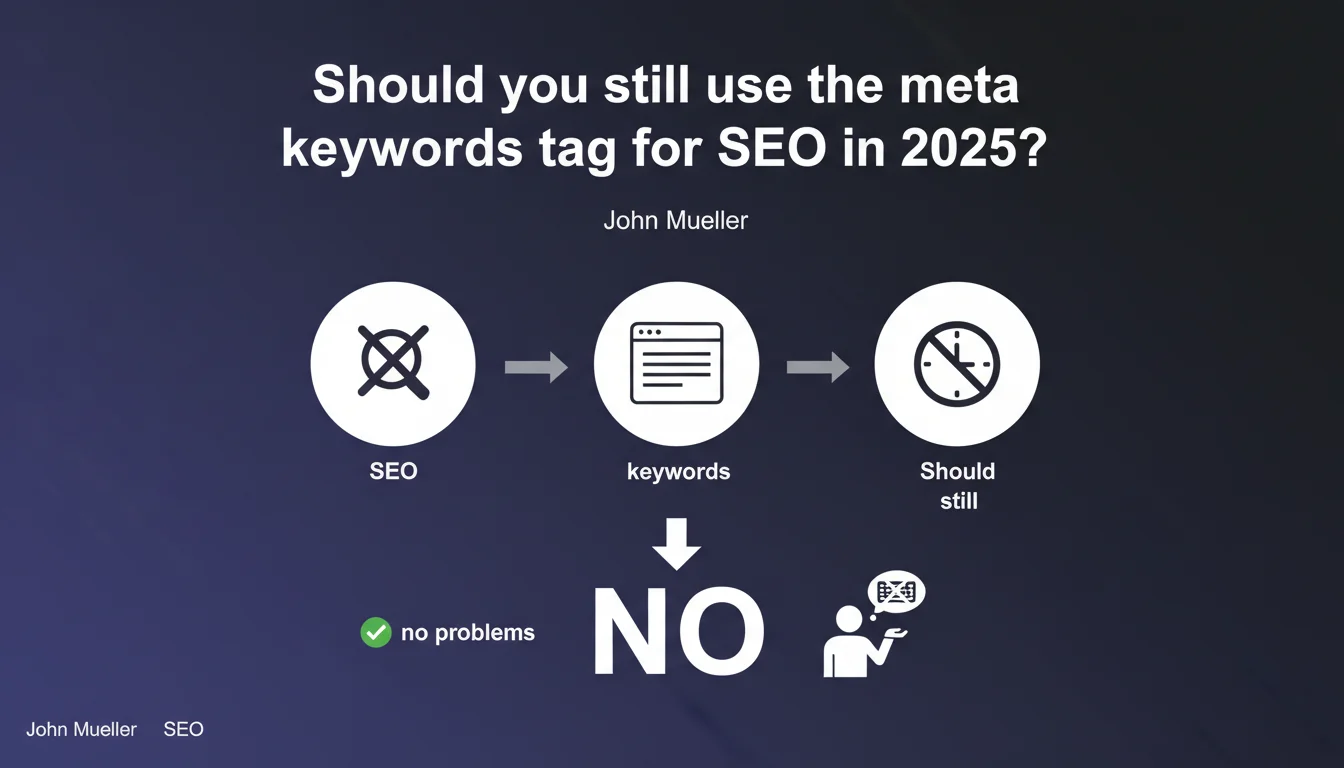
Google confirms that the meta keywords tag has no impact on search rankings. No major search engine uses it in its algorithms. There's no point wasting time filling it out, even though its presence doesn't penalize your site.
What you need to understand
Why did this tag exist and how did we get here?
The meta keywords tag was used in the 1990s to tell search engines the main keywords of a page. Back then, algorithms were rudimentary and relied partly on these indications provided by webmasters.
The problem — and the reason it was abandoned — was massive keyword stuffing. Websites quickly crammed this tag with hundreds of unrelated keywords, transforming a legitimate tool into a spam vector. Google stopped using it in 2009, followed by other major search engines.
What does this mean concretely for my SEO work?
Simple: you can completely ignore this tag in your optimizations. It provides no added value for natural search rankings, neither positive nor negative.
If it's already present on your pages — through an old template or legacy CMS — removing it isn't a priority. But if you have to choose where to invest your time, focus on elements that actually matter: title, meta description, H tag structure, content, internal linking.
- The meta keywords tag has had no impact on Google rankings for over 15 years
- No modern search engine (Google, Bing, Yandex) uses it
- Its presence doesn't cause problems, but managing it is wasted time
- CMSs that generate it automatically pose no issue — there's no need to disable this function if it exists
Is this true for all search engines?
John Mueller states that "no search engine" uses it. This is true for major Western market players: Google, Bing, DuckDuckGo, Yahoo (which uses Bing), Qwant.
Some regional or niche search engines could theoretically still consult it, but no official documentation confirms this. Even Baidu and Yandex, often cited as possible exceptions, have never confirmed using it in their current algorithms.
SEO Expert opinion
Is this statement consistent with what we observe in the field?
Absolutely. For years, empirical tests have shown zero correlation between the presence or content of the meta keywords tag and positioning in the SERPs. Adding, modifying, or removing this tag generates no detectable movement in rankings.
Google's position on this point is clear, consistent, and documented since 2009. Unlike some vague statements about other ranking factors, this one leaves no room for interpretation.
Are there any special cases where this tag could still be useful?
In pure SEO? No. But it can have a use outside of search rankings — and that's where some people get confused.
A few internal site search systems (proprietary search engines, not Google) can be configured to read this tag. Some content analysis or taxonomy tools also use it to categorize pages internally. But these are marginal uses, unrelated to public SEO.
Why do some CMSs continue to offer this field?
Due to technical legacy and inertia. Many WordPress, Joomla, or Drupal templates created before 2010 still include this field by default. Developers haven't removed it because its presence doesn't pose a problem — and removing it could break existing configurations.
Some SEO plugins (Yoast, Rank Math) have simply disabled or hidden this field in their modern interfaces. Others leave it visible but marked as "not recommended" or "obsolete." This is a UX choice question, not an SEO strategy.
Practical impact and recommendations
What should I do if this tag is already on my site?
Nothing. Seriously. If your pages already include a meta keywords tag — filled or empty — leaving it in place doesn't penalize you. Google simply ignores it; it doesn't count toward your crawl budget or page analysis.
Removing this tag won't free up any "SEO resources" and won't change your performance. If you have limited development time, prioritize something else: fix duplicate title tags, improve page load speed, restructure internal linking.
Should I add it to a new site or redesign?
No. There's no valid reason to include it in your HTML code in 2025. If your CMS or template generates it automatically, you can leave it — but don't waste time filling it in manually.
If you're building a site from scratch or choosing a new template, opt for a clean structure that doesn't include obsolete tags. This simplifies your source code and prevents non-SEO teams from asking unnecessary questions later.
- Don't spend any time filling or optimizing the meta keywords tag
- If it already exists on your pages, there's no need to remove it — it has no negative impact
- On a new project, don't add it to the HTML code or templates
- Redirect your energy toward tags that actually matter: title, meta description, H tags, structured data
- Document this point with your clients or management to avoid recurring requests
How do I explain this to a client who insists on filling it in?
Show them Google's official documentation or John Mueller's statement. Explain that filling in this tag is like adding lines to a file that no one reads — technically possible, but with no effect whatsoever.
If the client absolutely wants to "do something" with their keywords, redirect that energy toward useful actions: optimize title tags, enrich content with semantic field, work on internal linking anchors, improve meta descriptions for CTR.
❓ Frequently Asked Questions
La balise meta keywords peut-elle pénaliser mon site si elle contient trop de mots-clés ?
Est-ce que Bing utilise encore la balise meta keywords ?
Certains outils SEO me disent que cette balise manque, dois-je m'inquiéter ?
Si je supprime la balise meta keywords, dois-je faire une redirection ou informer Google ?
Y a-t-il une balise meta alternative qui remplace meta keywords ?
🎥 From the same video 11
Other SEO insights extracted from this same Google Search Central video · published on 26/06/2025
🎥 Watch the full video on YouTube →
💬 Comments (0)
Be the first to comment.