
Official statement
Other statements from this video 11 ▾
- □ Le HTML invalide nuit-il vraiment au référencement naturel ?
- □ Pourquoi vos métadonnées cassées sabotent-elles votre SEO sans bloquer l'indexation ?
- □ Faut-il encore utiliser la balise meta keywords en SEO ?
- □ Les commentaires HTML ont-ils un impact sur le référencement Google ?
- □ Les noms de classes CSS influencent-ils vraiment votre référencement naturel ?
- □ Votre thème WordPress sabote-t-il votre référencement sans que vous le sachiez ?
- □ Les Core Web Vitals sont-ils vraiment un levier de classement dans Google ?
- □ Comment vérifier que JavaScript ne bloque pas l'indexation de votre contenu ?
- □ Angular bénéficie-t-il d'un traitement de faveur chez Google ?
- □ Faut-il vraiment virer tous ces scripts Google de votre site ?
- □ La structure HTML sémantique est-elle vraiment un facteur de compréhension pour Google ?
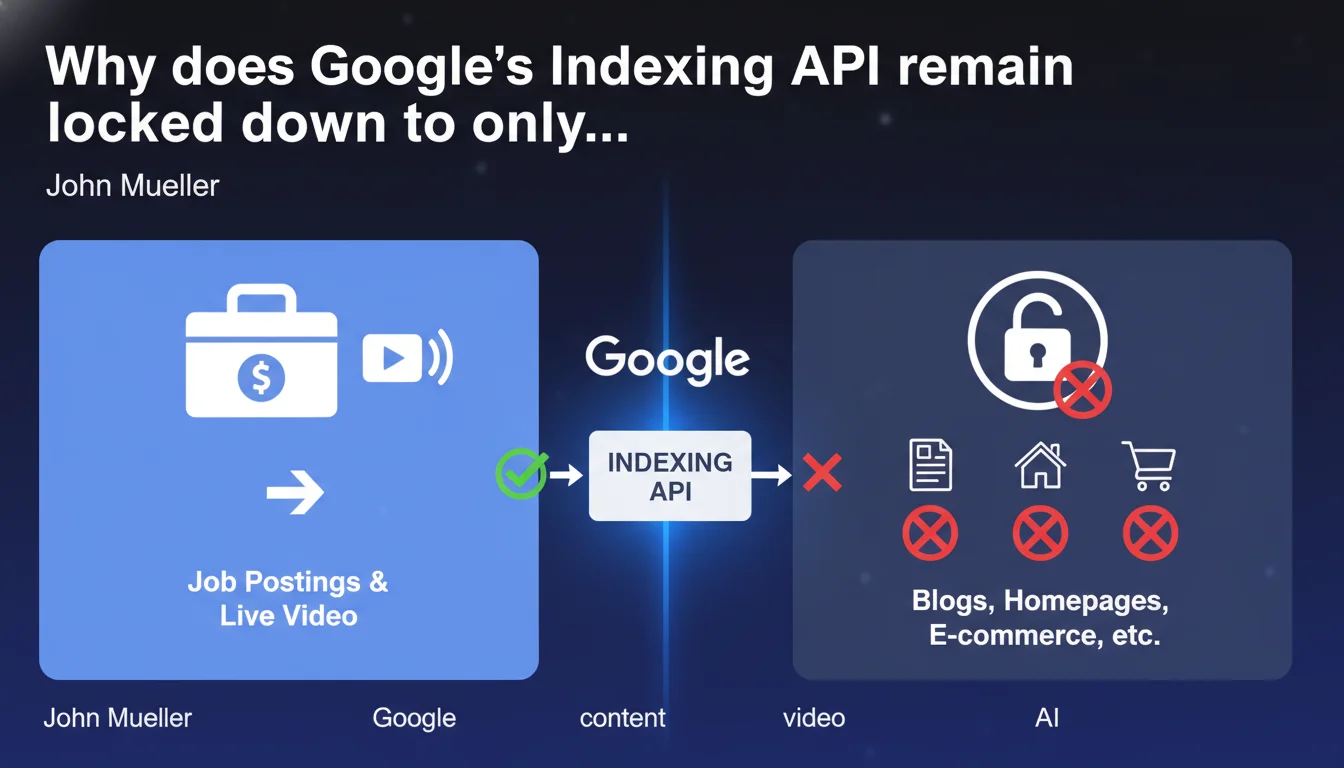
Google's Indexing API works ONLY for job postings and live video broadcasts. Every other content type — blogs, e-commerce, corporate pages — must go through traditional channels. Mueller permanently closes the door on any future expansion of this API.
What you need to understand
What is the Indexing API and why does it exist?
The Indexing API allows you to notify Google immediately when a page appears or disappears. Unlike Search Console where you submit URLs one by one, this API automates the process at scale.
Google created it for content with an extremely short lifespan: a livestream starting in 10 minutes, a job opening expiring tonight. What's the common thread? A relevance window of a few hours, not a few days.
Why does Google limit the API to these two verticals?
Because this content requires near-instantaneous indexing or it loses all value. A blog article published today remains relevant tomorrow — it can wait for natural crawling.
A missed livestream is a permanently lost opportunity. Google therefore prioritizes its resources on cases where indexing latency literally destroys content value.
Does this restriction really apply to all other content?
Yes, without ambiguity. Mueller leaves no gray area: blogs, e-commerce, product pages, news, landing pages — everything that isn't jobs or livestream goes through standard methods.
No exceptions, no workarounds. Even news sites with breaking news must use XML sitemaps and classic crawling.
- Only two content types are eligible for the Indexing API: job postings and livestreams
- Standard content (blogs, e-commerce, corporate) must use XML sitemaps and wait for natural crawling
- Google plans no expansion of this API to other verticals
- The limitation is based on the ultra-short lifespan of these two content types
SEO Expert opinion
Is this restriction consistent with real-world observations?
Absolutely. Since the API's launch, we've observed that attempts to use it outside jobs/livestream systematically fail. Google either rejects the requests or ignores them outright.
Some SEOs attempted to force rapid indexing of e-commerce pages through this API — result: zero measurable impact. The restriction isn't just a recommendation; it's a technical lock.
Why does Google refuse to extend this API to other content?
The official answer: "To prevent abuse." The real-world reality? If Google opened the API to all content, every site would send thousands of notifications daily to accelerate indexing.
The system would collapse under the request volume, eliminating all benefit. Google prefers maintaining crawling based on its own algorithmic priorities rather than ceding control to webmasters.
[To verify] — Google has never published metrics on current API request volume or the real impact on indexing speed compared to standard crawling. We lack hard data to assess actual gains.
Are there workarounds or viable alternatives?
No. Some have tried disguising their pages as fake livestreams or fake job postings to fool the API. Google detects these manipulations through structured data markup analysis and actual content evaluation.
Alternatives remain classic: well-structured XML sitemap, optimized crawl budget, solid internal linking, pings via Search Console. Nothing revolutionary, but this is what actually works.
Practical impact and recommendations
What should you do if you have job postings or livestreams on your site?
Configure the Indexing API via Google Cloud Platform. Implement structured data for JobPosting or BroadcastEvent depending on your case. Automate notifications for each publication, modification, or deletion.
Test thoroughly: a notification sent for a page without proper markup will be ignored. Monitor API error logs to detect rejections.
How do you optimize indexing for all other content?
Return to the fundamentals: clean XML sitemap, submitted via Search Console, updated in real time. Optimize your crawl budget by eliminating unnecessary pages (facets, duplicates, infinite pagination).
Strengthen internal linking so new pages are discovered quickly. A page linked from the homepage or main category will be crawled within hours.
Use Search Console's "Request Indexing" feature for strategic pages — but sparingly (limited daily quota). Reserve it for product launches or critical content.
What mistakes should you absolutely avoid?
Never attempt to use the Indexing API to accelerate indexing of blogs or product pages. You'll waste your time and risk losing your API access.
Don't send API notifications in bulk without verifying that each page has the correct Schema.org markup. Google ignores malformed requests without explicit error notification.
- Verify whether your site publishes job postings or livestreams — the only legitimate use cases for the API
- Implement structured data markup for JobPosting or BroadcastEvent as applicable
- Configure the Indexing API via Google Cloud Platform and automate notifications
- For all other content: optimize XML sitemap, crawl budget, and internal linking
- Use "Request Indexing" manually only for strategic pages
- Monitor API error logs to detect rejections and fix markup issues
❓ Frequently Asked Questions
Puis-je utiliser l'API d'indexation pour mon blog ou mon site e-commerce ?
Que se passe-t-il si j'envoie des URLs de blog via l'API d'indexation ?
Comment accélérer l'indexation de mes nouvelles pages produits sans l'API ?
L'API d'indexation garantit-elle une indexation immédiate des livestreams ?
Google prévoit-il d'étendre l'API à d'autres types de contenus ?
🎥 From the same video 11
Other SEO insights extracted from this same Google Search Central video · published on 26/06/2025
🎥 Watch the full video on YouTube →
💬 Comments (0)
Be the first to comment.