
Official statement
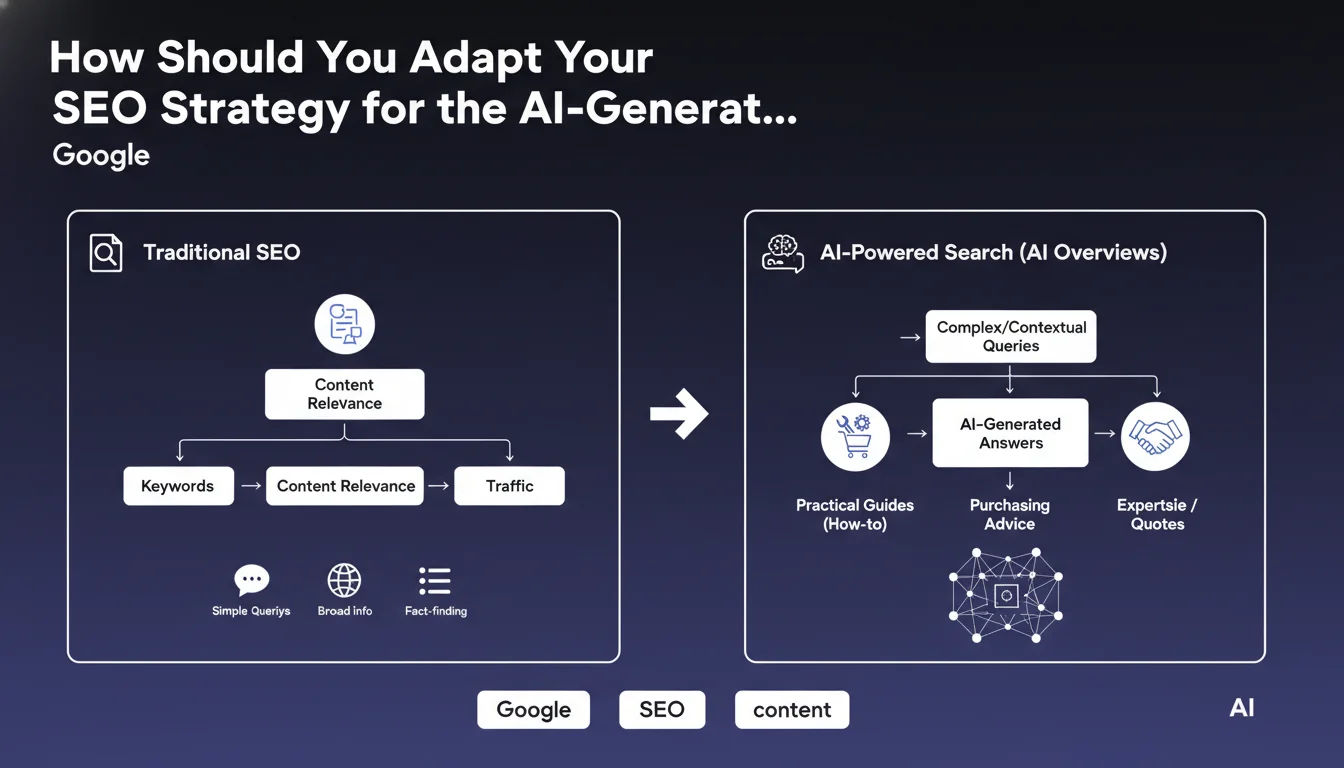
Thus, queries addressed to AI are often more complex and contextual, generally oriented towards practical guides (how to), purchasing advice, or requests for expertise or quotes. Content creators must therefore understand these new uses and adapt their editorial strategies to these intents.
Another necessity: being cited in articles, rankings, public mentions strongly contributes to visibility in AI-generated responses, as the model favors reputable and frequently referenced sources. PR is therefore also a lever for exposure to AI, not just to users.
Finally, reviews can play a role as long as they provide real value. On the other hand, buying reviews has little interest insofar as AI primarily seeks authenticity and relevance, like a human.
What you need to understand
Google officially confirms that the arrival of AI Overviews and AI Mode is transforming the very nature of searches performed by users. Robby Stein, VP of Product at Google Search, specifies that the fundamentals of SEO remain valid, but their application must adapt.
The main evolution lies in the type of queries addressed to AI interfaces. Users now formulate questions that are longer, more complex, and more contextual than before. They seek less simple factual answers than detailed guides, comparisons, or personalized recommendations.
Google highlights three pillars for optimizing visibility in these new result formats:
- Adapt content to complex intents: prioritize practical guides, detailed tutorials, and expert content
- Strengthen brand authority: being cited, mentioned, and referenced in other publications increases the likelihood of appearing in AI responses
- Cultivate authenticity: reviews and testimonials must be genuine, as AI detects and values real relevance
This statement therefore formalizes what many suspected: SEO for AI (sometimes called AEO or GEO) is not a radically new discipline, but a natural evolution that rewards authority, expertise, and content depth.
SEO Expert opinion
This position from Google is perfectly consistent with what we've been observing in the field since the gradual rollout of AI Overviews. The sites that appear in these generated responses are indeed those that combine strong domain authority and deeply structured content.
The mention of digital PR as an SEO lever is particularly interesting. It confirms that the AI algorithm relies on external reputation signals, similar to how the original PageRank functioned. Brands frequently cited in positive contexts benefit from a significant advantage. This puts qualitative link building and digital press relations strategies back at the center of the game.
One important nuance however: this approach mechanically favors established brands at the expense of new entrants. A recent site, even with exceptional content, will struggle to emerge in AI responses without first having built a presence and citations elsewhere on the web. The virtuous (or vicious) circle of brand awareness is thereby reinforced.
Practical impact and recommendations
- Audit your existing content to identify opportunities for transformation into detailed practical guides, step-by-step tutorials, and in-depth "how-to" content
- Develop an editorial strategy targeting complex and conversational queries in your sector (analyze Google suggestions and "People Also Ask")
- Structure your content with clear semantic markup (schema.org, HowTo, FAQ) to facilitate extraction by AI models
- Launch a digital PR campaign to obtain mentions, citations, and backlinks from authoritative sources in your industry
- Identify rankings and comparisons in your sector where your brand should appear, and implement actions to be referenced there
- Create an authentic review program by soliciting your real customers after experience, with a facilitated but never financially incentivized process
- Monitor your presence in AI Overviews for your strategic queries (use dedicated tracking tools)
- Absolutely avoid buying reviews, artificial mentions, or any automated reputation generation system
These optimizations require a comprehensive and coordinated approach affecting editorial production, content marketing, digital public relations, and technical analysis simultaneously. Implementing these levers simultaneously can prove complex to orchestrate in-house, particularly for teams with limited resources. Support from a specialized SEO agency in new search dynamics can significantly accelerate these transformations, by benefiting from cross-functional expertise and tools dedicated to monitoring AI visibility.
💬 Comments (0)
Be the first to comment.