
Official statement
Other statements from this video 11 ▾
- □ Did Google really struggle to understand linking words like 'not' in search queries?
- □ Is Google really optimizing for your search segment, or sacrificing it for others?
- □ Is topical relevance becoming an outdated SEO criterion?
- □ Does Google really apply a balance principle between different site types in its search results?
- □ Is your long-tail keyword strategy already outdated since natural language understanding arrived?
- □ Does Google really favor promoting quality over penalizing mediocrity?
- □ Does Google Really Design Featured Snippets Around Semantic Understanding Rather Than Keyword Matching?
- □ Is E-E-A-T really a ranking factor or just an SEO myth?
- □ Why does Google distrust query volume as a quality indicator?
- □ Are Google's Quality Rater Guidelines really the secret manual for SEO success?
- □ Does Google really prioritize search bugs based on frequency and severity, and what does this mean for your SEO strategy?
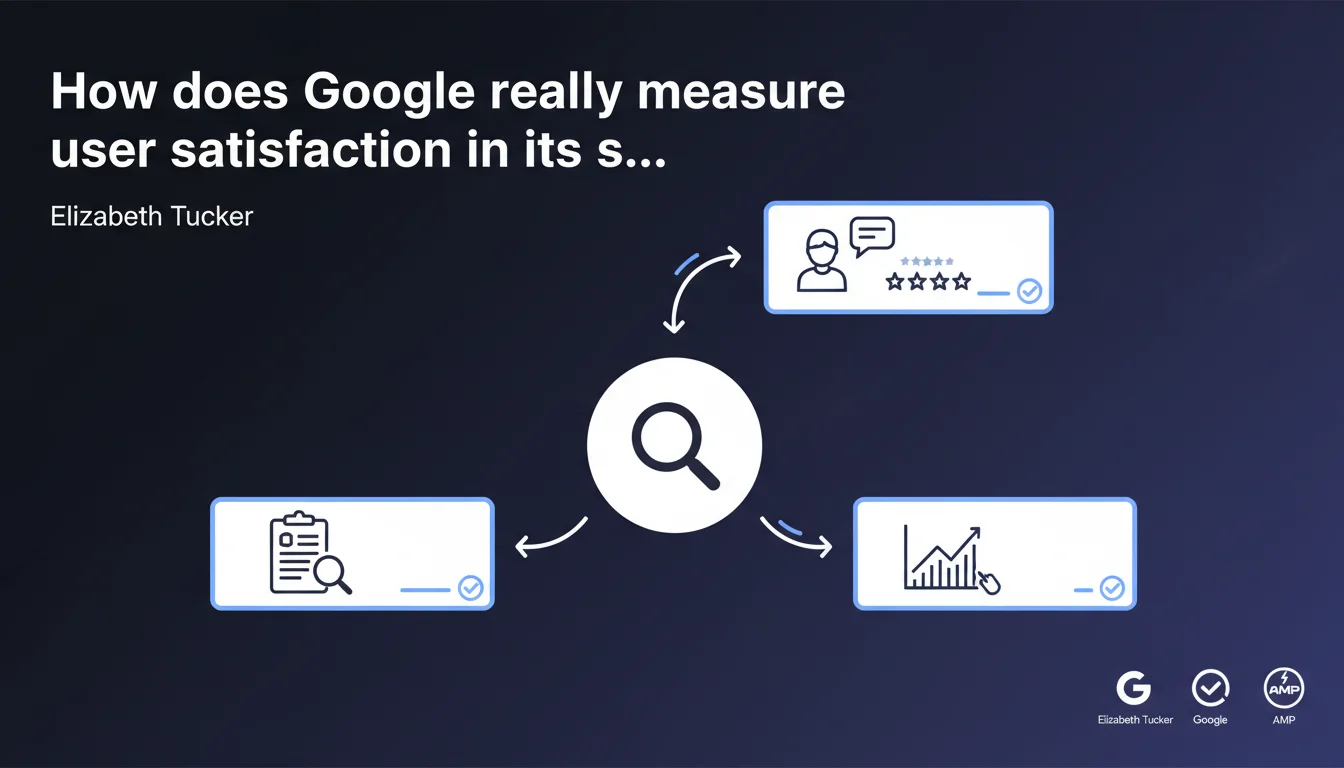
Google combines three approaches to evaluate the quality of its results: direct user surveys, a team of human raters who judge relevance on samples of queries, and behavioral analysis to detect whether internet users actually find what they're looking for. These three axes directly influence rankings — it's not just about blind algorithms.
What you need to understand
What exactly are these three evaluation methods?
Google first uses direct surveys displayed in the SERPs, notably the question "How helpful are these results?". These micro-surveys capture the user's immediate perception of the quality of the results presented.
Next, an army of human raters (the famous Quality Raters) work on samples of queries. They apply the Search Quality Rater Guidelines to judge whether pages truly answer the search intent. This data is used to train and fine-tune algorithms.
Finally, behavioral analysis: Google observes how users interact with results. Clicks, rapid backtracking (pogo-sticking), time spent, query reformulations — all signals that reveal whether someone found satisfaction or not.
Why does Google combine so many sources?
Because no single metric tells the whole truth. A high CTR might simply signal clickbait headlines — not necessarily quality. A long visit duration can indicate engagement... or complete confusion on a poorly designed page.
By crossing these three dimensions, Google builds a more reliable picture of what truly satisfies users. It's also a safeguard against manipulation: it's difficult to fool trained humans, real users, and consistent behavioral patterns simultaneously.
What does this change for a site trying to rank?
It means optimizing solely for the algorithm is no longer sufficient — if it ever was. Google evaluates actual user satisfaction, not just technical or semantic compliance.
Content can check all the classic SEO boxes (keywords, structure, backlinks) and still generate negative behavioral signals if the experience disappoints. Conversely, a page that perfectly answers the intent, even without aggressive optimization, can outperform thanks to positive feedback from users and raters.
- Google doesn't rely only on machines: humans remain at the heart of quality evaluation
- User surveys directly influence Google's perception of SERP relevance
- Behavioral analysis detects signals of post-click satisfaction or dissatisfaction
- These three methods reinforce each other to counter SEO manipulation
- Technically perfect content that disappoints users won't hold up over time
SEO Expert opinion
Is this statement consistent with what we observe in the field?
Yes, and it explains a lot of things. Experienced SEO professionals have long noticed that pages with high bounce rates and low time on page gradually lose positions — even with a solid link profile and keyword-dense content.
The presence of human raters isn't new, but Google now openly insists on their role. This confirms that the Search Quality Rater Guidelines aren't just a communication document: it's a real specification that guides algorithm training. Understanding these guidelines becomes essential — not optional.
What gray areas remain in this explanation?
Google remains deliberately vague about the exact weight of each method. Do the "How helpful" surveys have direct impact on a specific page's ranking, or do they only serve to calibrate the algorithm globally? [To verify]
Behavioral analysis also raises questions: what exact signals are tracked? Dwell time? Query reformulation rate? Click-to-immediate-return ratio? Google never specifies this officially — for good reason, disclosing these metrics would open the door to massive manipulation.
Does this multi-source approach create new optimization angles?
Absolutely. If Google measures satisfaction through behavior AND surveys AND human raters, it means you need to optimize for the post-click experience, not just the click itself.
Concretely: a compelling but misleading headline can drive CTR, but if users leave immediately disappointed, Google will capture these negative signals. Same for technically flawless but unreadable content, poorly structured or not really answering the intent — Quality Raters will penalize it in their assessments.
This rewards sites that really work on UX, information clarity, speed of intent fulfillment. Not just keyword stuffing or link buying.
Practical impact and recommendations
What specifically needs to change in your SEO strategy?
Start by auditing the user experience on your most strategic pages. Use tools like Hotjar or Crazy Egg to observe real behaviors: where people click, how far they scroll, where they leave.
Next, cross-reference with Search Console data: if a page has good CTR but stagnant or declining ranking, it's probably because the post-click experience disappoints. Google captures these signals and adjusts accordingly.
Improve clarity of the answer from the first screens. Users must immediately understand they're in the right place and their answer is coming. No endless introductory rambling — especially on mobile.
How do you align your content with Quality Raters' expectations?
Dive into the Search Quality Rater Guidelines. It's a hefty 170-page document, but it's THE reference for understanding what Google considers quality content.
Special focus on E-E-A-T concepts (Experience, Expertise, Authoritativeness, Trustworthiness). If your content touches health, finance, law — the famous YMYL (Your Money Your Life) — these criteria are scrutinized even more.
Add explicit authority signals: identified author with biography, cited sources, visible update dates, easily accessible contact. These elements reassure both human raters and users.
What critical mistakes must you absolutely avoid?
- Sacrificing readability to stuff keywords — human raters instantly detect artificial content
- Using clickbait headlines that don't match actual content — this generates massive pogo-sticking
- Neglecting mobile: most users browse from smartphones, and poor mobile UX tanks behavioral signals
- Ignoring Core Web Vitals: a slow or unstable page creates frustration, thus measurable negative signals
- Publishing shallow or generic content that doesn't really answer intent — Quality Raters are trained to spot disguised "thin content"
- Hiding important information behind popups or content walls — Google penalizes intrusive interstitials
Google no longer settles for analyzing technical signals alone. User satisfaction measured concretely — through surveys, trained raters, and observable behaviors — is now at the heart of rankings.
This demands a more mature SEO approach: optimize for real experience, not just algorithms. Regularly audit what happens post-click. Align content with Quality Raters' expectations. Ruthlessly track anything generating user frustration.
These cross-cutting optimizations — technical, content, UX, behavioral signals — can quickly become complex to orchestrate alone, especially on large sites. If you want to structure a coherent approach that accounts for these different dimensions, support from a specialized SEO agency can help you prioritize initiatives and avoid dead ends.
❓ Frequently Asked Questions
Les sondages 'How helpful are these results' influencent-ils directement le classement d'une page ?
Peut-on accéder aux évaluations des Quality Raters sur son propre site ?
Quels signaux comportementaux Google utilise-t-il concrètement ?
Un site peut-il bien ranker malgré des signaux comportementaux négatifs ?
Les Quality Raters peuvent-ils pénaliser directement un site ?
🎥 From the same video 11
Other SEO insights extracted from this same Google Search Central video · published on 27/06/2024
🎥 Watch the full video on YouTube →
💬 Comments (0)
Be the first to comment.