
Official statement
Other statements from this video 9 ▾
- □ Does user experience really impact SEO rankings, or just conversions?
- □ Is a high bounce rate really a red flag for your SEO performance?
- □ Is your SEO expertise blinding you to what your users actually need?
- □ Is your site losing traffic because of poor UX? Here's how to know when research is critical for SEO.
- □ Should you really start with heuristic evaluation before testing with real users?
- □ Can cognitive walkthrough really boost your SEO through better user experience?
- □ Why do five users truly unlock 85% of UX problems for SEO professionals?
- □ How can qualitative-quantitative triangulation transform your UX research into a powerful SEO lever?
- □ Why will 100 users never be enough to validate your SEO user experience strategy?
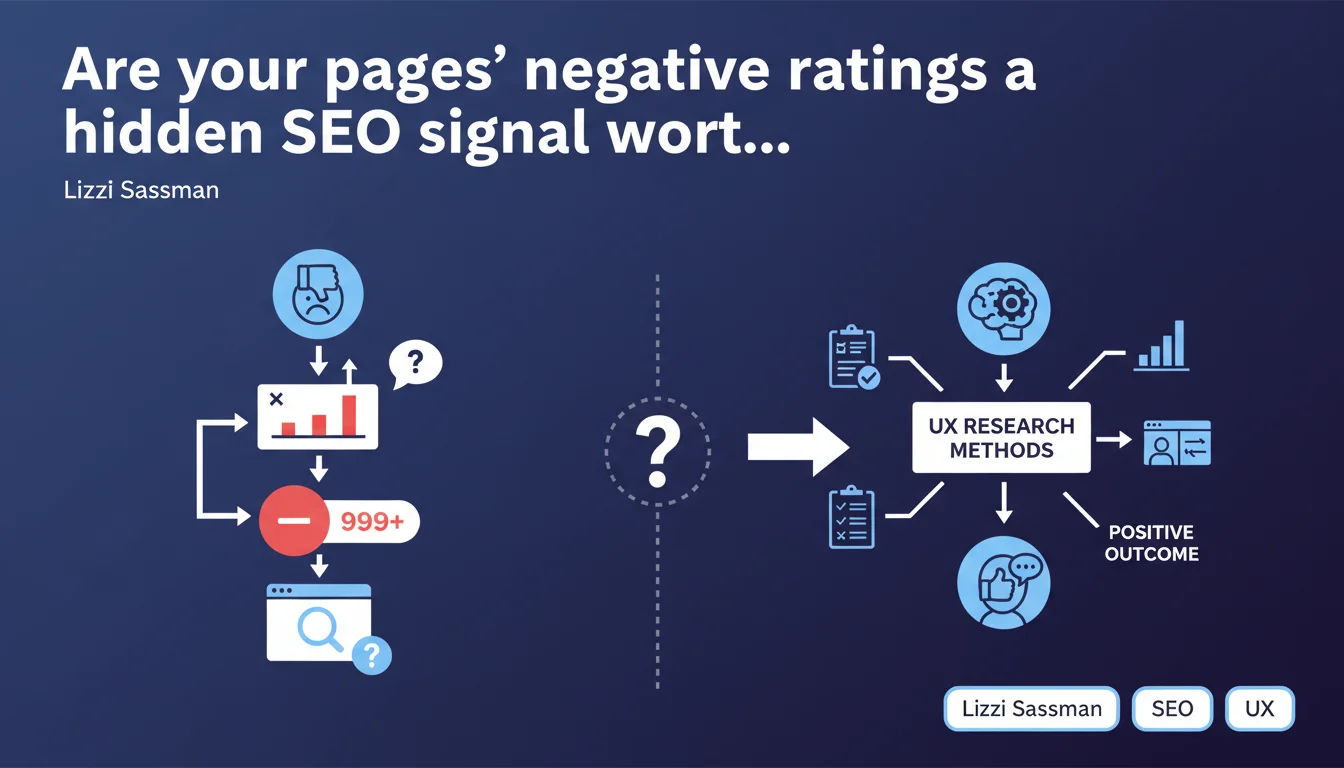
Google confirms that a high rate of negative votes on a page should trigger a thorough UX investigation to identify the root causes of the problem. This user signal, while not directly a ranking criterion, reveals experience issues that can indirectly impact your visibility. The investigation must go through classic UX research methods, not solely through traditional SEO metrics analysis.
What you need to understand
Google introduces an interesting concept here: negative user feedback as a trigger for investigation. This is not a new ranking criterion, but rather an indicator of underlying issues that deserve attention.
The statement remains intentionally vague about exact mechanisms. Are we talking about feedback buttons in SERPs? On-site rating systems? Google doesn't specify, making practical application unclear.
What types of negative ratings is Google referring to?
The phrasing "negative vote button" suggests explicit feedback mechanisms. We naturally think of thumbs-down buttons in certain Google interfaces, but also on-site review systems.
The context lacks technical precision. Are we talking only about signals captured by Google directly, or do we include third-party data like customer reviews, bounce rates, aggregated behavioral signals? The boundary isn't clear.
Why focus on UX research rather than technical SEO?
Google emphasizes UX research methods — user testing, qualitative analysis, interviews. That's a strong signal: the problem isn't necessarily technical (speed, indexing) but related to content-intent alignment.
This focus reveals an evolution in Google's messaging. We're moving from purely algorithmic logic to recognition that certain problems require a human, qualitative approach to be resolved.
- A high rate of negative votes is not a direct ranking criterion, but a symptom to investigate
- Google explicitly recommends UX methods (testing, interviews, observations) rather than purely quantitative analysis
- The statement remains vague about collection mechanisms for these negative ratings
- The focus is on understanding causes rather than immediately fixing symptoms
- This approach assumes satisfaction problems are often qualitative and contextual, not purely technical
SEO Expert opinion
Is this recommendation truly actionable for SEO practitioners?
Let's be honest: Lizzi Sassman's statement stays at surface level. It identifies a problem (high negative votes) and prescribes a generic solution (UX research), without providing a quantitative threshold, precise methodology, or concrete examples. [To verify]: what rate of negative votes should trigger the alert? 5%? 20%? 50%?
On the ground, most sites don't have direct access to Google's feedback data. So we work with proxies: adjusted bounce rate, time on page, pogosticking signals, customer comments, support data. The approach remains relevant, but it requires a data collection and analysis infrastructure that not all sites possess.
Do negative user signals actually impact rankings?
Google has been saying for years that engagement metrics (bounce rate, time on page) are not direct ranking factors. Yet the insistence on investigating negative votes suggests they reveal problems that do impact rankings — inadequate content, poor UX, unmet promises.
The nuance is important: it's not the negative vote that penalizes, it's what it reveals. A page massively rejected by users probably has an issue with intent, quality, or experience — all criteria that clearly appear in the guidelines.
When does this recommendation become counterproductive?
Beware of overinterpretation. Not all negative votes signal a serious SEO problem. Some topics are naturally polarizing (politics, controversial health, finance) and generate rejection regardless of content quality.
Similarly, coordinated attacks or smear campaigns can skew signals. UX investigation costs time and resources — you need to prioritize. If business KPIs (conversions, qualified engagement, revenue) remain solid despite negative votes, the urgency is relative.
Practical impact and recommendations
What should you do concretely when facing a high negative vote rate?
First step: identify the signal source. Are you collecting satisfaction data on-site (surveys, feedback buttons)? Do you have access to Google Business reviews, comments, support feedback? Cross-reference these sources for an aggregated view.
Next, apply classic UX methods. Launch moderated user tests (5 to 8 participants are often enough to identify major issues). Observe real users interacting with the page: where do they get stuck? What generates frustration? Supplement with qualitative interviews to understand unmet expectations.
What mistakes should you avoid during investigation?
Don't limit yourself to quantitative metrics. A high bounce rate or low time-on-page doesn't tell you *why* users reject the page. It's the qualitative approach (verbatims, observations) that reveals root causes.
Also avoid blind fixes. If you make major page changes without understanding the real problem, you risk making things worse. UX investigation must precede optimizations, not follow them.
How do you integrate this recommendation into your SEO workflow?
Add a behavioral monitoring layer to your usual dashboards. Monitor adjusted engagement metrics (actual time on page, scroll depth, interactions), cross-reference them with satisfaction data if you collect it.
Prioritize critical pages: those generating significant organic traffic, strategically important for conversions, or targeting high-value queries. That's where the impact of user dissatisfaction is heaviest.
- Implement a feedback collection system on your key pages (satisfaction buttons, post-visit micro-surveys)
- Identify pages with high dissatisfaction signals: rapid bounces, pogosticking, low engagement, negative reviews
- Launch moderated user tests on these pages to understand causes (5 to 8 participants suffice)
- Supplement with qualitative analysis: interviews, verbatim analysis, session recordings
- Don't fix blindly: validate hypotheses before deploying major changes
- Monitor post-optimization impact on engagement metrics AND business metrics (conversions, revenue)
Google's recommendation is simple in principle: a strong dissatisfaction signal should trigger thorough investigation. But practical implementation requires data collection infrastructure, UX skills, and time — resources not all sites possess internally.
If you're seeing persistent dissatisfaction signals on strategic pages and lack the resources or expertise to investigate effectively, it may be wise to partner with an SEO agency specialized in both technical optimization and qualitative UX approaches. A well-conducted investigation can reveal unsuspected growth levers.
❓ Frequently Asked Questions
Les votes négatifs sur une page impactent-ils directement son classement dans Google ?
Comment Google collecte-t-il les évaluations négatives des utilisateurs ?
Quel taux de votes négatifs doit déclencher une investigation UX ?
Quelles méthodes UX concrètes utiliser pour investiguer ces signaux négatifs ?
Faut-il traiter tous les votes négatifs avec la même urgence ?
🎥 From the same video 9
Other SEO insights extracted from this same Google Search Central video · published on 31/10/2024
🎥 Watch the full video on YouTube →
💬 Comments (0)
Be the first to comment.