
Official statement
Other statements from this video 9 ▾
- □ L'expérience utilisateur impacte-t-elle directement le SEO ou seulement les conversions ?
- □ Le taux de rebond élevé est-il vraiment un signal d'alerte pour votre SEO ?
- □ Pourquoi votre expertise SEO vous aveugle-t-elle face aux vrais besoins de vos utilisateurs ?
- □ Quand faut-il lancer une recherche UX pour améliorer son SEO ?
- □ Les évaluations négatives de vos pages sont-elles un signal SEO à investiguer ?
- □ Le cognitive walkthrough peut-il améliorer le SEO par l'expérience utilisateur ?
- □ Pourquoi cinq utilisateurs suffisent-ils pour une recherche UX efficace en SEO ?
- □ Pourquoi la triangulation qualitative-quantitative transforme-t-elle votre recherche UX en levier SEO ?
- □ Pourquoi 100 utilisateurs ne suffisent jamais pour valider une stratégie d'expérience utilisateur SEO ?
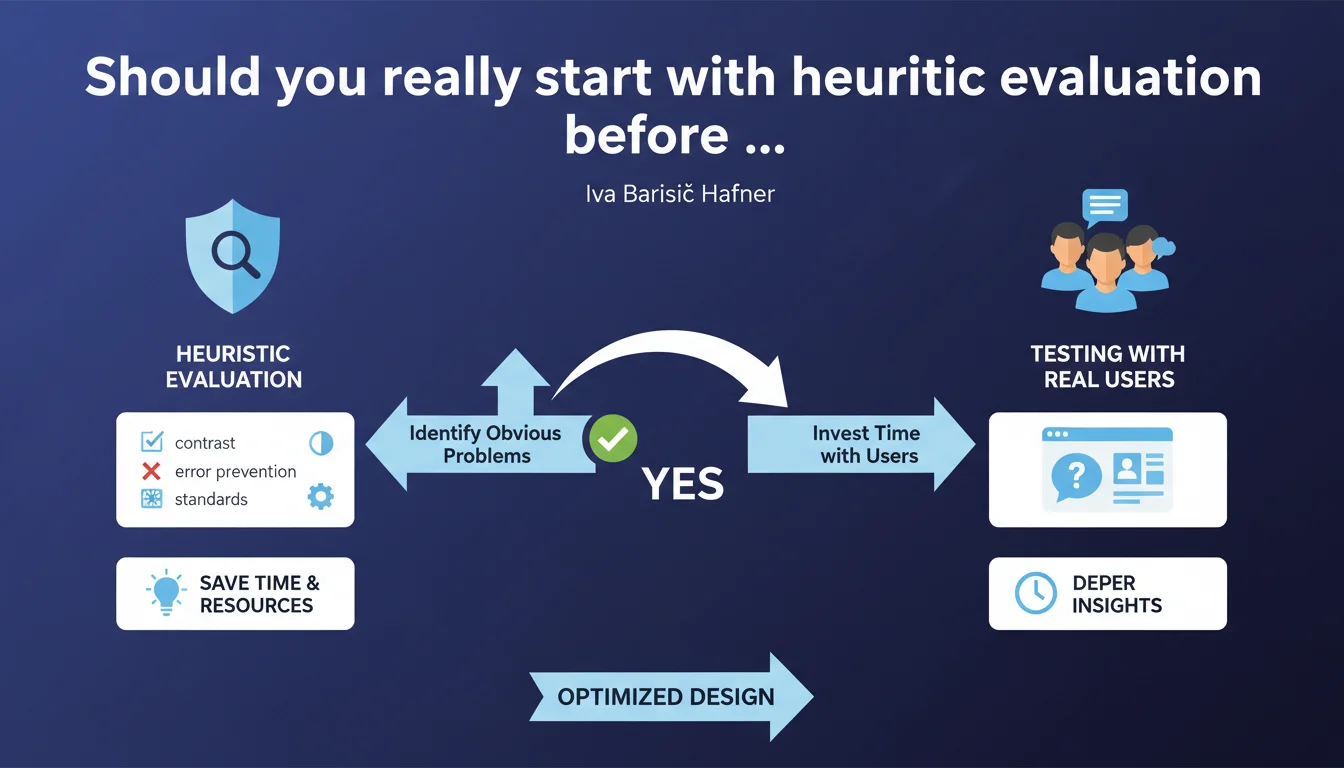
Google recommends using heuristic evaluation — a systematic check against a list of usability standards — before investing time with real users. This approach allows you to identify obvious problems (contrast, error prevention, etc.) quickly and cost-effectively. For SEO, this means that basic user experience must be verifiable and correctable without waiting for field feedback.
What you need to understand
What is heuristic evaluation and why is Google talking about it now?
Heuristic evaluation is a method from UX design where you compare each screen of your site against a list of established usability principles (the "heuristics"). Color contrast, clarity of error messages, navigation consistency — everything that falls under good ergonomic sense but that we often forget in the heat of the moment.
Google is highlighting this approach because it still observes too many sites that fail on obvious fundamentals. Before launching expensive user testing, you might as well fix what's glaringly obvious — and which, incidentally, impacts the UX signals the engine captures via Chrome and Core Web Vitals.
Which heuristic standards really matter for SEO?
Not all usability principles carry the same weight in SEO. Heuristics that affect readability (contrast, font size, visual hierarchy) directly influence time on page and bounce rate. Error prevention — clear forms, understandable warning messages — reduces conversion abandonment, an indirect signal that Google can detect.
Standards of consistency (predictable navigation, repeatable structure) facilitate crawling and indexation. If a bot or a human gets lost in your site architecture, that's bad for everyone. Finally, loading speed and the absence of blocking elements also fall under heuristics — and here, the SEO impact is direct and measurable.
How does this approach differ from traditional user testing?
User testing gives you real behavioral insights: where people click, where they hesitate, what they don't understand. It's powerful but time-consuming and expensive — you have to recruit, observe, analyze.
Heuristic evaluation, on the other hand, is quick and systematic. You take a grid, you audit each page against known standards, you list the shortcomings. No surprises: if your main button is light gray on a white background, you don't need a panel of 20 users to know that's a problem. Google tells you: fix these things first, then refine with real people.
- Heuristic evaluation: quick identification of obvious problems via a standardized checklist
- User testing: behavioral observation to capture subtle friction points and qualitative insights
- Complementarity: heuristics clean up the big bugs, user testing reveals the nuances
- SEO impact: UX signals (time on page, bounce, conversion) depend on both dimensions
SEO Expert opinion
Is this statement consistent with what we observe in the field?
Yes and no. In my practice, I've seen technically flawless sites — impeccable loading times, perfect markup — but with catastrophic ergonomics: invisible buttons, incomprehensible forms, absent visual hierarchy. These sites don't convert and their engagement metrics are abysmal. Google is right to point out heuristics.
But — and here's where it gets tricky — Google says nothing about the weighting of these signals in the algorithm. How much does poor contrast weigh compared to a quality backlink? A mystery. [To verify]: the exact impact of UX heuristics on ranking remains unclear, even though intuition says that an unusable site can't rank well long-term.
What are the limitations of heuristic evaluation in SEO?
Heuristic evaluation is quality control, not strategy. It tells you whether your site meets standards, but it doesn't tell you if those standards match actual audience expectations. A site can be heuristically perfect yet fail to convert because it misses positioning, messaging, or offering.
Another limitation: heuristics are often generic. A mass-market B2C e-commerce site doesn't have the same requirements as a technical B2B portal. If you blindly apply a standard UX checklist, you risk flattening your site and losing what makes it unique. Ergonomics should serve your project, not the other way around.
Do you really need to do this before user testing?
Let's be honest: in an ideal world, yes. In reality, many sites have neither the time nor budget for both. If you have to choose, heuristic evaluation is a good first filter — quick, low-cost, objective. You fix the obvious errors, you improve basic UX signals, and you can already see gains.
But don't stop there. User testing reveals invisible friction points: ambiguous wording, counterintuitive conversion paths, misunderstood features. These insights are strategic and won't come from a checklist. The ideal approach is still to combine both — sequentially or in parallel depending on your resources.
Practical impact and recommendations
What do you actually need to do to conduct an effective heuristic evaluation?
Start by choosing a framework. Nielsen's 10 heuristics are the historical standard (system status visibility, user control, consistency, etc.). You can also adopt WCAG accessibility criteria if your site needs to be compliant, or create your own grid tailored to your industry.
Next, audit all critical user journeys: homepage, category pages, product sheets, forms, checkout funnel. For each screen, note heuristic violations: insufficient contrast, unclear error message, invisible CTA button, inconsistent navigation. Document with screenshots and specific recommendations.
Finally, prioritize. Not all problems are equal. An invisible CTA button on a conversion page is urgent. A typo in the footer is much less so. Rank your findings by business impact and correction cost, and tackle first what delivers the most value for the least effort.
What mistakes to avoid when conducting heuristic evaluation?
First mistake: mechanically applying a checklist without understanding context. A news site and an e-commerce site don't have the same requirements. If you just check boxes, you risk proposing corrections that degrade experience instead of improving it.
Second mistake: ignoring quantitative data. Heuristic evaluation is qualitative. But if you identify a problem on a page converting at 8%, maybe that's not the priority. Always cross your observations with analytics, heatmaps, bounce rates. Numbers will tell you where to focus effort.
Third mistake: not involving your teams. A heuristic audit run by an external consultant who dumps a 50-page PDF ends up in a drawer. Involve devs, designers, marketers from the start. Run workshops, show problems live, co-create solutions. Otherwise, nothing will change.
How do you verify that your site meets basic heuristic standards?
Use automated tools for objective verification: Lighthouse for accessibility and performance, Wave for contrast and semantic structure, Axe for WCAG violations. These tools don't replace human audit but they catch obvious errors.
For everything else, there's no shortcut: spend time on your site. Browse it like an ordinary user. Try to accomplish a key action (buy, sign up, download) without knowing the backend. Note all friction points, all moments of hesitation, all ambiguities. It's hands-on but remarkably effective.
Finally, ask someone unfamiliar with your site to do the same. An outside perspective catches blind spots you can't see anymore from being immersed in it. You don't need a panel of 50 people — three or four opinions are enough to spot recurring problems.
- Choose a heuristic framework suited to your industry (Nielsen, WCAG, custom grid)
- Audit all critical journeys: homepage, categories, product pages, forms, checkout
- Document each violation with screenshot + specific recommendation
- Prioritize by business impact × correction cost
- Use automated tools (Lighthouse, Wave, Axe) for objective checks
- Manually test key journeys in real conditions
- Involve teams from the start to ensure execution
- Cross heuristic observations with analytics data
❓ Frequently Asked Questions
L'évaluation heuristique remplace-t-elle les tests utilisateurs ?
Quel référentiel heuristique utiliser pour un site e-commerce ?
Est-ce que Google pénalise les sites qui ne respectent pas les heuristiques UX ?
Combien de temps prend une évaluation heuristique complète ?
Dois-je refaire une évaluation heuristique après chaque refonte ?
🎥 From the same video 9
Other SEO insights extracted from this same Google Search Central video · published on 31/10/2024
🎥 Watch the full video on YouTube →
💬 Comments (0)
Be the first to comment.