
Official statement
Other statements from this video 9 ▾
- □ L'expérience utilisateur impacte-t-elle directement le SEO ou seulement les conversions ?
- □ Le taux de rebond élevé est-il vraiment un signal d'alerte pour votre SEO ?
- □ Pourquoi votre expertise SEO vous aveugle-t-elle face aux vrais besoins de vos utilisateurs ?
- □ Quand faut-il lancer une recherche UX pour améliorer son SEO ?
- □ Les évaluations négatives de vos pages sont-elles un signal SEO à investiguer ?
- □ Faut-il vraiment commencer par une évaluation heuristique avant de tester avec de vrais utilisateurs ?
- □ Le cognitive walkthrough peut-il améliorer le SEO par l'expérience utilisateur ?
- □ Pourquoi cinq utilisateurs suffisent-ils pour une recherche UX efficace en SEO ?
- □ Pourquoi 100 utilisateurs ne suffisent jamais pour valider une stratégie d'expérience utilisateur SEO ?
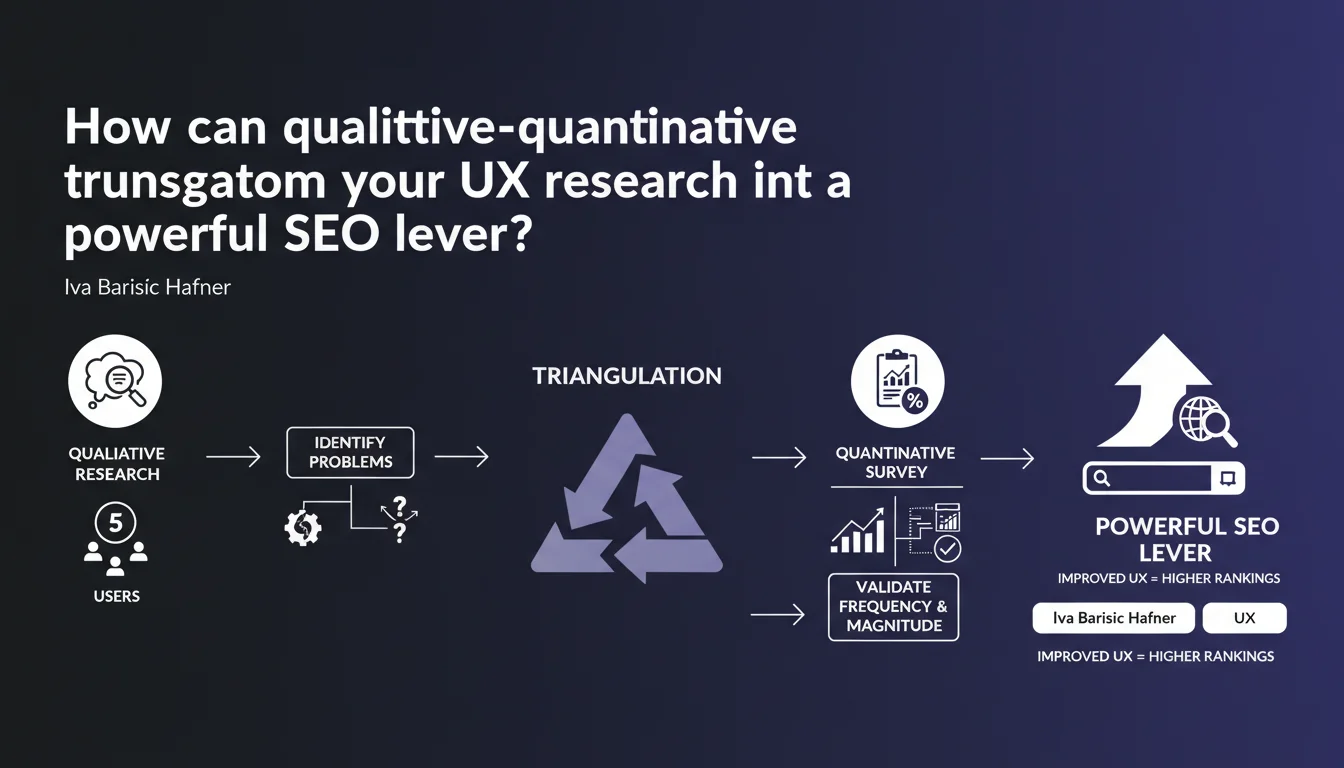
Google recommends combining qualitative research (5 users) and quantitative validation through surveys to identify and measure UX problems. This methodological triangulation allows you to move from field hypotheses to statistically significant data. The approach is presented as a standard for any user experience optimization.
What you need to understand
What is data triangulation in UX research?
Data triangulation involves cross-referencing multiple research methods to validate the same phenomenon. Concretely: you don't just observe 5 users struggling with your conversion funnel — you then quantify this problem through a large-scale survey.
The classic approach? Start with exploratory qualitative (user tests, interviews) to detect friction points, then move to confirmatory quantitative (analytics, surveys) to measure the magnitude of the problem. That's the difference between "3 users abandon at checkout" and "43% of visitors abandon at checkout for the same reasons".
Why does Google insist on "five users"?
The number 5 comes from Jakob Nielsen's work on the economics of UX research. Essentially: 5 user tests reveal approximately 85% of major usability problems. Beyond that, returns diminish — you mostly discover edge cases.
Google adopts this standard as a starting point sufficient to identify problems, not to quantify them. It's a pragmatic threshold: enough to detect, not enough to generalize. Hence the need to follow up with quantitative data.
What is the direct link to SEO?
User engagement signals (bounce rate, time spent, interactions) are part of the quality criteria analyzed by Google. If your UX is broken, your behavioral metrics collapse — and Google detects it.
Triangulation lets you prioritize optimizations with high SEO impact. You don't fix things by guesswork: you know exactly which problems affect how many users, so you can predict the ROI of each fix.
- Qualitative method: identify concrete UX friction points (confusing navigation, invisible CTAs, painful forms)
- Quantitative method: measure the prevalence and impact of these friction points across all traffic
- Triangulation: cross both methods to prioritize optimizations with high SEO and business impact
- Standard of 5 users: minimum threshold to detect 85% of major problems in the exploratory phase
SEO Expert opinion
Does this recommendation really reflect real-world SEO practices?
Let's be honest — how many e-commerce sites actually conduct user testing before launching a redesign? Most settle for Google Analytics, if not just intuition. Google describes here an academic best practice that remains rare in production.
The problem? This approach requires time, budget, and UX research skills that many SEO teams don't have in-house. Result: we optimize based on incomplete data — analytics without qualitative context, or intuitions without statistical validation.
What are the practical limitations of this triangulation?
First pitfall: recruitment bias. Your 5 users may not represent your actual target. If you test with tech early adopters while your audience is mainstream, your qualitative insights will be skewed from the start.
Second point — the quantitative survey that follows must be methodologically sound. Sufficient sample size, unbiased questions, relevant segmentation. Otherwise you're replacing one intuition with false statistical certainty. [To verify]: Google provides no significance threshold for the quantitative phase, which leaves the door open to hasty interpretations.
In what cases does this approach become counterproductive?
On sites with low or highly segmented traffic, the quantitative survey will lack statistical power. You won't have enough respondents per segment to draw reliable conclusions. In this case, it's better to deepen the qualitative — move to 8-10 targeted interviews rather than force a survey that tells you nothing.
Another limitation: pure technical SEO problems (crawl, indexing, structure) don't require UX research. Qualitative-quantitative triangulation concerns user experience, not technical architecture. Confusing the two wastes time on non-issues.
Practical impact and recommendations
How do you concretely implement this triangulation on an SEO project?
First step: frame your qualitative research. Define 2-3 critical journeys (landing page → conversion, internal search → product sheet). Recruit 5 users representative of your target — not your colleagues, not your family. Observe them without intervening, note recurring friction points.
Second step: synthesize detected friction. Group problems by category (navigation, content, forms, speed). Prioritize those appearing in at least 3 out of 5 users — that's your shortlist for the quantitative phase.
Third step: build a targeted survey. Ask closed questions about friction points identified in qualitative. "Did you have difficulty finding [X]?" "Did the form seem too long to you?" Target 100+ responses minimum for basic representativeness.
What mistakes should you avoid in this approach?
Mistake #1: skip the qualitative phase and send a survey directly. Result: you ask the wrong questions, you measure non-problems, you miss real blockers. Qualitative frames quantitative — never the reverse.
Mistake #2: overweight the qualitative. "3 out of 5 users clicked the wrong button" doesn't mean 60% of your traffic does the same. It's a hypothesis to validate, not a statistical truth. Don't launch a complete redesign based on 5 tests.
Mistake #3: neglect technical context. If your site loads in 8 seconds on mobile, UX research will only reveal an obvious fact: users leave. Fix performance issues first before triangulating experience.
How do you verify that this triangulation produces measurable SEO results?
Set up a post-optimization A/B test. Fix the friction points identified, measure the impact on your behavioral KPIs (bounce rate, pages per session, time spent). If your metrics improve significantly, Google will capture these positive signals.
Then monitor ranking variations on your optimized pages. UX improvement doesn't mechanically boost rankings, but it strengthens engagement signals that are part of the overall quality equation.
- Define 2-3 critical user journeys for your SEO strategy
- Recruit 5 users representative of your target — not internal profiles
- Observe without intervening, note recurring friction (appearing in 3+ users)
- Build a targeted quantitative survey on these friction points (100+ respondents minimum)
- Prioritize optimizations based on their measured prevalence in quantitative data
- A/B test corrections to validate impact on behavioral metrics
- Monitor evolution of engagement signals post-optimization
- Never launch a major redesign on qualitative data alone
❓ Frequently Asked Questions
Pourquoi 5 utilisateurs suffisent-ils en phase qualitative ?
Peut-on faire de la triangulation avec Google Analytics uniquement ?
Quelle taille d'échantillon viser pour l'enquête quantitative ?
La recherche UX a-t-elle un impact direct sur les rankings Google ?
Faut-il refaire cette triangulation à chaque modification du site ?
🎥 From the same video 9
Other SEO insights extracted from this same Google Search Central video · published on 31/10/2024
🎥 Watch the full video on YouTube →
💬 Comments (0)
Be the first to comment.