
Official statement
Other statements from this video 9 ▾
- □ Is a high bounce rate really a red flag for your SEO performance?
- □ Is your SEO expertise blinding you to what your users actually need?
- □ Is your site losing traffic because of poor UX? Here's how to know when research is critical for SEO.
- □ Are your pages' negative ratings a hidden SEO signal worth investigating?
- □ Should you really start with heuristic evaluation before testing with real users?
- □ Can cognitive walkthrough really boost your SEO through better user experience?
- □ Why do five users truly unlock 85% of UX problems for SEO professionals?
- □ How can qualitative-quantitative triangulation transform your UX research into a powerful SEO lever?
- □ Why will 100 users never be enough to validate your SEO user experience strategy?
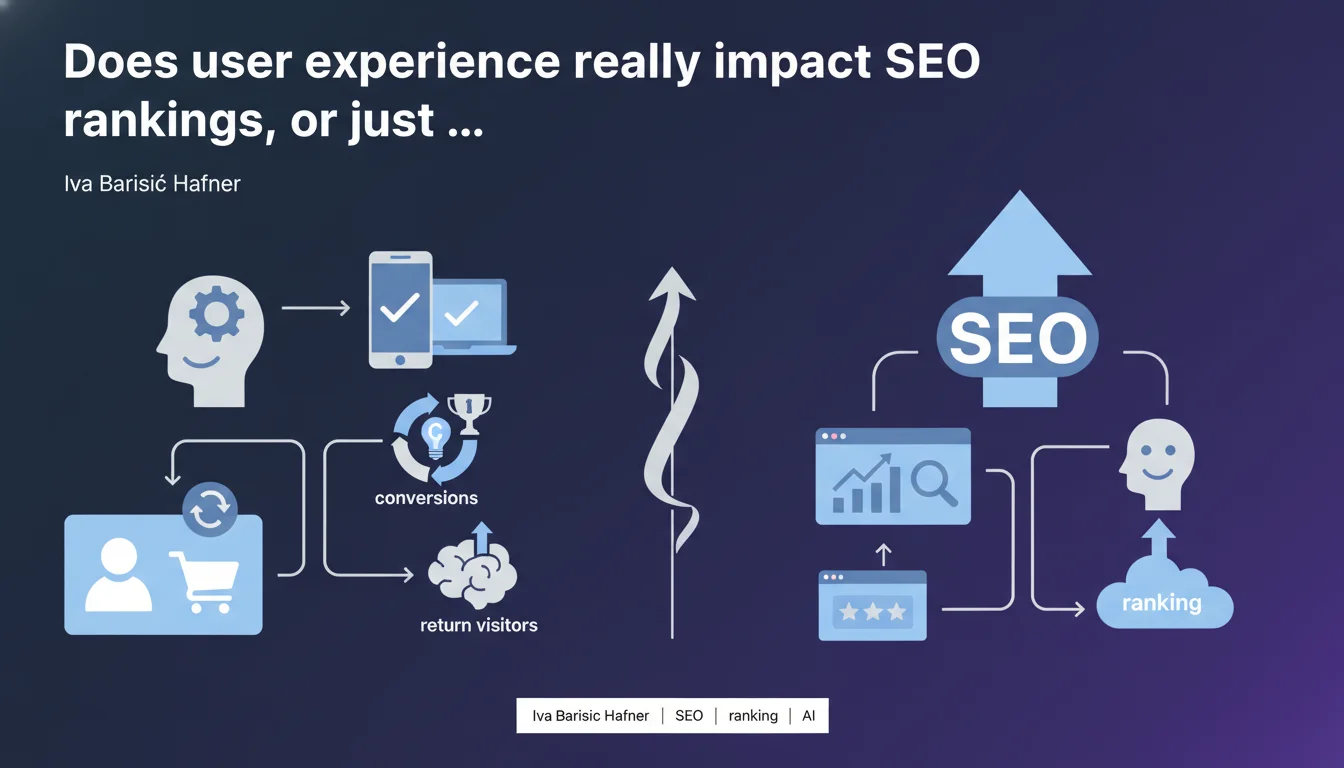
Google states that a frustrating website loses visitors and generates no repeat traffic. UX affects conversions and customer loyalty — two business metrics that, according to Google, are not direct ranking factors. The statement remains vague about the actual link between UX and rankings.
What you need to understand
Does Google say UX is a ranking factor?
No, not explicitly. Iva Barisic Hafner is talking here about conversions and visitor returns, two business metrics. She doesn't mention organic rankings.
The message stays centered on the end goal: a site that frustrates loses its audience. But does Google use these behavioral signals to adjust its search results? The statement doesn't say.
What behavioral signals could Google be using?
We know that Core Web Vitals are integrated into the Page Experience ranking system. Bounce rate, time on page, repeat sessions — Google has access to this data via Chrome and Analytics, but officially denies using them as direct ranking factors.
What's certain: a slow, poorly designed, broken mobile site loses organic visitors even if it ranks well. Fewer clicks, fewer page views, fewer positive signals sent to Google through aggregated user behavior.
Why does this statement remain unclear?
Because Google doesn't want to reveal whether user engagement metrics directly influence rankings. The phrasing "quality of their experience with your product" is generic.
It avoids saying explicitly: "if your bounce rate spikes, you'll lose positions." Yet real-world correlations exist — sites with better UX tend to rank better, but correlation isn't causation.
- UX impacts conversions and loyalty — this is factual and indisputable
- Google doesn't confirm that behavioral signals (bounce rate, dwell time) are direct ranking factors
- Core Web Vitals are the only UX signal officially integrated into ranking
- A frustrating site loses organic traffic even if it ranks — fewer clicks = indirect negative signal
- Google has the data (Chrome, Analytics) but denies using it for ranking
SEO Expert opinion
Is this statement consistent with real-world observations?
Yes, but it brings nothing new to the table. Every SEO professional knows a painful site to use loses its visitors. What's missing is clear confirmation that Google adjusts rankings based on these signals.
Field tests show that sites with better UX tend to perform better — but is it because Google favors them, or because they naturally generate more backlinks, shares, and mentions? Impossible to isolate properly.
What nuances should be added?
Google never says UX directly affects rankings. The statement talks about conversions and returns — business metrics, not SEO. [To verify] — the link between bounce rate and rankings remains a hypothesis, not an established fact.
Let's be honest: if Google used bounce rate as a ranking signal, news sites and recipe sites would be decimated. The user arrives, reads, leaves — mission accomplished. Yet these sites rank very well.
What really matters: Core Web Vitals (officially confirmed), mobile usability (Mobile-Friendly Update), page load speed. The rest — dwell time, pages per session — remains in Google's intentional gray zone.
In what cases does this rule not apply?
A site can have mediocre UX and rank perfectly if it dominates on other criteria: domain authority, massive backlinks, highly relevant content. UX is just one factor among many.
Concrete example: government sites, legacy B2B platforms with 2000s-era interfaces. They rank despite catastrophic UX because they have authority and links. UX becomes critical mainly in competitive niches where everything else is equal.
Practical impact and recommendations
What concrete steps should you take to improve UX for SEO?
Prioritize Core Web Vitals — it's the only UX signal officially integrated into ranking. LCP under 2.5s, FID under 100ms, CLS under 0.1. Use PageSpeed Insights and Search Console to identify problematic pages.
Optimize mobile experience: responsive design, clickable buttons, readable text without zoom. Google now indexes mobile-first — a broken mobile site won't rank, period.
Reduce user friction: aggressive pop-ups (Google penalizes intrusive interstitials), overly long forms, confusing navigation. Each friction point = risk of losing a visitor = fewer positive signals sent to Google.
What mistakes should you avoid?
Don't confuse UX and SEO. A beautiful site with smooth animations but zero semantic structure, missing H1 tags, broken internal linking — won't rank. UX without solid SEO foundations is pointless.
Avoid believing that Google tracks your Analytics bounce rate to adjust your rankings. [To verify] — no official confirmation. Focus on what's proven: speed, mobile, Core Web Vitals.
How do you verify your site meets Google's UX criteria?
Run a complete Core Web Vitals audit via Search Console. Identify "Poor URLs" and prioritize fixing those that drive traffic.
Test your site on real mobile devices, not just Chrome responsive mode. Touch bugs, too-small elements, broken mobile redirects — they're only visible in real conditions.
- Audit your Core Web Vitals via Search Console and PageSpeed Insights
- Optimize LCP (lazy load images, CDN, browser cache)
- Reduce CLS (reserve space for images/ads, avoid dynamic top-of-page injections)
- Remove or lighten intrusive interstitials (full-screen pop-ups on load)
- Verify mobile experience: button size, spacing, readability without zoom
- Test user journey: time to reach key info, navigation clarity
- Analyze pages with high bounce rates — content or UX problem?
- Measure perceived load time (First Contentful Paint) and optimize critical rendering path
User experience clearly impacts conversions and loyalty — that's indisputable. Its direct effect on rankings remains unclear, except for Core Web Vitals (officially confirmed). Focus your efforts on what's proven: speed, mobile, usability.
Don't neglect UX under the pretense that it's not a direct ranking factor — a frustrating site loses visitors, so organic traffic collapses over time. But don't sacrifice your SEO foundations (structure, content, links) for slick animations either.
These optimizations — Core Web Vitals, mobile overhaul, user journey improvement — often require cross-functional skills (dev, UX, SEO). If your team lacks resources or expertise, working with a specialized SEO agency can accelerate results and prevent costly mistakes. Personalized guidance helps you prioritize projects based on their real impact on your traffic and conversions.
❓ Frequently Asked Questions
L'expérience utilisateur est-elle un facteur de classement direct ?
Google utilise-t-il le taux de rebond pour ajuster les rankings ?
Quels signaux UX impactent réellement le SEO ?
Un site avec mauvaise UX peut-il quand même bien ranker ?
Faut-il prioriser l'UX ou les fondations SEO classiques ?
🎥 From the same video 9
Other SEO insights extracted from this same Google Search Central video · published on 31/10/2024
🎥 Watch the full video on YouTube →
💬 Comments (0)
Be the first to comment.