
Official statement
Other statements from this video 11 ▾
- □ Did Google really struggle to understand linking words like 'not' in search queries?
- □ Is Google really optimizing for your search segment, or sacrificing it for others?
- □ Is topical relevance becoming an outdated SEO criterion?
- □ Is your long-tail keyword strategy already outdated since natural language understanding arrived?
- □ Does Google really favor promoting quality over penalizing mediocrity?
- □ Does Google Really Design Featured Snippets Around Semantic Understanding Rather Than Keyword Matching?
- □ How does Google really measure user satisfaction in its search results?
- □ Is E-E-A-T really a ranking factor or just an SEO myth?
- □ Why does Google distrust query volume as a quality indicator?
- □ Are Google's Quality Rater Guidelines really the secret manual for SEO success?
- □ Does Google really prioritize search bugs based on frequency and severity, and what does this mean for your SEO strategy?
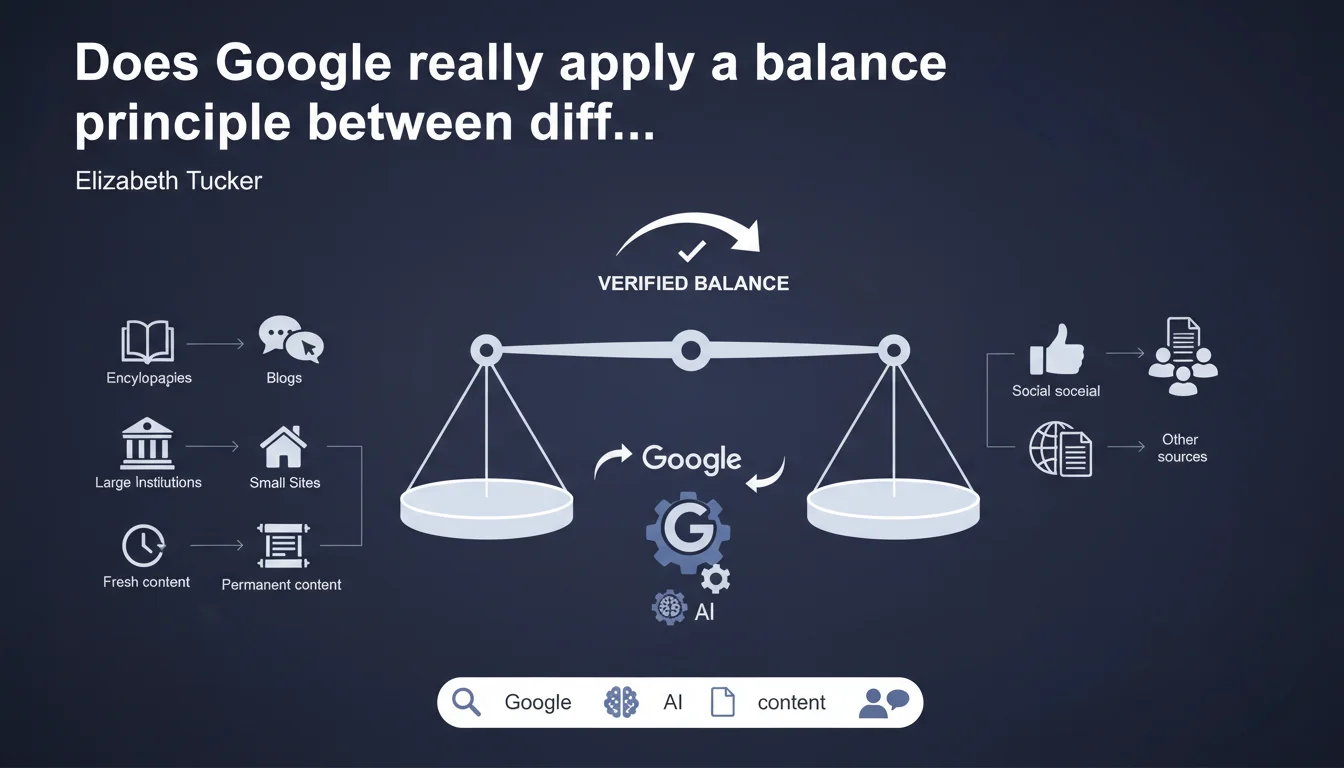
Google claims to actively monitor SERP balance to prevent any single site type (encyclopedias, institutions, blogs, social networks) from dominating excessively. This statement suggests the existence of regulatory mechanisms that temper systemic biases, but remains vague about the thresholds and criteria applied.
What you need to understand
What does this balance monitoring mean in concrete terms?
Google indicates that its systems analyze the distribution of formats in search results to detect glaring imbalances. The stated objective: prevent any single category from monopolizing the space without editorial legitimacy. For example, if all top 10 results for an informational query point to encyclopedias, a corrective would be applied to diversify.
This approach suggests an algorithmic arbitration between raw relevance and structural diversity. In other words, a small niche blog could gain visibility against Wikipedia if the overall balance tips too heavily toward encyclopedias for that query.
Which types of sites are affected by this logic?
Google explicitly mentions four diversity axes: encyclopedias vs blogs, large institutions vs small sites, fresh content vs permanent content, social media vs other sources. These binaries reveal the internal classification criteria that the algorithm mobilizes.
Each query would trigger a contextual evaluation. Breaking news would favor fresh content, but not to the point of completely excluding in-depth permanent analyses. A technical question could prioritize specialized forums over mainstream media — if the overall balance demands it.
- Balance varies by intent: informational, transactional, navigational
- No format enjoys permanent structural advantage, everything depends on query context
- Small sites theoretically retain a chance if their niche compensates for the over-representation of major players
- Freshness doesn't systematically crush evergreen reference content
Does this mechanism contradict other ranking signals?
Not necessarily. Balance acts as a second-order corrective, applied after standard signals (E-E-A-T, backlinks, UX). If the raw top 10 generates a marked bias, the system injects diversity — without promoting mediocre content in the process.
This principle echoes the logic of query deserves diversity (QDD), but applied to formats rather than intents. Google seeks to prevent any structural typology from cannibalizing user experience, even if that typology legitimately dominates through its metrics.
SEO Expert opinion
Is this statement consistent with on-the-ground observations?
Frankly, it's hard to verify. SEO professionals regularly observe monopolistic dominations: Wikipedia crushes certain informational queries, Reddit dominates entire verticals, aggregators control transactional searches. If a rebalancing mechanism exists, its effects remain invisible or highly selective.
Cases where a small blog manages to appear alongside giants usually stem from hyper-specialized thematic focus or exceptional editorial freshness — not charitable algorithmic arbitration. [To verify]: the existence of a quantified threshold triggering this rebalancing has never been publicly documented.
What nuances should be added to this claim?
First point: balance doesn't mean forced equality. Google doesn't distribute positions by quota. If encyclopedias dominate, it's often because they better meet E-E-A-T criteria for broad queries. The corrective only applies when this domination becomes disproportionate to actual utility.
Second nuance: this monitoring likely concerns ambiguous or generic queries, not ultra-specialized niches where one format naturally prevails. A specialized technical search may legitimately return only forums — no artificial rebalancing would inject a mainstream news article there.
In what cases does this rule probably not apply?
Navigational queries logically escape this mechanism — searching "Facebook" must return Facebook, not a blog analyzing Facebook. Transactional queries with clear commercial intent will always prioritize e-commerce sites, even if it creates an obvious structural bias.
Similarly, ultra-fresh searches tied to breaking news naturally favor media outlets over permanent content — balance yields to immediacy. Let's be honest: this principle mostly resembles a safeguard for broad informational queries, where format diversity objectively improves user experience.
Practical impact and recommendations
What should you concretely do to benefit from this balance?
First strategy: exploit blind spots in dominant formats. If your niche is saturated with encyclopedias, produce experiential content, field reports, practical case studies that these factual sources don't cover. Google might favor this complementarity if it improves overall diversity.
Second lever: mix freshness and permanence. Regularly update your evergreen content to signal active maintenance, while preserving its structural depth. An in-depth article regularly updated combines the advantages of both categories.
Third axis: assert your typology clearly. If you're a small expert site, don't try to mimic the institutional tone of major players — own your distinct editorial positioning. Format signals (schema markup, editorial structure, publication frequency) help Google classify you correctly.
What mistakes should you avoid with this mechanism?
Don't sacrifice quality for artificial diversification. Creating a corporate blog just to "diversify your format" when your expertise lies in technical guides won't fool anyone. The balance Google seeks concerns the global ecosystem, not your isolated site.
Also avoid over-interpreting your fluctuations. If you lose positions, first verify fundamentals (technical, content, backlinks) before invoking a hypothetical format rebalancing. This principle remains marginal against standard ranking signals.
- Identify dominant formats on your target queries and analyze their editorial gaps
- Produce content that structurally complements what already exists, rather than duplicating it
- Maintain a clear editorial identity rather than imitating competing formats
- Regularly update your permanent content to combine freshness and depth
- Monitor the format distribution in SERP for your strategic queries
- Never neglect E-E-A-T fundamentals in pursuit of hypothetical diversity premiums
How can you measure if this principle impacts you positively or negatively?
Analyze your direct competitors by format. If you're a blog and you advance against encyclopedias on certain queries, document these cases — they could reveal the mechanism at work. Conversely, if a different-format site suddenly surpasses you without obvious editorial improvements, the rebalancing hypothesis becomes plausible.
Also track the composition of SERP over time. Format distribution variations without correlation to major algorithm updates can signal this system in action. That said, this analysis remains speculative until Google discloses transparent metrics.
❓ Frequently Asked Questions
Google favorise-t-il automatiquement les petits sites face aux gros acteurs ?
Ce mécanisme s'applique-t-il à toutes les requêtes ?
Peut-on manipuler ce système en changeant artificiellement de format ?
Comment savoir si mes fluctuations de positions sont liées à ce mécanisme ?
Ce principe contredit-il la domination observable de Wikipedia et Reddit ?
🎥 From the same video 11
Other SEO insights extracted from this same Google Search Central video · published on 27/06/2024
🎥 Watch the full video on YouTube →
💬 Comments (0)
Be the first to comment.