
Official statement
Other statements from this video 16 ▾
- □ Does Google really apply the same weight to every single one of your backlinks?
- □ Does the position of internal links really impact your SEO rankings?
- □ Does Google really categorize websites into rigid, fixed types?
- □ Does NAP consistency really impact local SEO rankings, or is it just about the Knowledge Graph?
- □ Is Your Business Data Contradicting Itself? How Conflicting Information Between Your Website and Google Business Profile Hurts Your Local SEO
- □ Are reciprocal links really risk-free for your SEO strategy?
- □ Does keyword frequency really influence your Google rankings?
- □ Should you really clean up ALL hacked pages or can you let Google sort them out?
- □ Why does Google refuse to index part of your site even when it's technically perfect?
- □ Do emojis in title tags and meta descriptions really boost your SEO rankings?
- □ Does the Search Console API really show the exact same data as your web interface?
- □ Why aren't your FAQs showing up in rich results despite correct markup?
- □ Should you really reuse the same URL for seasonal pages every year?
- □ Do Core Web Vitals really have no impact on crawling and indexation?
- □ Does Google really reset your site's evaluation when migrating from a subdomain to a primary domain?
- □ Are geo-redirects really blocking your content from getting indexed by Google?
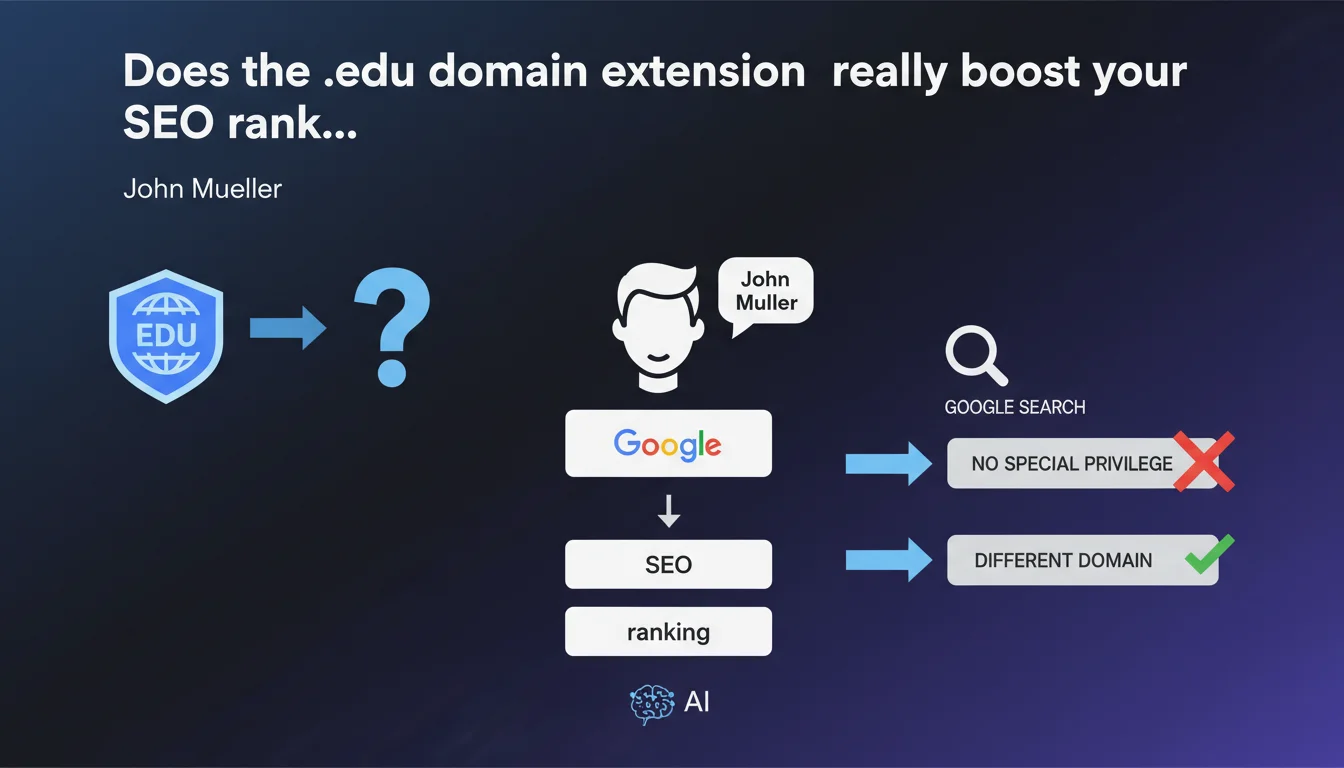
Google does not give preferential treatment to .edu TLDs in its rankings. Contrary to popular belief, this suffix offers no SEO advantage, even for education-related queries. Google treats .edu like any other domain.
What you need to understand
Why does this belief persist in the SEO community?
The idea that .edu domains benefit from a trust bonus comes from several decades of field observations. Educational websites often hold strong positions on competitive queries — but correlation is not causation.
The real factor? These institutions naturally accumulate high-quality backlinks, publish dense and referenced academic content, and enjoy authority built over a long time. It's not the TLD that drives the ranking, it's the ecosystem surrounding it.
What exactly does John Mueller say about this?
Mueller is clear-cut: Google considers .edu as simply a different domain, with no special privilege. No preferential filter, no boost on educational queries, nothing.
This position fits into a broader logic: Google has always claimed to evaluate sites on their intrinsic quality signals (content, links, E-E-A-T), not on superficial markers like domain extension.
Does this neutrality apply to all restrictive TLDs?
The question arises for .gov, .mil, and other restricted-access extensions. While Google confirms nothing officially, field observations show that these domains benefit from implicit trust — but again, this is probably linked to their nature (official sites) rather than the TLD itself.
For .edu specifically, the restricted access (reserved for accredited institutions in the United States) does not translate into any direct algorithmic advantage. This is a point Mueller clarifies unambiguously.
- Google gives no ranking bonus to .edu domains
- The SEO performance of educational sites is explained by classic quality factors (content, links, authority)
- The .edu TLD is treated as any other extension by the algorithm
- This rule applies even for education-related queries
SEO Expert opinion
Is this position consistent with what we observe in the field?
Let's be honest: yes and no. On paper, Mueller's statement holds up. We can verify that a poorly optimized .edu, with thin content and few links, won't rank better than a .com of equivalent quality.
The problem is that in real life, .edu domains are rarely in this configuration. They accumulate natural links over decades, benefit from offline notoriety that translates into direct searches, and often publish content that checks all the E-E-A-T boxes. It's hard to separate fact from fiction.
What nuances should be added to this statement?
First point: selection bias. In the United States, obtaining a .edu requires official accreditation. This entry filter guarantees a minimum level of institutional credibility. Result: even without algorithmic boost, the .edu indirectly signals a certain legitimacy.
Second point: user behavior. Faced with two equivalent results, many will instinctively prefer the .edu domain for academic information. This higher click-through rate can, over time, strengthen positions — but this is an indirect effect, not a ranking factor.
Third point: [To be verified] — we lack granular data on how Google treats restrictive TLDs in its trust systems. Mueller's statement concerns ranking, but what about PageRank propagation, spam resistance, or E-E-A-T evaluation? No transparency there.
In what cases might this rule not apply?
If you operate in a context where Google applies geographic or contextual filters, the TLD can play a role — but not because it's a .edu. For example, for a query localized to the United States, Google might prioritize results from American institutions, which would mechanically favor .edu domains.
Similarly, if Google detects a strong informational intent (academic definition, primary source), it could indirectly over-represent .edu domains — not through a TLD boost, but because these sites better answer the intent. A subtle distinction, but a critical one.
Practical impact and recommendations
Should you rethink your linking strategy toward .edu domains?
If your approach consists of hunting .edu domains solely for their extension, yes, you probably need to reconsider. What matters is the relevance of the link, the real authority of the source site, and the editorial context — not the domain suffix.
That said, a link from a quality .edu remains valuable — but for the right reasons. High-authority page, qualified traffic, strong thematic signal. The TLD is just a proxy indicator, not a metric in itself.
What mistakes should you avoid when evaluating your backlinks?
First mistake: overweighting superficial metrics. A .edu with a DA of 90 but no organic traffic and a suspicious link profile is worth nothing. Look beyond the extension.
Second mistake: neglecting .com or .org niche domains that, in your sector, have more real authority than a generic .edu. Education doesn't mean automatic relevance for all topics.
Third mistake: paying for .edu links under the assumption that they «count more». Google detects these schemes, and Mueller has been clear on the subject multiple times: paid links violate guidelines, regardless of the TLD.
How do you optimize your educational link-building approach?
Prioritize authentic partnerships: case studies with universities, research sponsorships, contributions to academic publications. These initiatives generate natural links, often from high-authority thematic pages.
Leverage open academic resources: many universities maintain curated lists of resources in their field. Propose quality content that deserves to be listed — without financial compensation.
- Evaluate your .edu backlinks on their intrinsic quality, not their extension
- Focus on thematic relevance rather than TLD
- Diversify your sources: don't neglect quality .org, .com, or ccTLDs
- Avoid paid link platforms that promise easy .edu links
- Document the real impact of each link on your traffic and rankings
- Build lasting partnerships with relevant institutions in your niche
❓ Frequently Asked Questions
Un lien .edu a-t-il plus de valeur qu'un lien .com ?
Dois-je arrêter de cibler les backlinks depuis des sites éducatifs ?
Le .edu aide-t-il au moins pour des requêtes liées à l'éducation ?
Les autres TLD restrictifs (.gov, .mil) fonctionnent-ils différemment ?
Comment évaluer la vraie valeur d'un backlink .edu ?
🎥 From the same video 16
Other SEO insights extracted from this same Google Search Central video · published on 30/01/2022
🎥 Watch the full video on YouTube →
💬 Comments (0)
Be the first to comment.