
Official statement
Other statements from this video 13 ▾
- □ Can you manage multiple websites without triggering SEO penalties?
- □ Does the dash vs underscore distinction in URLs really impact your SEO rankings?
- □ Does noindex follow really guarantee that Google will explore your internal links?
- □ Does Google Really Ignore URL Fragments with # for SEO Rankings?
- □ Do short 503 errors really impact your site's crawl rate?
- □ Why is noindex more effective than robots.txt for hiding a site from Google?
- □ Is the Indexing API really restricted to job postings and events only?
- □ Should you really ban text embedded directly in images?
- □ Does having duplicate burger menus in your DOM hurt your SEO rankings?
- □ Can you really target multiple countries with a single page using hreflang?
- □ Do external 404 errors really hurt your Google rankings?
- □ Do you really need a sitemap.xml to rank well on Google?
- □ Should you really abandon separate mobile URLs (m-dot) for better SEO results?
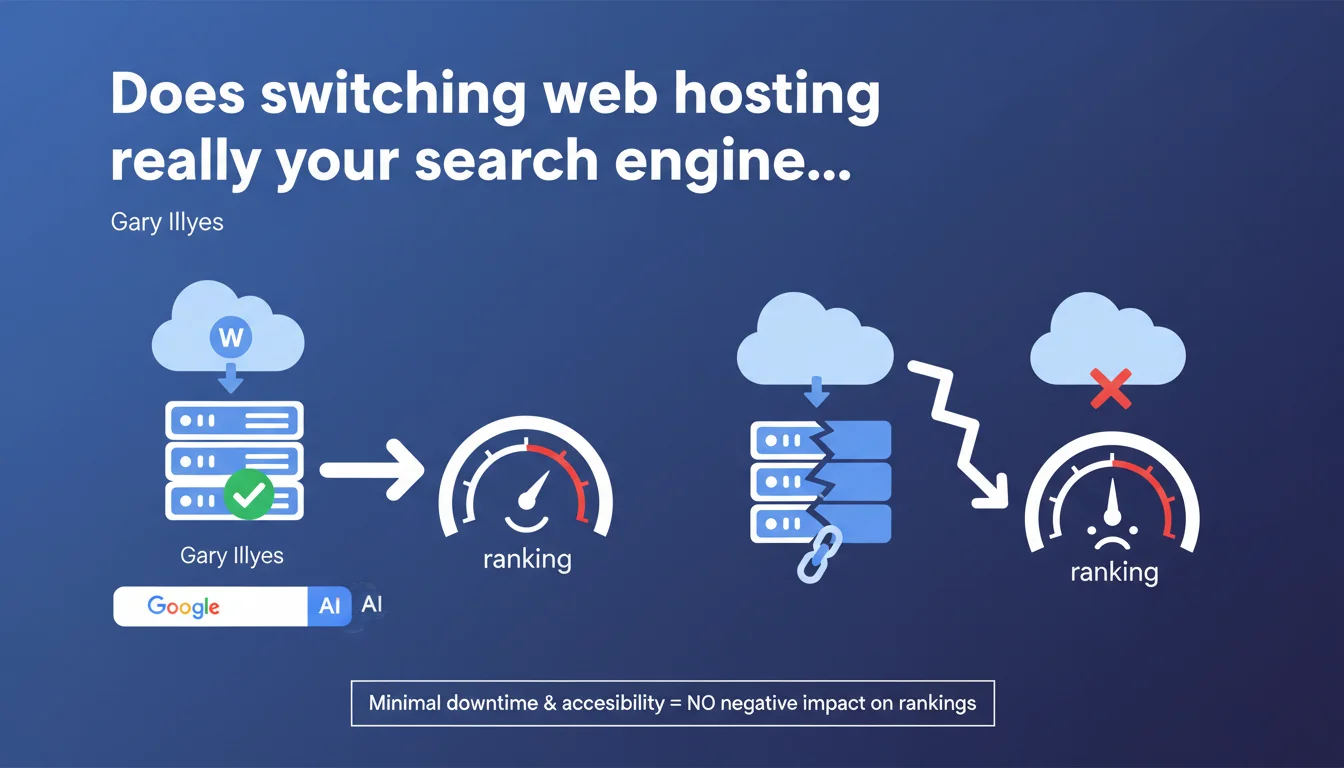
According to Gary Illyes, migrating to a new hosting provider has no negative impact on Google rankings if the transition is well orchestrated: site accessibility maintained, downtime kept to an absolute minimum. The message is clear: it's the technical execution that matters, not the change itself.
What you need to understand
Why does Google clarify that changing hosting doesn't harm SEO?
This statement addresses a recurring concern among SEO professionals: the fear that a hosting migration will cause a drop in rankings. Google wants to clarify that the technical infrastructure change in itself is not a ranking signal.
What matters is service continuity. If Googlebot can continue crawling normally, if pages remain accessible, if response times are stable — in short, if the user and bot experience isn't degraded — then there's no reason for rankings to fluctuate negatively.
What constitutes a "properly executed" change according to Google?
Gary Illyes mentions two essential criteria: constant site accessibility and minimal downtime. Concretely, this means a planned migration with progressive DNS switching, preliminary testing in the new environment, and real-time monitoring.
The underlying idea? Eliminate any noticeable interruption for bots and users. A downtime of a few seconds is negligible, but several hours of site unavailability can trigger alert signals at Google.
What are the practical implications for a migration project?
This statement formalizes what experienced SEO professionals have observed for years: quality of execution trumps choice of hosting provider. It doesn't matter whether you're moving from shared hosting to a dedicated VPS or from a European datacenter to a global CDN — what matters is the methodology.
- Changing hosting providers is not a ranking factor in itself
- Accessibility and service continuity are the only determining criteria
- Minimal downtime (a few seconds) does not trigger penalties
- Problems only arise from poor technical execution
- Google doesn't distinguish between premium and budget hosting providers for ranking purposes
SEO Expert opinion
Is this statement consistent with real-world observations?
Yes, absolutely. No properly prepared hosting migration has ever caused sustained traffic loss in my projects. However, I've witnessed disasters: sites unreachable for 48 hours, misconfigured server setups, forgotten 301 redirects to the old IP.
The real problem? Many migrations are underestimated. People think "copy-paste files" is enough. Result: DNS issues, expired SSL certificates, incompatible .htaccess files, corrupted databases. And then, yes, SEO takes a hit — but not because of the hosting change, because of technical incompetence.
What nuances should be added to this claim?
Gary Illyes deliberately remains vague about "minimal downtime". [To verify] How much time exactly? 10 minutes? 2 hours? 24 hours? No figures provided. My experience: beyond 4-6 hours of total unavailability, Googlebot starts returning error signals and crawl frequency temporarily decreases.
Another nuance: overly slow hosting can indirectly affect SEO. If your new server responds in 3 seconds instead of 300ms, Google won't penalize you for "changing hosts" — but Core Web Vitals will degrade, and that does impact rankings. Technically, it's not the change itself that's the problem, it's the performance of the new environment.
In what cases does this rule not apply?
If your migration involves a domain change in parallel, everything Gary Illyes says no longer applies. There, we enter complex SEO migration territory with 301 redirects, temporary link equity loss, and real risks of ranking fluctuations.
Similarly, if you're moving from hosting with a dedicated IP to shared hosting where your IP is shared with spam sites or penalized sites, [To verify] there's a theoretical risk of contamination — but Google has always denied that "bad neighborhoods" by IP are a significant ranking factor.
Practical impact and recommendations
What should you do concretely to successfully migrate hosting?
Rigorous planning: fully test the new environment before switching DNS. Verify that all URLs are accessible, SSL certificates work, and server performance meets expectations.
Progressive DNS switching: reduce DNS TTL a few days before migration (600 seconds or less). This accelerates propagation. Use a CDN or reverse proxy to manage the transition smoothly if the project is critical.
Real-time monitoring: watch Google Search Console, server logs, and uptime monitoring tools. Immediately detect any 500, 503 errors or timeouts. Prepare a quick rollback if necessary.
What errors must be avoided during a hosting change?
Never shut down the old hosting too quickly. Even after DNS switching, some users and bots may still point to the old IP for 24-48 hours. Keep the old server active in parallel during this period.
Forgetting to test server configurations. An .htaccess file that works on Apache can crash on Nginx. PHP environment variables, file permissions, absolute paths — everything must be verified.
Failing to inform Google via Search Console. If you're also changing IP address or CDN configuration, verify that Googlebot can still access your site using the URL inspection tool.
How do you verify your migration hasn't degraded your SEO?
- Before migration: export a complete crawl of your site (Screaming Frog, Sitebulb) as a reference baseline
- During migration: monitor HTTP codes returned, server response times, and accessibility of critical resources (CSS, JS, images)
- After migration: compare a new crawl with the baseline — no URL should newly return a 404 or 500 error
- Check Google Search Console: inspect coverage errors, Core Web Vitals, and crawl statistics over 7-14 days
- Analyze performance: compare load times before/after using PageSpeed Insights or WebPageTest
- Monitor organic traffic: no sudden drops should appear in GA4 or your analytics tool — if they do, rollback immediately
- Test availability from multiple geographic locations: use a tool like UptimeRobot or Pingdom to detect regional issues
In summary: changing hosting is a high-risk technical operation if poorly executed, but neutral for SEO if well orchestrated. The key lies in methodology: exhaustive preliminary testing, controlled DNS switching, continuous monitoring.
For critical projects or high-traffic sites, these optimizations require pointed technical expertise and rigorous coordination. Given the growing complexity of server migrations, calling in a specialized SEO agency can prove strategic — they'll know how to anticipate pitfalls, orchestrate the transition smoothly, and guarantee the continuity of your organic visibility without interruption.
❓ Frequently Asked Questions
Combien de temps d'indisponibilité maximum Google tolère-t-il lors d'un changement d'hébergeur ?
Faut-il informer Google d'un changement d'hébergeur via Search Console ?
Un hébergeur premium améliore-t-il directement le classement Google ?
Peut-on perdre du PageRank en changeant d'hébergeur ?
Faut-il attendre une période spécifique pour migrer d'hébergeur sans risque SEO ?
🎥 From the same video 13
Other SEO insights extracted from this same Google Search Central video · published on 18/04/2024
🎥 Watch the full video on YouTube →
💬 Comments (0)
Be the first to comment.