
Official statement
Other statements from this video 13 ▾
- □ Can you manage multiple websites without triggering SEO penalties?
- □ Does the dash vs underscore distinction in URLs really impact your SEO rankings?
- □ Does noindex follow really guarantee that Google will explore your internal links?
- □ Does Google Really Ignore URL Fragments with # for SEO Rankings?
- □ Why is noindex more effective than robots.txt for hiding a site from Google?
- □ Does switching web hosting really hurt your search engine rankings?
- □ Is the Indexing API really restricted to job postings and events only?
- □ Should you really ban text embedded directly in images?
- □ Does having duplicate burger menus in your DOM hurt your SEO rankings?
- □ Can you really target multiple countries with a single page using hreflang?
- □ Do external 404 errors really hurt your Google rankings?
- □ Do you really need a sitemap.xml to rank well on Google?
- □ Should you really abandon separate mobile URLs (m-dot) for better SEO results?
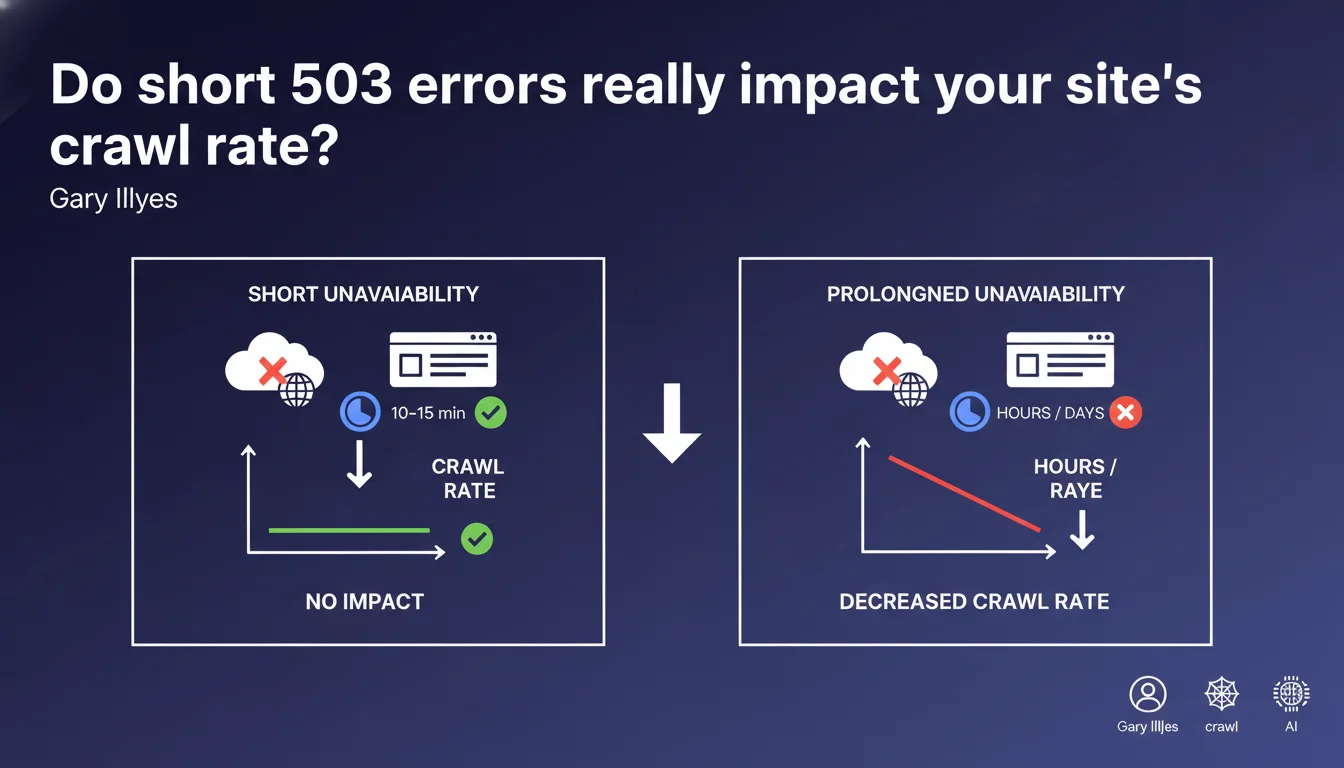
Google tolerates brief 503 errors (10-15 minutes, several times per week) without penalizing the crawl rate. It's prolonged exposure to 503s that triggers a decrease in crawl budget. In short: a weekly 15-minute maintenance causes no problems.
What you need to understand
Why does Google make this distinction between brief and prolonged 503 errors?
The 503 Service Unavailable code signals to the bot that the server is temporarily unavailable. Unlike 404 or 410, it indicates a reversible situation — the content will return.
Google needs to distinguish between planned maintenance and structural failure. If Googlebot treated every 503 as a negative signal, sites would be penalized for each legitimate technical operation. Tolerance for brief outages allows infrastructure management without sacrificing crawl budget.
What exactly constitutes a "prolonged" period?
Illyes provides a benchmark: 10-15 minutes several times per week is not considered prolonged. Conversely, serving 503s for several consecutive hours or days will trigger a reduction in crawl rate.
The exact threshold remains unclear. Google has never communicated a precise duration — likely because the decision also depends on site context (publishing frequency, authority, typical crawl budget).
What concrete takeaways should you draw from this tolerance?
- Brief maintenances (under 15 minutes) do not affect crawl if they remain occasional
- Unavailability of several hours or repeated daily will be problematic
- 503 remains preferable to 500 Internal Server Error for signaling temporary unavailability
- No specific figures on the timeframe before crawl reduction — Google maintains this discretionary margin
SEO Expert opinion
Is this statement consistent with real-world observations?
Yes, broadly. Sites that undergo brief weekly maintenances (deployments, restarts) generally report no crawl drop in Search Console. Logs confirm that Googlebot returns quickly after a brief 503.
However, sites experiencing repeated or prolonged outages see their crawl frequency drop — sometimes by 30 to 50% in observed cases. The problem is that Google never defines "prolonged" with precision. [To verify]: what is the maximum acceptable duration for a 503 before impact? 30 minutes? 1 hour? No official data.
What nuances should be added?
Google's tolerance assumes overall healthy availability. If your site already displays degraded response times, frequent timeouts, or high error rates, even a brief 503 could be perceived as an additional negative signal.
Another point: this rule concerns crawling, not indexing or ranking. Content inaccessible for 15 minutes won't be deindexed, but if this unavailability coincides with a crawl attempt of a newly published strategic page, it won't be indexed before the bot's next visit — which can delay its appearance in SERPs.
In what cases does this rule not apply?
If you serve 503s selectively or randomly (for example, only to bots or based on IP), Google could interpret this as cloaking or manipulation attempt. The 503 must be legitimate and consistent.
Also, this tolerance does not cover very low crawl budget sites. A small site receiving 10 crawls per day doesn't have the same flexibility as a news site crawled hourly. A 15-minute outage can represent a significant portion of available crawl.
Practical impact and recommendations
What should you concretely do to minimize the impact of 503 errors?
Schedule your maintenance during off-peak hours — early morning or late evening, depending on your audience. Consult logs to identify periods of low Googlebot activity and synchronize your interventions.
Use the Retry-After header in your 503 response. This tells the bot how long to wait before returning. Google generally respects this directive, preventing unnecessary crawl attempts during maintenance.
What errors must you absolutely avoid?
Don't confuse 503 with 500 Internal Server Error. The 500 signals a non-temporary server problem — Google reacts differently and may deindex content faster if the error persists.
Avoid prolonged 503s on your strategic pages (homepage, main categories, high-value content). If a technical maintenance affects the entire site, ensure it remains as brief as possible.
Don't accumulate outages. Multiple 15-minute maintenances in the same week remain tolerated according to Illyes, but if it becomes daily, Google will eventually interpret this as a structural problem.
How can you verify your site stays within acceptable limits?
- Enable Search Console alerts to monitor server errors and crawl anomalies
- Analyze your server logs to track the frequency and duration of 503s served to Googlebot
- Check the crawl statistics report in Search Console after each maintenance to detect any abnormal drops
- Set up uptime monitoring (Pingdom, UptimeRobot) to precisely quantify your downtime periods
- Document each planned maintenance and compare with crawl fluctuations to identify correlations
❓ Frequently Asked Questions
Un 503 de 20 minutes va-t-il réduire mon crawl budget ?
Faut-il préférer un 503 ou une page de maintenance HTML ?
Le header Retry-After est-il obligatoire avec un 503 ?
Les 503 affectent-ils le positionnement dans les résultats de recherche ?
Google désindexe-t-il les pages après plusieurs 503 ?
🎥 From the same video 13
Other SEO insights extracted from this same Google Search Central video · published on 18/04/2024
🎥 Watch the full video on YouTube →
💬 Comments (0)
Be the first to comment.