
Official statement
Other statements from this video 11 ▾
- □ Does a 302 redirect really cause you to lose PageRank compared to a 301?
- □ Are 307 and 308 redirects really pointless for classic SEO?
- □ Should you really ditch meta refresh redirects, or does Google actually handle them just fine?
- □ Does Google really follow JavaScript redirects the same way as server-side redirects?
- □ Do you really need to redirect every single URL individually during a domain migration?
- □ Why do domain mergers and divisions trigger extended SEO ranking swings?
- □ Are geographic redirects really preventing your European content from being indexed?
- □ Are interstitials with redirects really blocking Googlebot from indexing your content?
- □ Do you really need bidirectional redirects between mobile and desktop versions to avoid indexing issues?
- □ Why does the URL Inspection Tool show a 200 status code even after a redirect?
- □ Should you really be using 302 redirects between mobile and desktop versions?
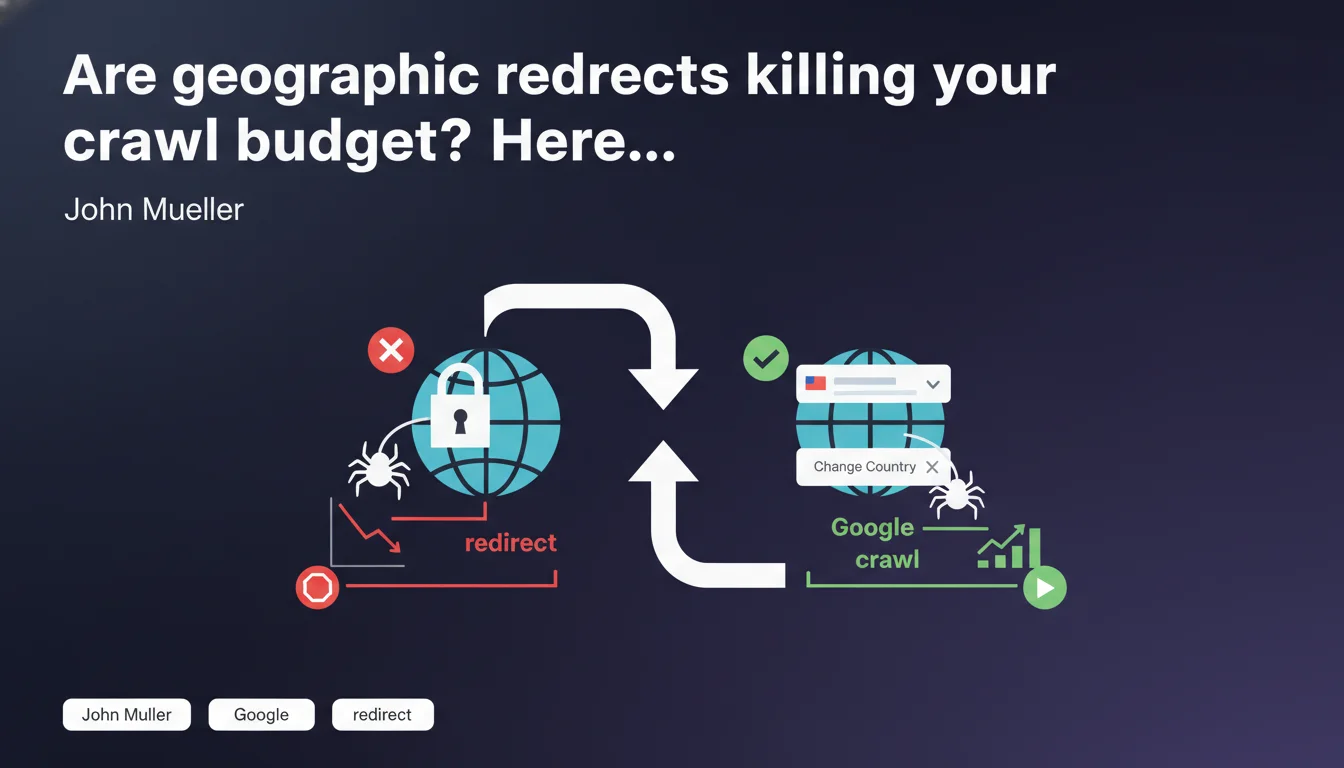
Google recommends replacing forced geographic redirects with banners or country selection menus. Why? These redirects often block Googlebot from accessing international versions of your site. The alternative preserves bot accessibility while guiding users to the right version.
What you need to understand
Why do geographic redirects cause problems for Googlebot?
Googlebot crawls primarily from data centers located in the United States. When a site detects an IP and automatically redirects to a local version, the bot gets stuck on the US version — or worse, lands on an error page if no US version exists.
Concrete result: your international versions are never explored, so they're never indexed. Google can't discover your French, German, or Japanese content if you force a redirect based on IP geolocation.
How do these redirects affect multilingual indexation?
An e-commerce site with 12 country versions ends up with just one version indexed if the geo redirect is misconfigured. The hreflang tags become useless since Googlebot never sees the alternative URLs.
The paradox: you invest in translations and local domains, but Google never reaches them. That's wasted budget for invisible results in international search rankings.
What's the concrete alternative recommended by Google?
Display a country suggestion banner or dropdown menu at the top of the page. The user stays in control, and Googlebot accesses all versions without technical obstacles.
This approach also helps detect users with VPNs or travelers who sometimes prefer to stay on a version that doesn't match their current IP location.
- Googlebot crawls from the United States: geographic redirects trap it on the US version
- International versions are never explored or indexed with forced redirects
- Hreflang tags become ineffective if the bot can't access alternative URLs
- Banners and selection menus: full accessibility for bots + user control
- Solution compatible with VPNs and traveling users
SEO Expert opinion
Is this recommendation consistent with real-world observations?
Absolutely. International SEO audits consistently reveal this problem: sites with 10+ country versions only have one version crawled regularly in Search Console.
The diagnosis is straightforward: if your organic traffic remains concentrated in a single geography while you're targeting multiple countries, check your redirects. High chances that Googlebot is blocked.
What nuances should we add to this statement?
Google doesn't specify how to handle actual legal restrictions — some content (alcohol, sports betting, pharmaceuticals) can't be displayed everywhere. In those cases, a redirect remains necessary for compliance.
The banner works for language suggestion or user preference, not for legal geographic blocking. [To verify]: what implementation does Google recommend for sites subject to strict legal obligations?
In what cases does this rule not fully apply?
Mobile apps or PWAs with location detection for business functions (delivery, local stock, regional pricing) may require a hybrid approach: no URL redirect, but client-side content adaptation.
Sites with geolocalized CDNs should also verify that HTML content remains identical regardless of request origin — otherwise Google will see a different version than the one served to French users.
Practical impact and recommendations
What do you need to do concretely on an existing site with geo redirects?
Start by auditing Search Console: compare the number of pages crawled by country version. If some versions show zero crawl or minimal indexation, that's confirmed.
Implement a JavaScript banner that detects browser language (navigator.language) or server-side IP, but which displays a suggestion instead of forcing a 301/302 redirect.
How do you manage the transition without losing acquired indexation?
Document all your currently indexed URLs via a Search Console export. Remove geo redirects progressively, version by version, while monitoring crawl evolution.
Add or verify your hreflang tags on all pages — they become critical once redirects are removed. Google must be able to clearly identify which version serves which language/region.
What errors should you avoid during migration?
Don't leave JavaScript redirects that are only detectable client-side — Google may interpret them as cloaking if content differs by user-agent.
Avoid banners covering the entire screen (intrusive interstitials): they can trigger mobile penalties. A discrete bar at the top is more than enough.
- Audit Search Console to identify non-crawled country versions
- Replace geographic 301/302 redirects with a suggestion banner
- Verify or add hreflang tags on all pages
- Test accessibility of each version with a VPN or international crawling tools
- Monitor crawl budget evolution by property for 4-6 weeks post-migration
- Document indexed URLs before/after to measure actual impact
❓ Frequently Asked Questions
Les bannières de suggestion de pays affectent-elles négativement l'expérience utilisateur ?
Peut-on combiner redirections géo et bannières pour certains cas spécifiques ?
Comment Googlebot gère-t-il les sites avec détection de langue navigateur sans redirection ?
Les balises hreflang suffisent-elles sans bannière utilisateur ?
Faut-il utiliser des cookies pour mémoriser la préférence utilisateur de pays ?
🎥 From the same video 11
Other SEO insights extracted from this same Google Search Central video · published on 17/11/2022
🎥 Watch the full video on YouTube →
💬 Comments (0)
Be the first to comment.