
Official statement
Other statements from this video 11 ▾
- □ 301 vs 302 : les redirections temporaires font-elles vraiment perdre du PageRank ?
- □ Faut-il vraiment abandonner les meta refresh pour vos redirections ?
- □ Les redirections JavaScript sont-elles réellement suivies par Google ?
- □ Faut-il vraiment rediriger chaque URL individuellement lors d'une migration de domaine ?
- □ Pourquoi les fusions et divisions de domaines provoquent-elles des fluctuations SEO prolongées ?
- □ Les redirections géographiques empêchent-elles vraiment l'indexation de vos contenus européens ?
- □ Faut-il abandonner les redirections géographiques pour préserver votre crawl budget ?
- □ Les interstitiels avec redirections bloquent-ils vraiment Googlebot ?
- □ Faut-il vraiment des redirections bidirectionnelles entre versions mobile et desktop pour éviter les problèmes d'indexation ?
- □ Pourquoi l'URL Inspection Tool affiche-t-il un code 200 même après redirection ?
- □ Faut-il vraiment utiliser des redirections 302 entre les versions mobile et desktop ?
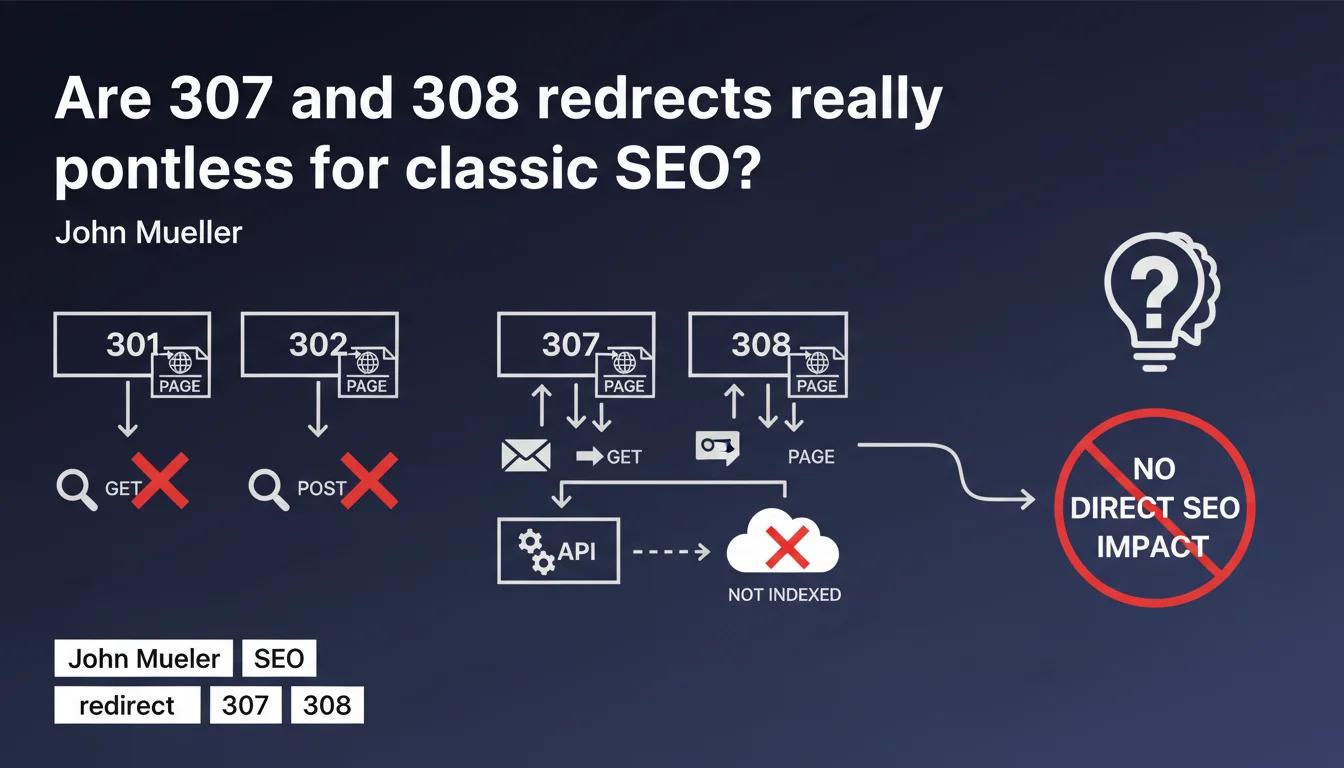
HTTP codes 307 and 308 preserve POST requests during a redirect, unlike 301 and 302 which only transfer GET requests. In practice? No direct SEO impact since these redirects serve APIs, which are rarely indexed by Google. SEO practitioners can safely continue using 301/302 for their standard redirect needs.
What you need to understand
What's the real difference between 301/302 and 307/308?
Classic HTTP redirects 301 (permanent) and 302 (temporary) automatically convert POST requests to GET. In other words, if a form sends data via POST to a redirected URL in 301, the browser transforms the request into GET and loses the form data.
Codes 307 (temporary) and 308 (permanent) fix this behavior: they preserve the original HTTP method. A POST stays a POST after redirection. The browser asks for user confirmation before resending the data.
Why does Mueller say "with no direct SEO impact"?
Web APIs heavily use POST requests to transmit structured data. These endpoints are generally not intended for indexing — they serve to exchange information between machines, not to display crawlable content.
Google doesn't crawl your API routes the way it crawls your HTML pages. So 307/308 redirects concern a technical scope that escapes traditional indexing mechanisms.
Should practitioners review their existing redirects?
No. Your classic SEO redirects (domain migrations, URL restructuring, page deletions) work perfectly fine with 301 and 302. Googlebots primarily use GET requests for crawling.
Codes 307/308 remain relevant only in very specific scenarios: web applications with POST forms, public API interfaces, or architectures where the HTTP method must be preserved. Not in 99% of daily SEO cases.
- 301/302 automatically convert POST to GET
- 307/308 preserve the original HTTP method (POST stays POST)
- This distinction mainly affects APIs and web forms, rarely indexed
- No reason to modify your existing SEO redirects if they're working with 301/302
- Google's crawler primarily uses GET requests for indexing
SEO Expert opinion
Does this statement really clarify Google's behavior?
Mueller stays descriptive. He explains the HTTP standard, not the crawler's actual behavior. Let's be honest: most sites have never used 307 or 308, and it's never caused problems.
What's missing here is explicit confirmation: does Google treat a 308 differently from a 301 when it exceptionally encounters an indexable POST resource? Probably not, but [To verify] in edge cases like certain publicly exposed GraphQL endpoints.
In what rare cases could this distinction have SEO impact?
Imagine a hybrid architecture where certain routes serve as both API endpoints (POST) and crawlable pages (GET). Rare but possible with modern frameworks like Next.js or SvelteKit.
In that case, using a 308 instead of a 301 could theoretically better preserve intent. But practically? Google crawls the GET version, indexes it, and ignores the POST behavior. Impact remains marginal, if any, on SERPs.
Should you prioritize 307/308 in modern SEO strategy?
No. Unless you have an explicit technical need to preserve POST. The 301 remains the standard for permanent SEO redirects — it transfers PageRank, preserves crawl history, and works perfectly for 99.9% of scenarios.
308 offers no measurable SEO advantage if your site only handles GET. It's a protocol subtlety useful to API developers, not practitioners managing content migrations.
Practical impact and recommendations
What should you actually do with this information?
Nothing, if your site operates in classic mode (HTML pages, server-side form handling, existing 301/302 redirects). Your current redirects continue working exactly as before.
If you manage a public API or advanced web application with important POST forms, consider 307/308 to avoid automatic POST → GET conversion. But that's an architectural choice, not SEO optimization.
What mistakes should you avoid?
Don't replace your 301s with 308s "just in case." You won't improve anything on the indexing side and risk introducing unexpected behaviors if your tech stack isn't prepared to handle POST after redirect.
Another pitfall: redirecting an API endpoint with 301/302 without verifying that clients (mobile apps, scripts) properly handle POST → GET conversion. Result: 400 (Bad Request) errors or data loss. In that case, a 307/308 would have been relevant.
- Keep your 301 redirects for classic HTML page migrations
- Use 308 only if you need to preserve POST (APIs, webhooks, complex forms)
- Verify your server supports 307/308 before implementing them (some legacy servers don't handle these codes)
- Don't mix 301 and 308 on the same URL — choose based on actual usage (GET or POST)
- Test your redirects with curl -X POST to verify API-side behavior
- Document your HTTP code choices in your technical documentation to prevent future confusion
❓ Frequently Asked Questions
Dois-je remplacer mes redirections 301 par des 308 pour améliorer mon SEO ?
Google crawle-t-il mes endpoints API en POST ?
Dans quel cas précis utiliser un code 307 ou 308 ?
Un 308 transfère-t-il le PageRank comme un 301 ?
Mon serveur supporte-t-il les codes 307 et 308 ?
🎥 From the same video 11
Other SEO insights extracted from this same Google Search Central video · published on 17/11/2022
🎥 Watch the full video on YouTube →
💬 Comments (0)
Be the first to comment.