
Official statement
Other statements from this video 11 ▾
- □ 301 vs 302 : les redirections temporaires font-elles vraiment perdre du PageRank ?
- □ Pourquoi les redirections 307 et 308 sont-elles inutiles pour le SEO classique ?
- □ Faut-il vraiment abandonner les meta refresh pour vos redirections ?
- □ Les redirections JavaScript sont-elles réellement suivies par Google ?
- □ Pourquoi les fusions et divisions de domaines provoquent-elles des fluctuations SEO prolongées ?
- □ Les redirections géographiques empêchent-elles vraiment l'indexation de vos contenus européens ?
- □ Faut-il abandonner les redirections géographiques pour préserver votre crawl budget ?
- □ Les interstitiels avec redirections bloquent-ils vraiment Googlebot ?
- □ Faut-il vraiment des redirections bidirectionnelles entre versions mobile et desktop pour éviter les problèmes d'indexation ?
- □ Pourquoi l'URL Inspection Tool affiche-t-il un code 200 même après redirection ?
- □ Faut-il vraiment utiliser des redirections 302 entre les versions mobile et desktop ?
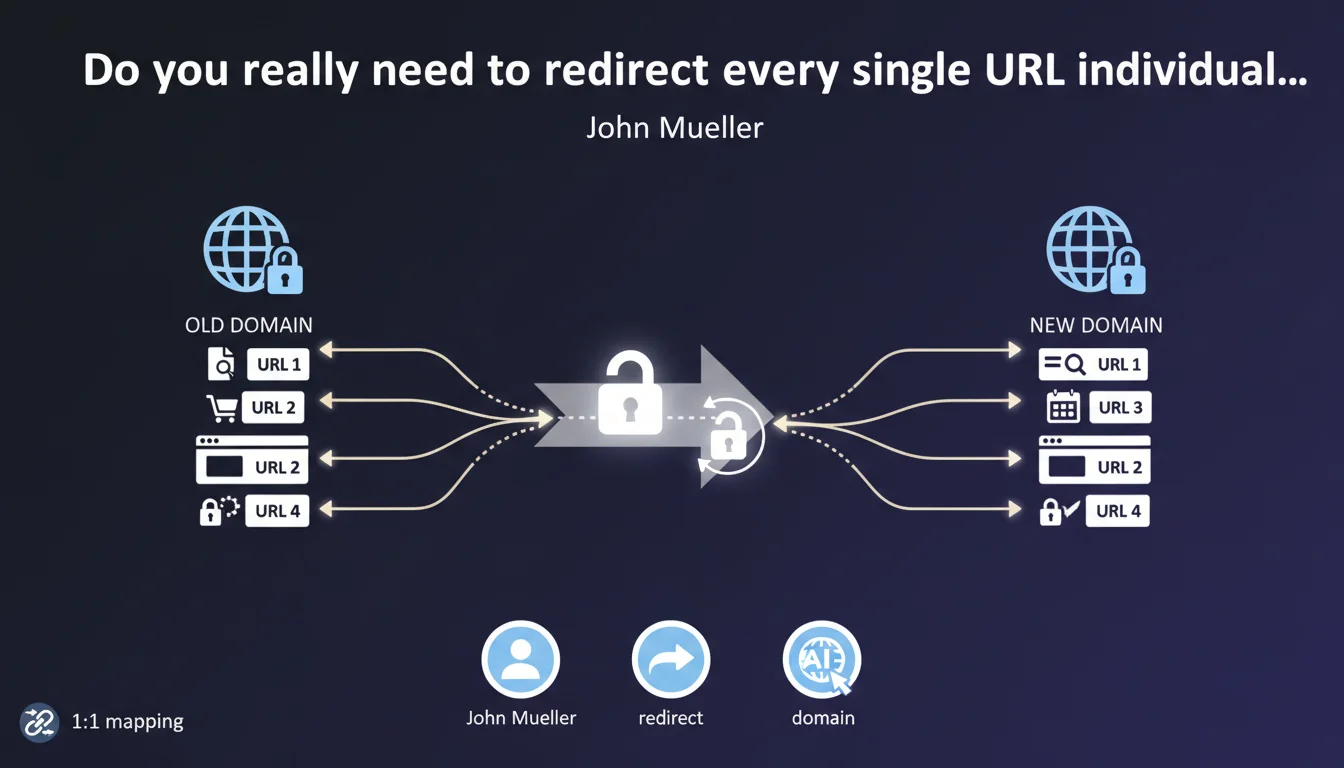
Google requires a complete 1:1 mapping to transfer SEO signals during a domain migration. Each old URL must point to its corresponding new version — global redirects to the homepage simply aren't enough. Without this precise mapping work, you risk losing authority, rankings, and organic traffic.
What you need to understand
Why does Google insist so much on 1:1 mapping?
Google needs semantic continuity between the old and new domain. A page that covered a specific topic (e.g., a comprehensive guide on backlinks) must lead to its equivalent version on the new domain, not to a generic homepage.
The engine transfers historical signals — authority, inbound links, acquired rankings — only if the destination remains coherent with the original content. A global redirect dilutes these signals and forces Google to recrawl everything as if it were a new site.
What happens if you don't follow this principle?
Concretely? You lose a substantial portion of your rankings. Google determines there's no clear correspondence and treats the new domain as a separate entity, with no legacy inheritance.
External backlinks continue pointing to old URLs. If they redirect poorly or not at all, PageRank dissipates. Crawl budget gets wasted on 404s or broken redirect chains.
Does this rule apply to every single page?
Yes, in absolute terms. Even deep pages, low-traffic pages, or older pages should be mapped. Google doesn't make qualitative distinctions upfront — it follows URLs it knows through its index and through backlinks.
That said, pragmatic prioritization still makes sense: prioritize pages with high organic traffic, those receiving quality backlinks, and strategic conversions. Orphaned pages with no backlinks or traffic can be handled secondarily.
- 1:1 mapping mandatory: each old URL must point to its thematic equivalent on the new domain
- SEO signals preserved: authority, rankings, backlinks only transfer if the destination is coherent
- Global redirects ineffective: sending everything to the homepage destroys semantic continuity
- Prioritize by impact: start with strategic pages, but don't neglect deep URLs that accumulate backlinks
SEO Expert opinion
Is this statement consistent with real-world observations?
Completely. Every failed migration I've audited shows the same flaw: haphazard redirects, often 100% of old URLs pointing to the new homepage or just a handful of generic pages.
Result: 40-70% traffic drop within three months of launch, with only partial recovery after 6-12 months. Google loses its bearings, users land on inadequate pages, bounce rate skyrockets.
What nuances should we add to this rule?
Mueller speaks of "signals and trust" — but doesn't specify the transfer timeline. In practice, expect 2-4 weeks for Google to recrawl, follow 301 redirects, and consolidate data. It's not instantaneous. [To verify]: no official documentation quantifies average loss if mapping is only partial (e.g., 80% of URLs correctly redirected).
Another point: if an old page has strictly no thematic equivalent on the new domain (complete information architecture redesign, abandonment of certain editorial lines), a redirect to a related category or hub page is better than a hard 404 or generic homepage. But that's a compromise, not a strategy.
In what cases doesn't this rule fully apply?
If you're migrating a bare-bones domain (new site, minimal indexed content, virtually no backlinks), the impact of 1:1 mapping is marginal. You simply don't have much to transfer.
However, even in this case, establishing good habits from the start prevents nasty surprises if the site later gains authority. Google also analyzes redirect structure as a signal of overall site quality.
Practical impact and recommendations
What should you do concretely for a successful migration?
First, extract a complete inventory of indexed URLs (Search Console, server logs, Screaming Frog or Oncrawl crawls). Cross-reference with backlinks (Ahrefs, Majestic) to identify pages receiving external juice.
Next, build a two-column mapping file: old URL → new URL. Use a spreadsheet, validate each row manually for strategic pages, script repetitive patterns (e.g., /blog/2023/article/ becomes /resources/article/). Test this file on a staging environment before Go Live.
What mistakes must you absolutely avoid?
Never redirect all old URLs to the homepage. That's the worst possible decision — Google sees it as a signal that content has disappeared or the site is unmaintained.
Also avoid redirect chains (A → B → C). Always configure direct 301s to the final destination. Google theoretically follows up to 5 hops, but each link dilutes PageRank and slows crawling.
Last trap: forgetting URLs with parameters (filters, pagination, tracking). If they receive backlinks or organic traffic, they must also be properly mapped or canonicalized.
How do you verify the migration went well?
Monitor Search Console daily: 404 errors, index coverage, Core Web Vitals. Any post-migration anomaly must be addressed urgently.
Watch rankings on your strategic keywords via Semrush, Ahrefs, or your rank tracking tool. A sudden drop signals a mapping or crawl problem.
Finally, analyze server logs to verify Googlebot actively crawls new URLs and properly follows 301 redirects. If you see it continue hitting old addresses heavily without following 301s, that's a red flag.
- Extract complete inventory of indexed URLs and backlinks
- Build a 1:1 mapping file validated line-by-line for strategic pages
- Configure direct 301 redirects (no chains)
- Test mapping on staging before Go Live
- Declare the address change in Google Search Console
- Monitor daily: 404s, coverage, rankings, server logs
- Plan a rollback if migration goes wrong within 48 hours
❓ Frequently Asked Questions
Peut-on rediriger plusieurs anciennes URLs vers une seule nouvelle page ?
Combien de temps faut-il maintenir les redirections 301 après une migration ?
Faut-il mapper les URLs qui génèrent peu ou pas de trafic ?
Que faire si une ancienne page n'a aucun équivalent sur le nouveau domaine ?
La déclaration de changement d'adresse dans Search Console suffit-elle ?
🎥 From the same video 11
Other SEO insights extracted from this same Google Search Central video · published on 17/11/2022
🎥 Watch the full video on YouTube →
💬 Comments (0)
Be the first to comment.