
Official statement
Other statements from this video 11 ▾
- □ 301 vs 302 : les redirections temporaires font-elles vraiment perdre du PageRank ?
- □ Pourquoi les redirections 307 et 308 sont-elles inutiles pour le SEO classique ?
- □ Faut-il vraiment abandonner les meta refresh pour vos redirections ?
- □ Les redirections JavaScript sont-elles réellement suivies par Google ?
- □ Faut-il vraiment rediriger chaque URL individuellement lors d'une migration de domaine ?
- □ Les redirections géographiques empêchent-elles vraiment l'indexation de vos contenus européens ?
- □ Faut-il abandonner les redirections géographiques pour préserver votre crawl budget ?
- □ Les interstitiels avec redirections bloquent-ils vraiment Googlebot ?
- □ Faut-il vraiment des redirections bidirectionnelles entre versions mobile et desktop pour éviter les problèmes d'indexation ?
- □ Pourquoi l'URL Inspection Tool affiche-t-il un code 200 même après redirection ?
- □ Faut-il vraiment utiliser des redirections 302 entre les versions mobile et desktop ?
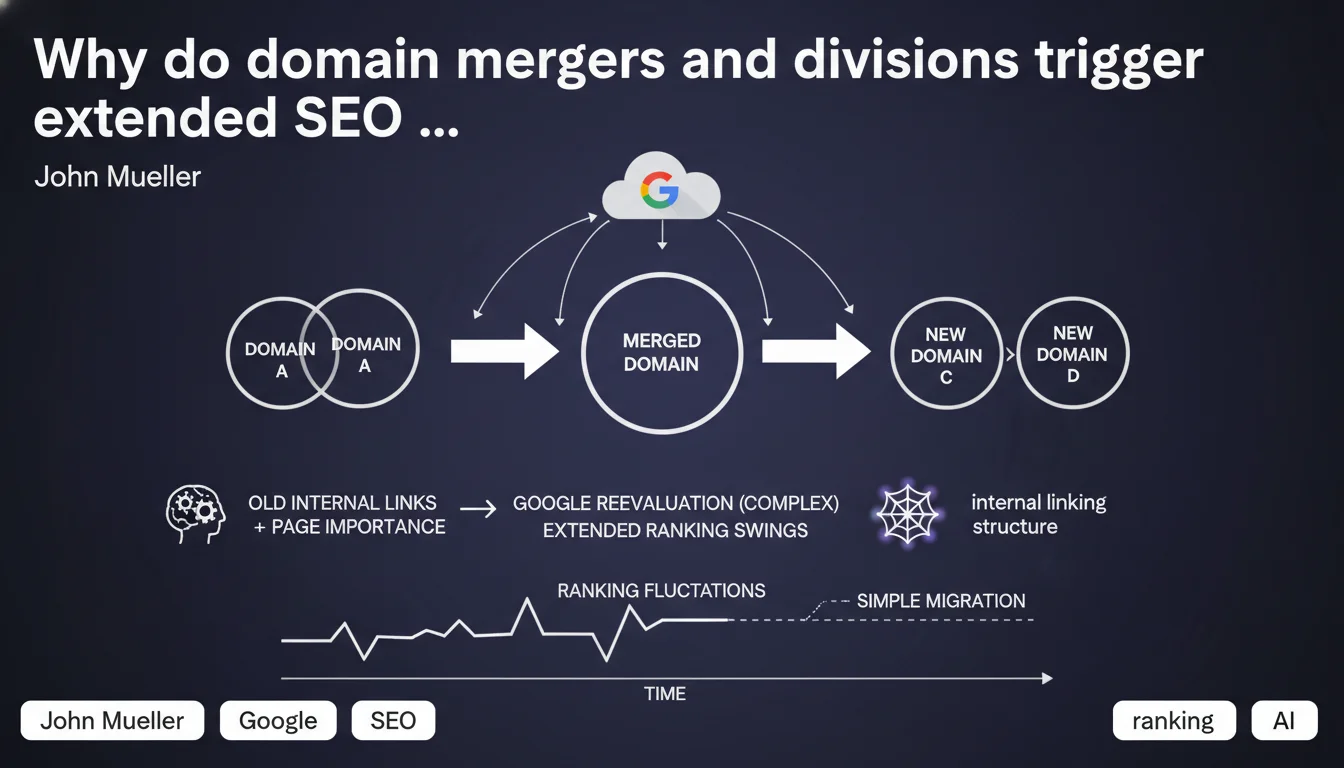
Google must reevaluate page importance and internal linking structure during domain mergers or divisions, which generates long-term ranking fluctuations. These operations are structurally more complex than simple domain migrations and require substantial adaptation time for the search engine.
What you need to understand
What's the difference between a standard migration and a domain merger/division?
A standard domain migration involves moving a site from domain A to domain B while preserving the same structure. Ranking signals are transferred via 301 redirects, and Google treats the operation as a simple address change.
Domain mergers and divisions involve deep structural overhaul. A merger combines multiple sites into one, while a division splits a domain into multiple entities. In both cases, internal linking and PageRank distribution change dramatically.
Why does Google take so long to stabilize rankings?
Google must recalculate the relative importance of each page within the new architecture. Internal PageRank redistributes differently, with some pages gaining authority while others lose it.
The engine also analyzes new linking patterns to understand the thematic hierarchy. This reevaluation cannot happen instantly — it requires multiple crawl and indexation cycles.
Which signals must the algorithm recalculate?
- Internal PageRank distribution: the merger or division modifies the link graph and authority transmission between pages
- Thematic hierarchy: Google must reevaluate which pages are central to which topics
- Semantic coherence: thematic clusters change, with some sections merging or splitting
- Behavioral signals: users navigate differently, impacting CTR and bounce rate
- Crawl depth: the new architecture modifies Googlebot's exploration priorities
SEO Expert opinion
Does this statement align with real-world observations?
Yes, unequivocally. Mergers/divisions trigger SEO roller coasters for a minimum of 6 to 12 months. I've seen sites lose 40% of traffic for 4 months before stabilizing above their original levels.
Internal linking reevaluation is particularly underestimated. When you merge two sites, you suddenly create unprecedented navigation paths between content that was never linked before. Google must recalculate the entire PageRank distribution — and that takes time.
What nuances should we add to this statement?
The duration and amplitude of fluctuations depend heavily on preparation quality. A merger executed with a solid redirect plan, coherent internal linking, and a merged content strategy stabilizes faster than a hastily thrown-together operation.
[Needs verification] Google doesn't specify how long these fluctuations last. In the field, I observe enormous variations: from 3 months for well-prepared small sites to over a year for poorly orchestrated complex mergers.
In what cases does this rule not apply?
If you divide a domain while maintaining strict thematic isolation that already existed, fluctuations can be minimal. For example, separating an e-commerce blog into blog.example.com and shop.example.com has minimal impact if both universes shared no internal links.
Conversely, merging two sites with no thematic proximity generates massive and often negative fluctuations. Google struggles to understand editorial coherence and may degrade the perceived relevance of the whole.
Practical impact and recommendations
What concrete steps should you take before a domain merger or division?
Map your current internal linking structure precisely with a crawler (Screaming Frog, Oncrawl). Identify pages receiving the most internal PageRank and those distributing the most — these are your structural pillars.
Plan the new linking architecture before migration. Decide which sections will merge, how old thematic silos connect in the new structure, which internal links to create to maintain PageRank flow.
Prepare a comprehensive redirect plan and test it in pre-production. Every URL from the old site must point to the most relevant page in the new one — not to the homepage for convenience.
What critical mistakes must you avoid during the operation?
Never launch a merger/division without real-time monitoring. Google Search Console, Analytics, and daily position tracking are essential for detecting issues quickly.
Avoid modifying structure AND content simultaneously. If you're merging two sites, don't use the opportunity to rewrite all your pages — you won't be able to isolate the cause of fluctuations.
Don't neglect the XML sitemap. Submit the new version immediately after launch and monitor indexation rate in Search Console. Orphaned non-crawled pages can remain invisible for weeks.
How do you minimize the negative impact of fluctuations?
- Preserve your best-performing URLs whenever possible — each redirect carries a PageRank loss risk
- Strengthen internal linking to your strategic pages immediately after launch
- Publish fresh content regularly to signal to Google that the site is active and maintained
- Monitor 404 errors and redirect chains — they amplify fluctuations
- Clearly communicate the merger/division in your content to help Google understand the new structure
- Anticipate a 6 to 12 month period before complete ranking stabilization
❓ Frequently Asked Questions
Combien de temps durent les fluctuations après une fusion de domaines ?
Une division de domaine est-elle moins risquée qu'une fusion ?
Peut-on éviter complètement les fluctuations lors d'une fusion ?
Faut-il attendre la stabilisation avant de lancer d'autres optimisations SEO ?
Les redirections 301 suffisent-elles à préserver le PageRank lors d'une fusion ?
🎥 From the same video 11
Other SEO insights extracted from this same Google Search Central video · published on 17/11/2022
🎥 Watch the full video on YouTube →
💬 Comments (0)
Be the first to comment.