
Official statement
Other statements from this video 8 ▾
- □ Did Google really hide a 15 MB indexing limit from everyone for 15 years?
- □ What are the only 3 technical requirements needed to get indexed by Google?
- □ Should you really stop worrying about what Google doesn't support?
- □ How should you prioritize your SEO actions using Google's official classification system?
- □ Is Googlebot accessibility really a binary condition for indexation?
- □ Does Google really distinguish between "absolute requirements" and "best practices" in SEO?
- □ Does Google really distinguish between documentation changes and algorithm updates?
- □ Can you really rank on Google without HTTPS and fast page speed?
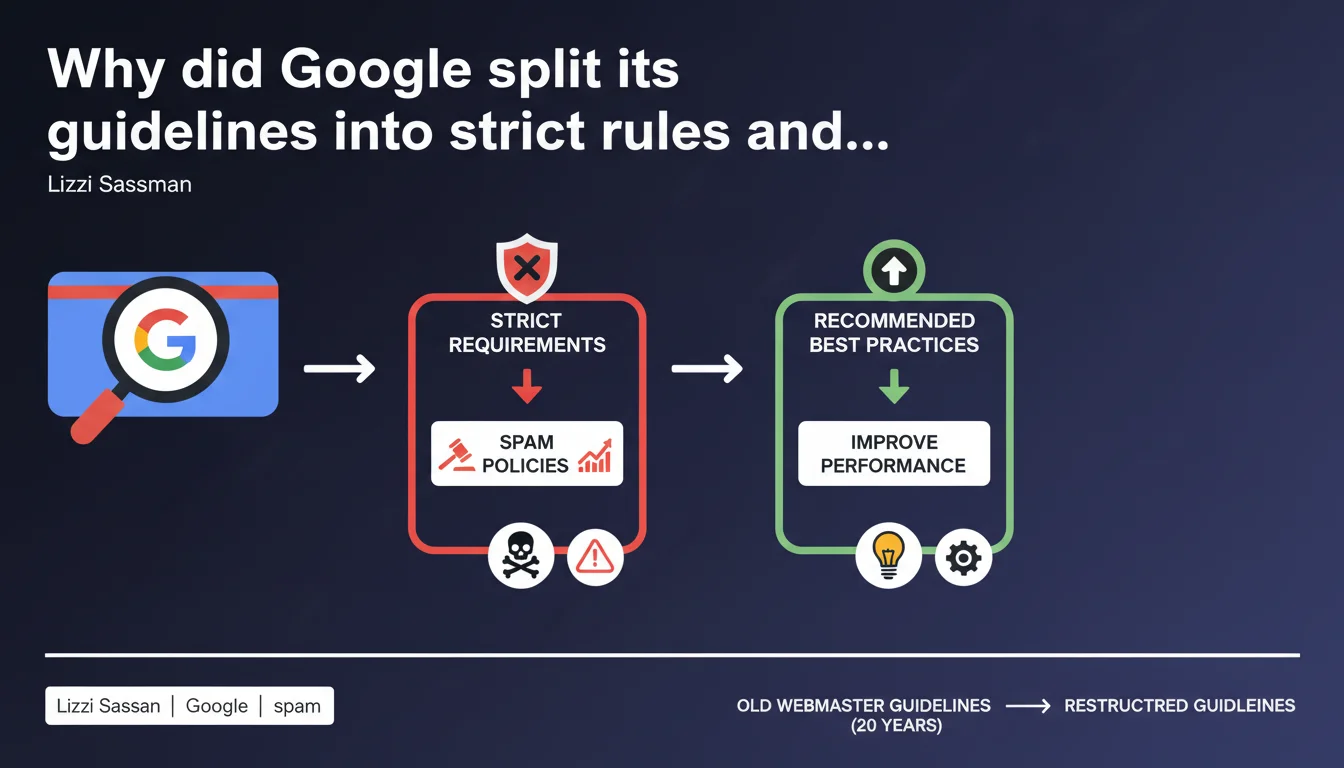
Google is abandoning its historic Webmaster Guidelines to clearly separate mandatory anti-spam rules from optional best practices. This restructuring ends 20 years of ambiguity: what can penalize you is now distinct from what is simply advised. The message? Google wants you to stop confusing requirements with suggestions.
What you need to understand
What exactly is changing with this restructuring?
Google is replacing its Webmaster Guidelines with two distinct sets. On one side, the spam policies — the hard rules, those that can trigger manual or algorithmic action if you violate them. On the other, the recommendations — everything that potentially improves your performance without being mandatory.
For 20 years, these two types of guidelines coexisted in the same document. Result: permanent confusion between what was an obligation and what was just optimization advice.
Why is this separation important for SEO practitioners?
Because it clarifies the risk zone. Before, you had to interpret each guideline to know if failing to follow it could cost you rankings or even trigger a penalty. Now, the spam policies are explicit: violate them, and you're exposed to sanctions.
Best practices, on the other hand, fall under optimization. You can ignore them without risking being removed from the index — you'll just leave performance on the table.
Does this modularization change how the algorithm works?
No. Google is not modifying its ranking criteria or spam detection. It is reorganizing its documentation to make it less ambiguous.
But this clarification has an interesting side effect: it forces Google to be more transparent about what actually constitutes spam versus what is simply a recommendation for improvement.
- Spam policies: strict rules with risk of manual or algorithmic penalty
- Recommendations: optional best practices to improve performance
- No algorithmic change: this is an editorial overhaul, not a technical one
- 20 years of ambiguity resolved by a clear separation of requirements and advice
SEO Expert opinion
Is this separation really new in substance?
Not really. Experienced professionals were already making the distinction between sanctionable blackhat practices and recommended optimizations. What's changing is that Google is formalizing this distinction in its documentation.
Where it becomes interesting: Google is implicitly committing to maintaining this separation going forward. If a practice moves from "recommendation" to "spam policy", it will have to be explicit. No more gray zones where an acceptable technique suddenly becomes risky without warning.
What nuances should be added to this announcement?
The boundary between "spam" and "bad practice" often remains fuzzy. Take keyword stuffing: that's clearly spam. But what exact keyword density becomes problematic? [To verify] — Google never gives numerical thresholds.
Another point: recommendations are not neutral. Ignoring Core Web Vitals won't penalize you directly, but it remains a ranking factor. So "optional" doesn't mean "consequence-free" — just "without sanction".
In what cases is this clarification insufficient?
When you're in a gray area. For example: automated content is spam... except when it provides value. Manipulative guest blogging is forbidden... except if links are nofollow and the content is legitimate.
These ambiguous cases persist. Modularization helps, but it doesn't replace the contextual judgment of an expert who knows where the red line sits for a given project.
Practical impact and recommendations
What should you do concretely following this restructuring?
First, carefully review the spam policies. Verify that your site — and your SEO tactics — don't cross any explicitly listed red lines. That's the foundation: eliminate any risk of penalty.
Next, go through the recommendations to identify quick wins. Not all best practices are created equal: some have measurable impact, others are cosmetic. Prioritize those that touch on indexing, loading speed, and user experience.
What mistakes should you avoid now that the distinction is official?
Don't confuse "not mandatory" with "not important". Recommendations remain optimization levers — ignoring them entirely means letting your competitors gain the advantage.
Another trap: thinking you're safe as long as you respect spam policies. Google can adjust its criteria without notice. A tolerated practice today can become problematic tomorrow if the algorithm evolves.
How do I verify that my site is compliant and optimized?
Start with a strict compliance audit against spam policies. No compromises here: cloaking, misleading redirects, scraped content, link schemes — all of this must be absent.
Next, evaluate your performance against key recommendations. Use Search Console to identify improvement opportunities: slow pages, indexing problems, mobile errors.
- Download and compare the new spam policies against your current practices
- Identify gray areas (automated content, guest posts) and document their legitimacy
- Technically audit the site to detect any risky elements (questionable redirects, purchased links)
- Prioritize recommendations based on their measured impact on your SEO KPIs
- Set up monitoring for updates to these two sets of rules
- Train your teams to clearly distinguish requirements from optional optimizations
❓ Frequently Asked Questions
Les spam policies remplacent-elles les anciennes Webmaster Guidelines ?
Si je ne suis pas les recommandations, est-ce que je risque une pénalité ?
Comment savoir si une pratique ambiguë est tolérée ou sanctionnable ?
Google va-t-il continuer à enrichir ces deux ensembles de règles ?
Cette séparation change-t-elle la manière dont Search Console signale les problèmes ?
🎥 From the same video 8
Other SEO insights extracted from this same Google Search Central video · published on 22/12/2022
🎥 Watch the full video on YouTube →
💬 Comments (0)
Be the first to comment.