
Official statement
Other statements from this video 8 ▾
- □ Pourquoi la limite de 15 Mo de Googlebot n'est-elle documentée que maintenant ?
- □ Quelles sont les 3 seules exigences techniques absolues pour être indexé par Google ?
- □ Faut-il vraiment ignorer ce que Google ne supporte pas ?
- □ Pourquoi Google a-t-il divisé ses guidelines en règles strictes et simples recommandations ?
- □ L'accessibilité Googlebot est-elle vraiment une condition binaire pour l'indexation ?
- □ Google distingue-t-il vraiment les « exigences absolues » des « bonnes pratiques » en SEO ?
- □ Google distingue-t-il vraiment les changements de documentation des changements d'algorithme ?
- □ HTTPS et vitesse : peut-on vraiment s'en passer pour ranker sur Google ?
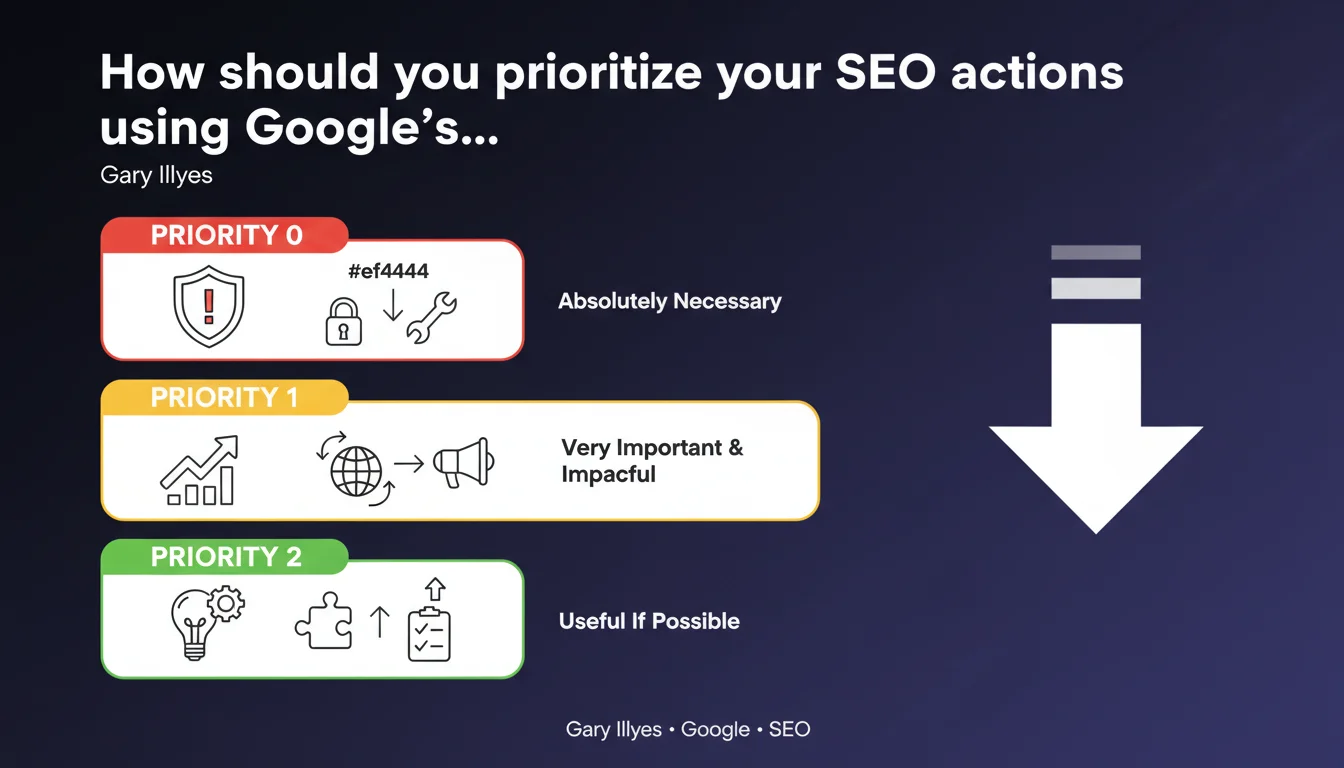
Google now offers an official hierarchy of its SEO recommendations across three priority levels: Priority 0 (essential), Priority 1 (high impact), and Priority 2 (secondary). This classification aims to simplify life for webmasters by allowing them to focus their efforts on what truly matters rather than spreading themselves thin.
What you need to understand
Why is Google introducing this hierarchy now?
Google has produced hundreds of SEO recommendations over the years — across official documentation, Search Central videos, tweets from Gary Illyes or John Mueller, and more. The problem? This overwhelming volume of information becomes paralyzing for many webmasters.
By segmenting recommendations into three clear priorities, Google is implicitly acknowledging that not all its advice carries equal weight. This is a notable shift: the algorithm itself is now distinguishing what's critical from what's merely cosmetic.
What does each priority level actually mean in practice?
Priority 0 encompasses the fundamentals without which your site simply cannot function in search: indexability, mobile compatibility, HTTPS security, minimum acceptable speed. Without these foundations, you don't exist.
Priority 1 covers high-impact optimizations relevant to most sites: clean title tags, relevant structured data, performant Core Web Vitals, coherent internal linking architecture. This is where the difference between ranking on page 3 versus aiming for the top 5 actually happens.
Priority 2 is the refinement layer — valuable once you've built a solid foundation. Optimized meta descriptions, perfect breadcrumbs, WebP images, advanced lazy loading. Useful, but not decisive if you've neglected the higher levels.
- The classification enables prioritizing efforts based on actual impact
- Google admits that all its recommendations are not equivalent in terms of effect
- Limited resources (time, budget) can now be allocated rationally
- This transparency simplifies communication with clients or non-technical decision-makers
SEO Expert opinion
Does this classification align with what we observe in the real world?
Yes — and that's reassuring. The Priority 0 criteria correspond exactly to the blocking factors we identify during technical audits. A site running on pure HTTP or completely inaccessible to crawlers genuinely has no chance.
The blur appears more on the boundary between Priority 1 and Priority 2. For instance, Google sometimes classifies structured data as Priority 1, but in practice, its impact varies enormously by industry. For an e-commerce site, Product Schema is decisive; for a corporate blog, much less so. [To verify]: Does Google specify anywhere how to adapt these priorities based on your business context, or does it remain a one-size-fits-all classification?
What nuances should we add to this hierarchy?
This classification remains relatively static while actual priorities shift over time. Core Web Vitals, for example, have oscillated between "critical" and "secondary" depending on algorithmic updates and contradictory statements from Google.
Another point: priority also depends on your starting position. If you're already in the top 3 for your main keywords, the marginal gains from Priority 2 work could make all the difference against competitors. If you're starting from scratch, you're better off ignoring these details for the first six months.
Does Google provide enough detail to apply this classification?
That's where it gets tricky. The announcement sets the framework, but where do you find the complete, up-to-date list of what falls into each priority? If Google publishes this classification in the Search Central documentation, perfect. Otherwise, we're left with good intentions but limited actionability.
Moreover, some criteria evolve: what was Priority 2 two years ago (mobile-first indexing) is now Priority 0. [To verify]: Is Google committing to maintaining this classification, or risks it becoming outdated without regular updates?
Practical impact and recommendations
What should you do concretely right now?
Start by auditing your site against Priority 0 criteria. If you have any doubts about indexability, HTTPS security, or mobile compatibility, that's where you invest your time first.
Next, build a priority-versus-effort matrix. Some Priority 1 actions are quick to implement (optimizing title tags); others take weeks (overhauling your link architecture). Order them by actual ROI, not just the number Google assigns.
What mistakes should you avoid in this prioritization?
Don't skip steps. Too many sites neglect Priority 0 because they think "it's already working." Except a site crawled at only 60% due to a misconfigured robots.txt is a massive waste of potential.
Another trap: trying to do everything at once. This classification exists precisely to prevent that kind of scattered effort. If you have a small team or limited budget, concentrate on one level at a time until it's truly solid.
How can you verify that your site meets the essential priorities?
- Check actual indexation via Google Search Console (coverage, crawl stats, indexing report)
- Test mobile compatibility with Google's Mobile-Friendly Test — not just visually
- Ensure that 100% of your site runs on HTTPS, with no mixed content or unnecessary redirects
- Analyze Core Web Vitals via PageSpeed Insights and CrUX — aim for at least the "Good" threshold
- Audit your title tags and descriptions: are they unique, descriptive, and optimized per page?
- Implement relevant structured data for your industry (Product, Article, FAQ, Breadcrumb as appropriate)
- Clean up your internal linking: every important page should be reachable in 3 clicks maximum from the homepage
❓ Frequently Asked Questions
Où puis-je consulter la liste officielle des recommandations classées par priorité ?
Les priorités varient-elles selon le type de site (e-commerce, blog, site vitrine) ?
Faut-il obligatoirement traiter les priorités dans l'ordre (0 puis 1 puis 2) ?
Un site déjà bien classé doit-il encore se concentrer sur la priorité 0 ?
Cette classification rend-elle obsolètes certaines pratiques SEO avancées ?
🎥 From the same video 8
Other SEO insights extracted from this same Google Search Central video · published on 22/12/2022
🎥 Watch the full video on YouTube →
💬 Comments (0)
Be the first to comment.