
Official statement
Other statements from this video 8 ▾
- □ Pourquoi la limite de 15 Mo de Googlebot n'est-elle documentée que maintenant ?
- □ Quelles sont les 3 seules exigences techniques absolues pour être indexé par Google ?
- □ Faut-il vraiment ignorer ce que Google ne supporte pas ?
- □ Pourquoi Google a-t-il divisé ses guidelines en règles strictes et simples recommandations ?
- □ Comment prioriser vos actions SEO selon le système de classification de Google ?
- □ L'accessibilité Googlebot est-elle vraiment une condition binaire pour l'indexation ?
- □ Google distingue-t-il vraiment les « exigences absolues » des « bonnes pratiques » en SEO ?
- □ Google distingue-t-il vraiment les changements de documentation des changements d'algorithme ?
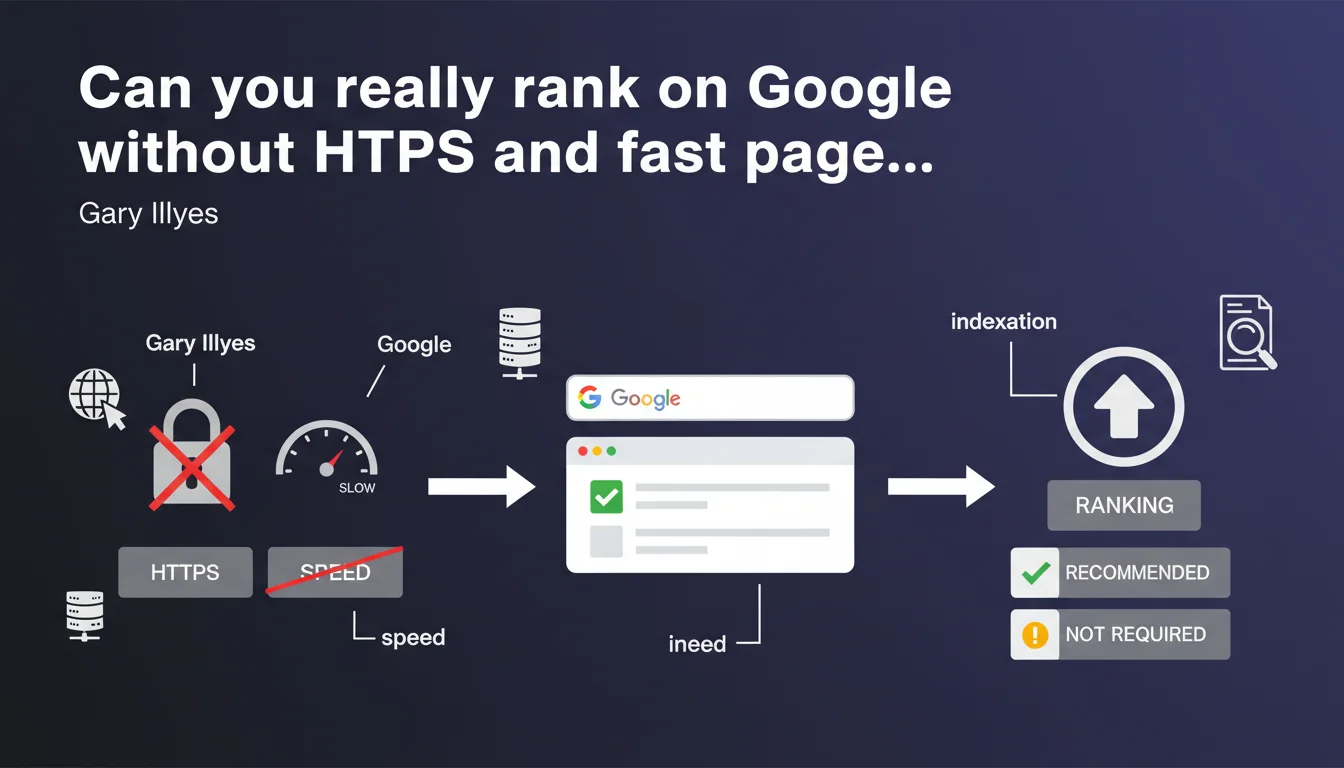
Google confirms that HTTPS and speed are not prerequisites for indexation. A slow HTTP site can therefore appear in search results. But beware: these factors still influence ranking, even if their absence doesn't eliminate a site from the index.
What you need to understand
Does Google really distinguish between indexation and ranking?
Absolutely. And it's crucial not to confuse the two. Indexation simply refers to the presence of a page in Google's index — in other words, the possibility that it appears somewhere in the results. Ranking, on the other hand, determines at what position.
Gary Illyes makes it clear: neither HTTPS nor speed block access to the index. A site can therefore be indexed even if it's slow as a snail and still runs on HTTP. But that says nothing about its ability to position itself correctly against better-optimized competitors.
Why does Google insist on this distinction?
Because many site owners panic thinking that a poor PageSpeed score or lack of SSL certificate will make them disappear from the index. That's not the case. Google wants to reassure: indexation remains accessible, even with technical shortcomings.
Now, does that mean we can ignore these criteria? No. This statement doesn't say that HTTPS and speed have no impact — just that they're not barriers to entry. A fundamental nuance.
What are the key takeaways from this statement?
- Indexation ≠ ranking — a slow HTTP site can be indexed but poorly positioned
- HTTPS and speed remain confirmed ranking factors for years
- Google does not set a minimum technical threshold to enter the index
- Best practices remain recommended for competitiveness and user experience
- This statement aims to downplay technical constraints, not minimize them
SEO Expert opinion
Is this statement consistent with real-world observations?
Yes and no. On paper, it's true: we still find HTTP sites in results, and some slow sites are indexed. So technically, Gary Illyes isn't lying. But let's look at reality.
In most competitive sectors, an HTTP site or one with catastrophic Core Web Vitals never makes the first page. So yes, it can be indexed — but practically speaking, what value does that have if no one sees it? We're talking about an academic distinction that has little strategic interest for a real business.
What nuances should be added to this official discourse?
Google plays with words. Saying that HTTPS and speed are not absolute requirements says nothing about their real weight. We've known since 2014 that HTTPS is a ranking signal. We've known since 2021 that Core Web Vitals influence ranking via Page Experience.
What's missing here — and this is intentional — is an indication of the extent of this impact. [To verify]: Google gives no figures on the weighting of these criteria. Does it count for 1% or 15% of the score? Impossible to say with this vague statement.
In what cases can you afford to downplay these criteria?
Let's be honest: if you're in an ultra-specific niche market with little competition and a captive audience, you can probably survive without HTTPS or heavy speed optimization. But that's the exception.
For 95% of sites, especially in e-commerce, media, or B2B services, ignoring these criteria amounts to shooting yourself in the foot. Algorithms favor user experience — and HTTPS + speed are direct markers of it. So yes, technically optional. Strategically? Essential.
Practical impact and recommendations
What should you concretely do with this information?
First, don't panic if your HTTPS migration or speed optimizations take time. Your site won't disappear from the index overnight. But don't rest on your laurels either.
Next, prioritize intelligently. If you have to choose between fixing a structural indexation problem (poorly configured robots.txt, messy canonicals) and improving your PageSpeed score, start with the first. But keep HTTPS and speed on your short-term roadmap.
What mistakes should you avoid following this statement?
The classic mistake would be to conclude: "Google says it's not required, so I won't do it." That's loser's thinking. Just because a criterion isn't blocking doesn't mean it's negligible.
Another trap: believing that good content alone compensates for poor user experience. Yes, content is still king — but a king on a wobbly throne doesn't rule for long. HTTPS reassures users, speed reduces bounce rate. These elements have an indirect effect on the behavioral signals Google observes.
How can you verify your site meets current standards?
- Verify that your site runs entirely on HTTPS (no mixed HTTP/HTTPS content)
- Test your Core Web Vitals via PageSpeed Insights and Search Console
- Analyze priority pages: homepage, category pages, product sheets / flagship articles
- Identify third-party scripts that slow down load time (ads, tracking, widgets)
- Fix render-blocking issues (unoptimized CSS, JavaScript)
- Set up regular speed monitoring (don't rely on a one-time test)
- Prioritize high-impact actions: image compression, lazy loading, browser cache
❓ Frequently Asked Questions
Un site en HTTP peut-il vraiment ranker en première page sur Google ?
Les Core Web Vitals sont-ils vraiment importants si Google dit que la vitesse n'est pas une exigence absolue ?
Dois-je prioritiser HTTPS ou la vitesse si je dois choisir ?
Cette déclaration change-t-elle quelque chose aux recommandations SEO habituelles ?
Google donne-t-il des seuils précis de vitesse à respecter ?
🎥 From the same video 8
Other SEO insights extracted from this same Google Search Central video · published on 22/12/2022
🎥 Watch the full video on YouTube →
💬 Comments (0)
Be the first to comment.