
Official statement
What you need to understand
What exactly is Google saying about link anchors today?
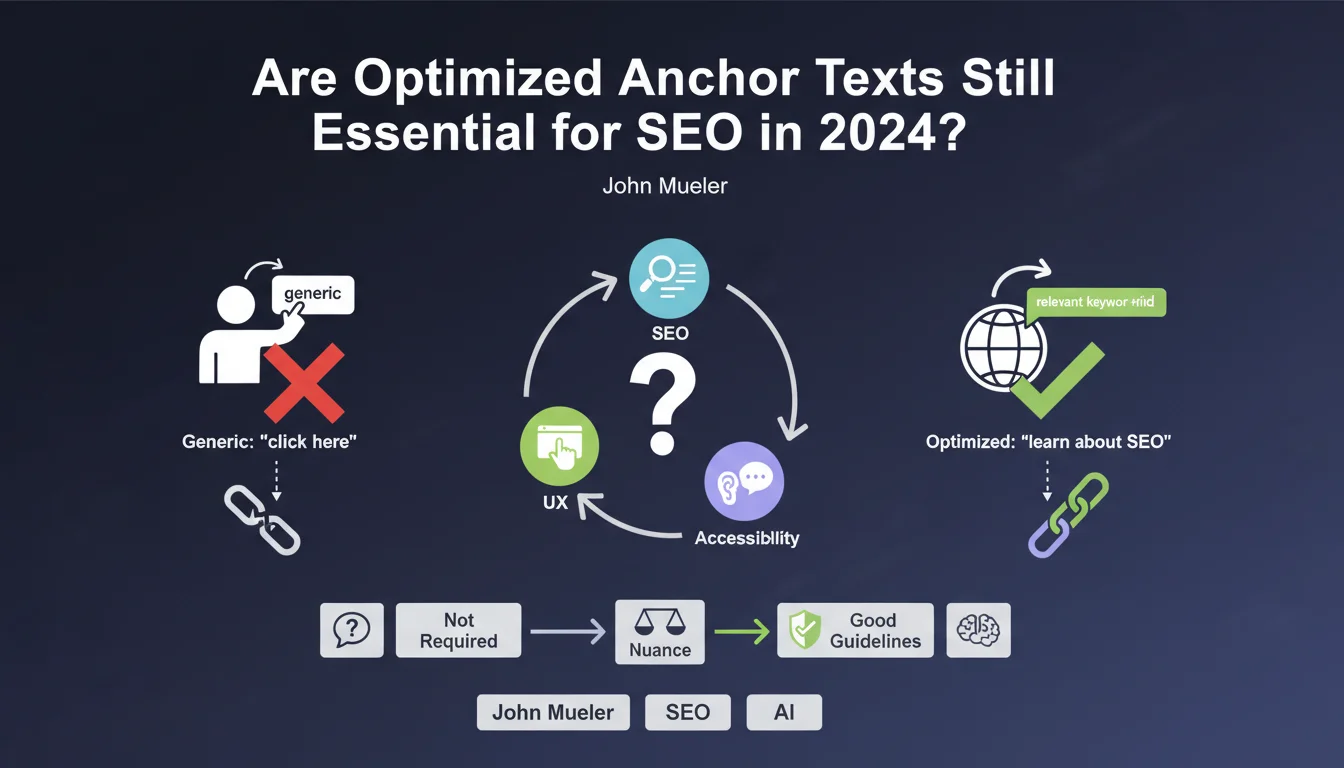
Google confirms that its guidelines on link best practices remain current, including recommendations concerning anchor text. These guidelines encourage the use of descriptive anchors rather than generic ones.
However, the important nuance lies in the fact that these are guidelines, not strict requirements. Google acknowledges that judgment must be exercised and these recommendations should not be applied rigidly.
- Link guidelines date from 2022-2023 and are still valid
- Using descriptive anchors remains a best practice
- These recommendations also serve accessibility and user experience
- These are not absolute rules but guidelines to be nuanced
Why does Google encourage certain anchors over others?
Google favors descriptive anchors because they allow users and search engines to better understand the content of the destination page. A link like "discover our complete guide on link building" is more informative than "click here".
This preference fits within a broader logic of improving user experience. Descriptive anchors also help people using screen readers, strengthening web accessibility.
What's the difference between a guideline and an SEO requirement?
A requirement implies a strict obligation whose non-compliance can lead to penalties. A guideline constitutes a best practice recommendation that improves quality but whose application can be flexible.
In this case, Google explicitly admits that a nuanced approach is justified. You won't be penalized for occasionally using "learn more", as long as your link profile remains natural and diversified.
SEO Expert opinion
Is this statement consistent with practices observed in the field?
Absolutely. Observations from the past 15 years show that sites with natural link profiles perform better than those that systematically over-optimize their anchors. Sites penalized by Penguin had precisely overly optimized and artificial anchor profiles.
Google's position reflects the evolution of its algorithms toward better understanding of semantic context. The engine no longer needs exact anchors to understand a page's theme thanks to BERT, MUM and now generative AI.
- Natural sites naturally use between 60-80% branded or generic anchors
- A ratio exceeding 30% exact match optimized anchors is often suspicious
- Anchor diversity has become a quality signal in itself
What nuances absolutely need to be applied to this guideline?
Link context plays a fundamental role. An internal link in structured interlinking can and should use optimized anchors to help Google understand your architecture. However, for external backlinks, naturalness takes priority.
There's also a notable difference between editorial links and navigation links. Menus, footers and navigation elements can legitimately use generic anchors like "Home" or "Contact" without any problem.
In what cases should this rule be applied differently?
For internal linking, you have much greater latitude. Your internal links can be predominantly optimized because you control your own site and Google knows it. It's even recommended to strengthen thematic understanding.
For established authority sites with strong brand recognition, the use of branded anchors naturally becomes predominant. A site like Amazon or Wikipedia doesn't need to optimize its anchors to rank.
Finally, in certain technical B2B niches, the use of precise terminology in anchors is natural and expected. A link between two scientific articles will logically use specific terms.
Practical impact and recommendations
What concretely needs to be changed in your link building strategy?
First, audit your current anchor profile to identify any over-optimization. Use tools like Ahrefs, Majestic or SEMrush to analyze your backlink anchor distribution.
Second, establish a diversified anchor matrix for your future link building campaigns. Aim for approximately 50-60% branded or URL anchors, 20-30% generic anchors, and only 10-20% optimized anchors.
- Analyze the current distribution of your anchors with a professional SEO tool
- Create a strategy document defining target ratios by anchor type
- Prioritize branded anchors and variations for new backlinks
- Use optimized anchors primarily in internal linking
- Systematically vary formulations to stay natural
- Integrate contextualized generic anchors ("this complete guide" rather than "click here")
What mistakes should absolutely be avoided with link anchors?
The most critical error remains excessive repetition of the same optimized anchor. If you get 20 backlinks with exactly "plumber Paris 15" as the anchor, you trigger all of Google's alarm signals.
Another frequent pitfall: neglecting the semantic context around the link. A descriptive anchor in a relevant paragraph is infinitely better than a perfect anchor in an off-topic context.
How can you implement a powerful and sustainable anchor strategy?
Start by documenting your target anchors by page type: commercial pages, blog articles, resource pages. Each type requires a differentiated approach with its own ratios.
For internal linking, create a contextual link system that's automated or semi-automated that varies anchors while remaining relevant. Modern CMSs allow this granularity.
In external link building, systematically brief your partners or writers on the importance of naturalness. Provide them with a list of varied anchors rather than a single formulation.
- Create an anchor tracking spreadsheet by strategic page
- Train content teams on anchor best practices
- Set up monitoring alerts on your anchor profile
- Test and measure the impact of different anchor strategies
- Reassess your anchor distribution quarterly
💬 Comments (0)
Be the first to comment.