
Official statement
Other statements from this video 7 ▾
- □ Does the way you produce content really matter to Google?
- □ Does Google really publish all the quality signals that matter for your rankings?
- □ Is robots.txt really enough to control crawling on specific sections of your website?
- □ Can you really block Google Extended to prevent your content from training Bard and Vertex AI?
- □ Do responsible crawlers really respect robots.txt, or is it just a polite suggestion?
- □ Do meta robots tags really give you precise indexation control?
- □ Are CMSs really integrating new SEO options as fast as Google claims they do?
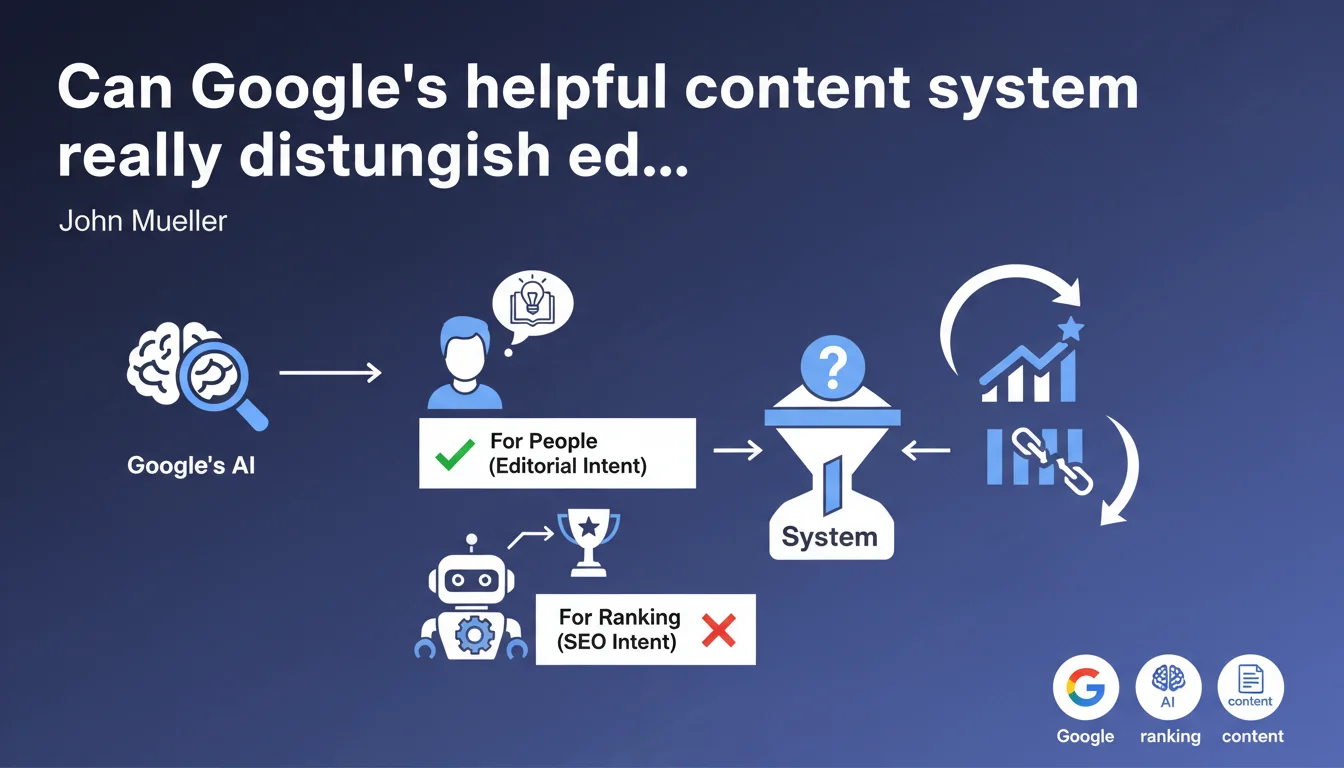
Google claims that its helpful content system identifies and prioritizes content created to meet user needs rather than to manipulate rankings. In practice, this means a site packed with SEO-optimized pages but poor in added value risks being penalized. The challenge: prove to the algorithm that your content serves the user first.
What you need to understand
What is the helpful content system and how does it work?
The helpful content system is a Google algorithmic filter designed to detect sites whose content appears to be primarily driven by SEO rather than genuine user utility. It is a site-wide ranking signal, not a manual penalty.
Unlike Panda (now integrated into the main algorithm), this system specifically targets editorial intent. A site can have grammatically correct, well-structured content, but if Google determines it exists solely to capture SEO traffic, it will be demoted.
How does Google evaluate the intention behind content?
Google uses behavioral signals (bounce rate, time spent, quick clicks back to SERPs) and semantic analysis to detect whether content genuinely answers a question or merely dances around the subject to place keywords.
Suspicious patterns include: generic content without a clear editorial angle, aggregating sub-questions without in-depth answers, lack of verifiable expertise. Simply put, if your page looks like an AI-generated FAQ compilation without added value, you're in the crosshairs.
What are the concrete criteria for content deemed helpful?
Google remains intentionally vague, but E-E-A-T (Experience, Expertise, Authoritativeness, Trustworthiness) is at the heart of the system. Helpful content brings a unique perspective, cites verifiable sources, and is written by someone who knows their subject.
- Does the content directly answer the search intent without detours?
- Does it provide insights the user won't find elsewhere?
- Is it written by someone with verifiable expertise or experience?
- Does it encourage users to stay on the page and interact (deep scrolling, internal clicks)?
- Does it avoid keyword stuffing and hollow paraphrasing techniques?
SEO Expert opinion
Is this statement consistent with real-world observations?
Yes, broadly speaking. Since the helpful content update rolled out, many affiliate sites, content farms, and question aggregators have seen their traffic collapse. Cookie-cutter "10 best products for X" articles without real testing, articles rephrasing information already available everywhere — they all took hits.
But — and here's where it gets tricky — the system isn't flawless. We still see SERPs where superficial but technically well-optimized content from authoritative domains outranks detailed articles published on lesser-known sites. [To verify]: the exact weighting of this signal against other ranking factors remains unclear.
What nuances should we add to this rule?
First, editorial intent isn't measured solely by writing style. An e-commerce site with detailed product sheets written by experts can be deemed helpful even if its ultimate goal is commercial. What matters is the added value provided to the user before conversion.
Second, beware of confirmation bias: some SEOs interpret any traffic drop as a content issue, when other factors (technical, toxic backlinks, cannibalization) might be at play. The helpful content system is one signal among many, not an absolute truth.
In what cases doesn't this rule fully apply?
On certain highly competitive informational queries, Google still heavily favors large authority domains (Wikipedia, established media sites) even if their content is sometimes less thorough than specialized sites. The helpful content system doesn't entirely compensate for historical PageRank weight.
Similarly, for transactional or local queries, other signals (reviews, proximity, business age) often outweigh editorial richness. A plumber with a basic but well-reviewed Google Business Profile will beat a competitor with a robust blog but no reviews.
Practical impact and recommendations
What should you do concretely to align with this system?
First step: audit your existing content. Identify low-engagement pages (high bounce rate, low visit duration, minimal scrolling) and ask yourself bluntly: if I landed on this page through Google, would I feel I found what I was looking for?
If the answer is no, you have three options: rewrite in depth to add real value, merge with another more comprehensive page, or delete and redirect with a 301. Don't leave mediocre content lying around dragging down your entire site.
What mistakes should you absolutely avoid?
Don't produce content just because a keyword tool says there's volume. If you have nothing original to say about "best CRM 2023," it's better to say nothing. Google is getting better at detecting generic content, even if well-written.
Also avoid the word count syndrome. A 3000-word article that repeats the same idea from 15 different angles is no better than an 800-word dense and precise article. What matters is information density, not volume.
How do you verify that your site aligns with Google's expectations?
Use Google Search Console to monitor your Core Web Vitals and engagement signals. A decent click-through rate (CTR) but an exploding bounce rate is a red flag. Compare your metrics with competitors using tools like SimilarWeb or SEMrush.
Test your content with real users — user testing sessions, post-read surveys, analysis of recurring comments and questions. If your readers consistently ask for clarification on a point, it means your content isn't thorough or clear enough.
- Audit all low-engagement pages and decide: improve, merge, or delete
- Prioritize content where you have verifiable expertise or experience
- Add E-E-A-T elements: identified authors, cited sources, testimonials, case studies
- Reduce the ratio of generic content to differentiated content across the site
- Monitor engagement metrics (time spent, scrolling, internal clicks) in Analytics
- Avoid keyword stuffing or automatic paraphrasing techniques
- Test your content with real users before publication
❓ Frequently Asked Questions
Le système de contenu utile est-il une pénalité manuelle ou algorithmique ?
Peut-on récupérer du trafic après avoir été touché par ce système ?
Un contenu généré par IA peut-il être considéré comme utile ?
Faut-il supprimer tous les articles de blog anciens peu performants ?
Le helpful content system affecte-t-il aussi les sites e-commerce ?
🎥 From the same video 7
Other SEO insights extracted from this same Google Search Central video · published on 01/11/2023
🎥 Watch the full video on YouTube →
💬 Comments (0)
Be the first to comment.