
Official statement
Other statements from this video 7 ▾
- □ La méthode de production du contenu importe-t-elle vraiment pour Google ?
- □ Le système de contenu utile de Google peut-il vraiment distinguer l'intention éditoriale ?
- □ Le robots.txt suffit-il vraiment à contrôler le crawl de zones spécifiques de votre site ?
- □ Comment Google Extended permet-il de bloquer l'indexation pour Bard et Vertex AI ?
- □ Le robots.txt est-il vraiment respecté par tous les crawlers ?
- □ Les robots meta tags permettent-ils vraiment un contrôle précis de l'indexation ?
- □ Les CMS intègrent-ils vraiment les nouvelles options SEO aussi rapidement que Google le prétend ?
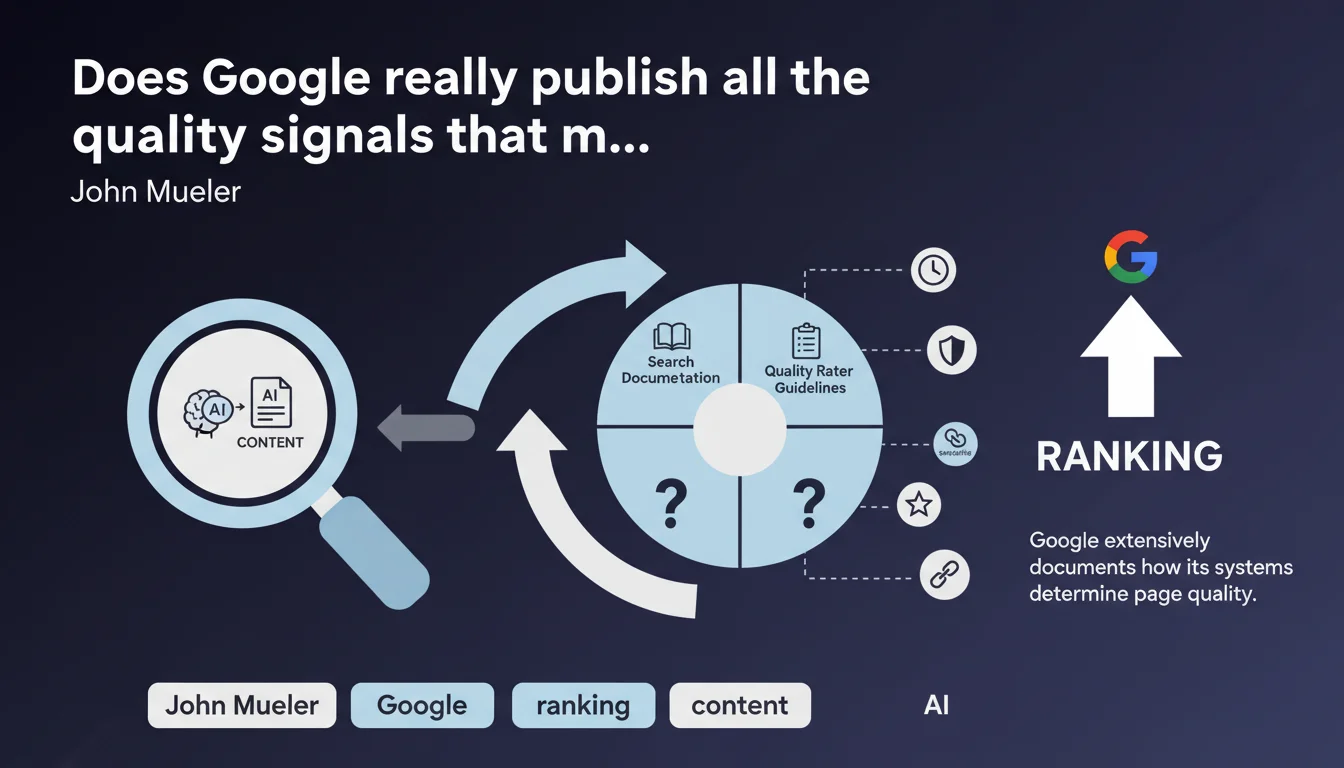
Google claims to publicly document all criteria used to evaluate page quality, whether content is AI-generated or not. This information is found in Search documentation and quality rater guidelines. However, this claim deserves nuance: certain signals remain intentionally vague or evolve without clear communication.
What you need to understand
Where does Google really document its quality criteria?
Google publishes two main resources: the official Search documentation (Search Central) covering technical and editorial basics, and the Search Quality Rater Guidelines, a 170+ page manual designed for human evaluators.
The Quality Rater Guidelines detail what Google considers high-quality content: expertise, authority, reliability (E-E-A-T), user utility, and absence of manipulation. These criteria apply regardless of how content is produced.
Does this documentation cover all ranking signals?
No. It outlines guiding principles and qualitative expectations, but doesn't explain how each algorithmic signal is weighted. Concrete example: Google documents the importance of E-E-A-T, but doesn't precisely reveal how the Helpful Content System measures expertise.
This distinction is crucial. You know what Google looks for (useful content, demonstrated expertise, smooth user experience), but not exactly how the algorithm detects it or what weight it applies.
Is AI-generated content treated differently?
Officially no — and Mueller reinforces this here. Google claims to evaluate the final result, not the production method. A well-sourced, fact-checked AI article with a unique perspective can theoretically outrank mediocre human content.
The catch? In practice, AI often produces detectable patterns: semantic redundancy, lack of nuance, generic formulations. Spam detection and Helpful Content algorithms pick up on these signals without necessarily naming them publicly.
- E-E-A-T remains the foundation: expertise, experience, authority, trustworthiness
- The Quality Rater Guidelines describe qualitative expectations, not algorithmic mechanisms
- Documentation explains the what, rarely the how or the weight of signals
- AI or human content: same theoretical evaluation framework, more nuanced reality on the ground
SEO Expert opinion
Does this announced transparency match reality on the ground?
Partially. Google does document its general expectations — that's undeniable. The Quality Rater Guidelines are public, detailed, and regularly updated. But calling this documentation "complete" is optimistic.
Concretely? You'll know Google values demonstrated expertise, but not how HCU (Helpful Content Update) precisely weights a detailed by-line versus a minimal author bio. You'll read that speed matters, but not the exact threshold where a 2.6s LCP becomes penalizing. [Verify]: the real impact of certain E-E-A-T signals largely remains based on correlations, not official confirmations.
What critical information remains intentionally vague?
Weightings and thresholds. Google rarely documents exact values or signal combinations. Example: you know backlinks matter, but not how the algorithm arbitrates between 50 average links and 5 excellent ones on a YMYL topic.
Another gray area: algorithm updates. Google communicates about Core Updates or Spam Updates after deployment, rarely before. Minor adjustments (and they're constant) receive no documentation. You learn through observation, testing, correlation — not official reading.
AI content perfectly illustrates this ambiguity. Google claims not to discriminate, but massive AI sites (automated content farms) took monumental hits during recent HCU rollouts. Coincidence or pattern detection? No documentation clarifies this.
In which cases is this documentation insufficient?
For anything involving advanced technical SEO and edge cases. Example: Google documents crawl budget in vague terms, but provides no threshold for 100K versus 1M page sites. You must extrapolate via server logs.
Same with spam. The Spam Policies state prohibitions (cloaking, deceptive redirects), but don't precisely define where the line is. Does a light promotional interstitial pass? Do you need 3 seconds or 5 before display? Radio silence.
Practical impact and recommendations
What should you actually do with this documentation?
Read the Quality Rater Guidelines at least once a year. Not skimming — really read them. They reveal Google's product philosophy: what the Search team considers a quality result. Use them as an audit framework: does your content meet expertise criteria? Does it demonstrate real experience?
Then cross this documentation with your ground truth data. Compare E-E-A-T recommendations with top 3 pages on your target queries. Observe the gaps: when Google's docs and the SERP diverge, it's often because other signals (domain authority, backlinks, CTR) compensate or dominate.
For AI content: follow the same standards as human content. Systematically add a layer of human expertise — personal analysis, proprietary data, unique angle. AI can draft the structure, but final editing must demonstrate deep subject understanding.
What errors should you absolutely avoid?
Don't treat Google documentation as an exhaustive instruction manual. It's a framework, not a recipe. Too many SEOs mechanically apply guidelines without understanding the broader algorithmic context. Result: content that's "compliant" on paper but drives no organic traction.
Also avoid neglecting undocumented signals. Google doesn't explicitly mention organic click-through rate (CTR) importance, yet A/B tests on title tags show measurable impact. Same for session duration or pogo-sticking. These behavioral metrics matter, even if they don't appear in official docs.
Final classic mistake: publishing raw AI content thinking that the lack of officially announced penalties protects you. Helpful Content Updates primarily targeted sites with generic, low-value-add content — often mass-produced via AI. If your text resembles 10,000 others, it doesn't matter if it's technically "correct."
How do you verify your site respects these criteria?
Conduct a rigorous E-E-A-T audit. For each strategic page: who's the author? Are their credentials visible and verifiable? Does the content cite reliable primary sources? Is there evidence of real experience (original data, case studies, testimonials)?
Test user perception via panels or tools like Hotjar. Content can technically check all Google boxes and still frustrate visitors. Pogo-sticking (immediate return to SERPs) is a warning signal: even if Google doesn't document it clearly, high bounce rate on informational queries raises red flags.
- Audit each page against E-E-A-T criteria from the Quality Rater Guidelines
- Verify authors display verifiable credentials (bio, LinkedIn/Twitter links, publications)
- Add primary sources for any factual claim (studies, official data)
- Evaluate AI content critically: does it offer a unique angle or rephrase existing material?
- Compare your top pages with positions 1-3 on your target queries — note qualitative gaps
- Monitor Core Web Vitals and mobile experience (PageSpeed Insights, Search Console)
- Analyze behavioral metrics (session duration, pages per visit) via GA4
❓ Frequently Asked Questions
Les Quality Rater Guidelines sont-elles un facteur de classement direct ?
Google pénalise-t-il spécifiquement le contenu généré par IA ?
Combien de critères de qualité Google utilise-t-il réellement ?
Faut-il prioriser E-E-A-T sur tous les types de contenu ?
La documentation Google suffit-elle pour optimiser un site correctement ?
🎥 From the same video 7
Other SEO insights extracted from this same Google Search Central video · published on 01/11/2023
🎥 Watch the full video on YouTube →
💬 Comments (0)
Be the first to comment.