
Official statement
Other statements from this video 16 ▾
- □ Are JavaScript Web Components really crawlable by Google's bots?
- □ Does Google really require FAQ Schema content to follow a strict presentation format?
- □ Does FAQ Schema Markup Really Guarantee That Your FAQ Snippets Will Show Up in Google?
- □ Should you really avoid duplicating your own content for SEO?
- □ Why does Google penalize excessive variations of the same content?
- □ Does Google really see your JavaScript content the way you do?
- □ Does your CMS really penalize your SEO compared to static HTML?
- □ Why aren't your pages getting indexed even though your site is technically flawless?
- □ Why have external user studies become essential for diagnosing quality issues that your team can no longer see?
- □ Should you really trust rel=canonical to control indexation?
- □ Are backlinks pointing to 404 pages really worthless for your SEO?
- □ Does the disavow tool really erase all traces of toxic links from Google's algorithms?
- □ Can an SSL certificate really penalize your search rankings?
- □ Does a progressive multi-domain ranking decline reveal a quality issue rather than a technical one?
- □ Does blocking Google Translate really impact your search rankings?
- □ Can the meta notranslate tag really remove the 'Translate this page' link from Google search results?
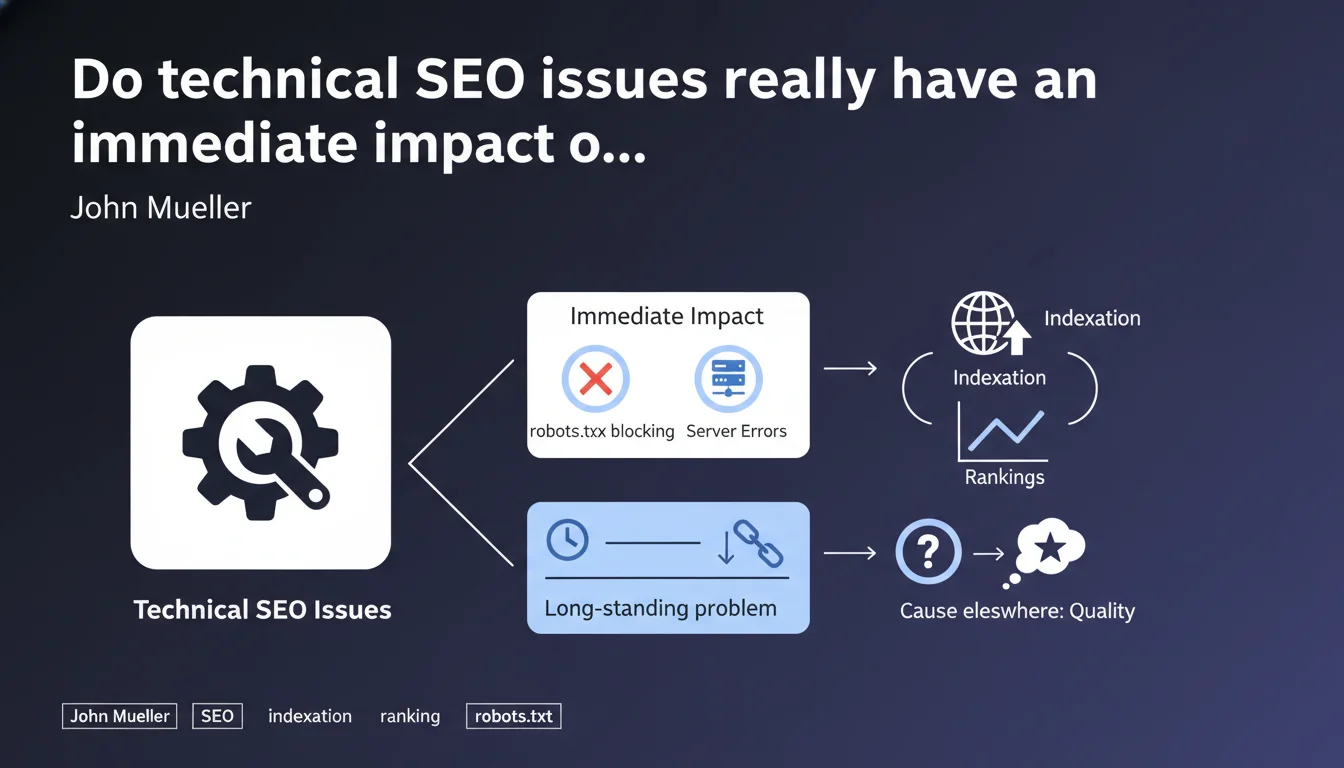
Real technical blockers (robots.txt, server errors) impact indexation instantly. If a technical issue has existed for months without visible consequences and traffic suddenly drops, look toward content quality rather than technical factors. Google clearly distinguishes between resource access problems and relevance problems.
What you need to understand
What are the "real" technical issues according to Google?
Mueller points the finger at access blockers and critical server errors. We're talking about a misconfigured robots.txt that prevents Googlebot from accessing entire sections, repeated HTTP 500 errors, or chronic server timeouts.
These issues physically prevent Google from crawling and indexing your pages. The effect is mechanical and immediate — no crawl, no indexation, no visibility. It's binary.
Why this distinction between technical and quality?
Many SEOs look for technical culprits when traffic drops. It's reassuring — a technical issue can be fixed, unlike content that has become outdated or surpassed by competitors.
Mueller reminds us here that if your site has been functioning correctly for months and Google crawls it without issue, a sudden drop is probably not technical. Quality algorithms (Helpful Content, Core Updates) then intervene, and that's a completely different battle.
What is the timeframe of a real technical issue?
The impact is almost instantaneous. A blocking robots.txt deployed by mistake? Your pages disappear from the index within days maximum. A server that regularly crashes? Google immediately reduces its crawl budget.
Conversely, if your supposed technical issue has existed for six months without consequence and a drop occurs today, you need to look elsewhere. Correlation is not causation.
- Immediate impact: blocking robots.txt, massive 5xx errors, DNS down, expired SSL certificate
- Progressive impact: moderate server slowness, soft 404, poorly managed pagination
- No direct impact: content quality, light internal duplication, non-optimized but valid HTML structure
- An old problem without visible effect is probably not the cause of a recent decline
SEO Expert opinion
Does this assertion hold up to field observations?
Yes, and it's actually one of the rare points where Google is perfectly aligned with what we observe. Technical blockers generate immediate alerts in Search Console. Indexation errors appear within 48-72 hours.
However — and this is where things get tricky — Mueller oversimplifies to an extreme. He opposes "technical" and "quality" as two separate universes. Reality? Many issues live in a gray zone.
What nuances should be added to this statement?
Take client-side rendered JavaScript. Technically, Google can crawl. But if rendering is slow or unstable, indexation becomes chaotic. Is it technical? Is it quality? Both, my friend.
Same observation for keyword cannibalization. Architectural problem (therefore technical) that generates semantic confusion (therefore quality). Or degraded Core Web Vitals — technically measurable, but the impact on ranking remains fuzzy and progressive, not binary.
[To verify]: Google never precisely defines where "technical" ends and where "quality" begins. This blurry boundary allows all interpretations.
In what cases does this rule not fully apply?
Site migrations are a textbook case. Technically, everything can work (301 redirects in place, robots.txt ok, fast server), but Google can take weeks to reevaluate authority and relevance in the new context.
Crawl budget issues on very large sites (millions of pages) also have a different effect. Google progressively reduces its exploration, the impact is not immediate but cumulative.
Practical impact and recommendations
How do you distinguish a real technical issue from a quality problem?
Analyze the timeframe. A major technical issue leaves immediate traces in Search Console: sharp drop in indexed pages, spike in server errors, explosion of crawl errors.
If your traffic curve plummets but Search Console remains silent on indexation errors, you're probably facing an algorithmic problem related to content quality or relevance.
What should you check first when traffic drops?
Start by eliminating obvious technical causes. Verify that Google can access your pages, that the server responds correctly, that the robots.txt hasn't been accidentally modified.
If everything is green on the technical side, pivot immediately to qualitative analysis: competitor positioning, content freshness, alignment with search intent, EEAT signals.
What tools should you use for quick diagnosis?
- Search Console: Coverage tab for indexation errors, Exploration statistics tab for crawl health
- Screaming Frog or Oncrawl: comprehensive audit of HTTP codes, response times, redirect chains
- Server logs: verify that Googlebot can access critical resources (JS, CSS, images)
- PageSpeed Insights: Core Web Vitals and rendering issues
- SERP comparison before/after: identify competitors who've taken your positions
- Content analysis: freshness, depth, differentiation vs competition
❓ Frequently Asked Questions
Combien de temps faut-il pour qu'un problème robots.txt impacte l'indexation ?
Une erreur 500 ponctuelle peut-elle faire chuter mon trafic durablement ?
Si mon site est lent mais accessible, est-ce un problème technique au sens de Mueller ?
Comment savoir si ma baisse de trafic vient d'une mise à jour algorithme ou d'un problème technique ?
Un contenu dupliqué est-il un problème technique ou de qualité ?
🎥 From the same video 16
Other SEO insights extracted from this same Google Search Central video · published on 08/05/2022
🎥 Watch the full video on YouTube →
💬 Comments (0)
Be the first to comment.