
Official statement
Other statements from this video 13 ▾
- □ Faut-il encore se fatiguer avec les données structurées si le machine learning fait le boulot ?
- □ Les données structurées donnent-elles vraiment du contrôle aux webmasters sur l'affichage Google ?
- □ Google vérifie-t-il réellement l'exactitude de vos données structurées ?
- □ Pourquoi Google recommande-t-il de commencer par les données structurées génériques ?
- □ Pourquoi votre Schema.org valide peut être rejeté par Google ?
- □ Faut-il implémenter des données structurées même si Google ne les utilise pas encore ?
- □ Les données structurées influencent-elles vraiment la compréhension du sujet d'une page par Google ?
- □ Les données structurées sont-elles vraiment utiles si Google comprend déjà votre page ?
- □ Faut-il vraiment bourrer vos pages de données structurées pour mieux ranker ?
- □ Faut-il abandonner JSON-LD au profit de Microdata pour les données structurées ?
- □ Le JSON-LD externe pose-t-il vraiment des problèmes de synchronisation pour Google ?
- □ Les outils de test Google sont-ils vraiment fiables pour détecter vos données structurées manquantes ?
- □ Les données structurées doivent-elles systématiquement refléter le contenu visible de la page ?
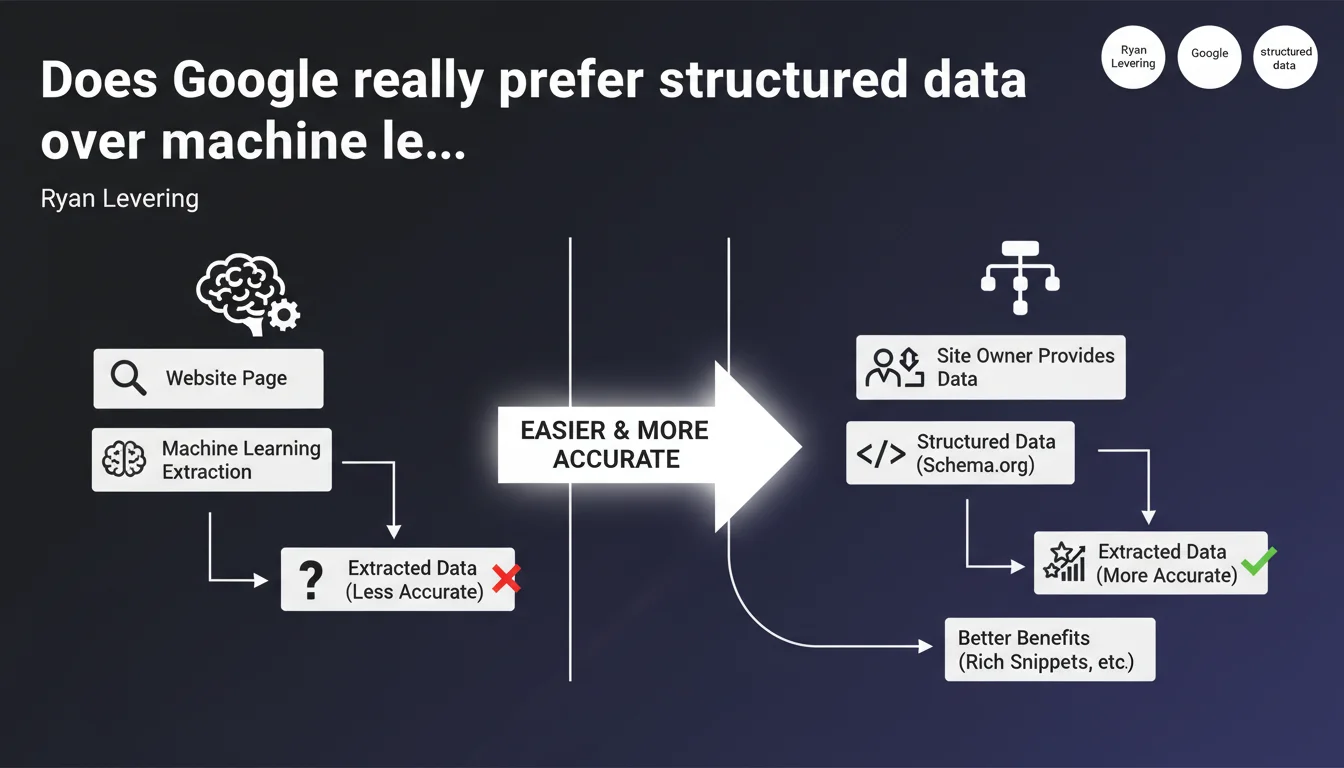
Google confirms that despite its machine learning capabilities, it is far more efficient and accurate to retrieve information through structured data provided directly by webmasters. This statement validates the strategic importance of Schema.org markup for improving the understanding and visibility of your content.
What you need to understand
Can't Google understand everything with its AI?
Contrary to what one might think, Google openly admits the limitations of its machine learning. Ryan Levering, an engineer at Google, explains that while the search engine is technically capable of extracting information from raw content, this approach remains less reliable than structured data provided voluntarily.
This statement contrasts sharply with the image of an all-powerful AI. Automatic extraction generates errors, rough interpretations, and even omissions. Structured data offers a clarity that ML cannot guarantee on its own.
What does this change for SERP visibility?
Rich results depend directly on the markup you implement. Without Schema.org, Google will have to guess — and it will sometimes guess wrong, or not at all. Result: you miss out on featured snippets, product cards, enriched FAQs.
Levering goes further by mentioning that the structured data provider receives direct benefits. Concretely: better representation in SERPs, improved click-through rate, privileged positioning on certain queries.
Which types of structured data does Google prioritize?
Google encourages Schema.org via JSON-LD for a wide range of types: articles, products, events, FAQs, recipes, local reviews, and more. Each type potentially activates specific enrichments in search results.
The underlying idea: the easier you make Google's job, the more it rewards you. It's a win-win exchange that saves the search engine expensive calculations and guarantees you better representation.
- Google's machine learning has recognized limitations for accurately extracting data from pages
- Structured data offers superior accuracy and activates rich results
- Providing Schema.org markup directly improves your visibility and your CTR in SERPs
- Google explicitly rewards those who structure their content
SEO Expert opinion
Is this position consistent with what we observe in the field?
Absolutely. For years, sites that correctly implement Schema.org dominate rich results. This statement confirms what practitioners observe daily: Google massively favors those who use proper markup.
There is, however, one caveat — and it's a significant one. Implementing Schema.org guarantees no rich result display. Google reserves the right to ignore your markup if it deems it irrelevant, manipulative, or of poor quality. Levering's statement remains incomplete: it doesn't detail the selection criteria for actual display.
What are the gray areas Google doesn't clarify?
Levering talks about "better benefits for the provider" without ever quantifying them. What real CTR gains? What impact on standard organic ranking? Google remains vague. [To verify]: does Schema.org markup directly influence positioning, or only the display?
Based on field observations, Schema.org is not a directly recognized ranking factor officially, but rich results mechanically boost CTR, which indirectly improves overall performance. Google never says this clearly — and that's probably no accident.
Should you systematically implement all available Schema types?
No, and that's a common mistake. Overloading a page with irrelevant or contradictory markup can result in manual or algorithmic penalties. Google Search Console regularly reports warnings for misleading markup.
Better to target Schema.org types that actually match your page content and that trigger useful enrichments for your audience. Quality over quantity.
Practical impact and recommendations
What should you implement as a priority on your site?
Start with Schema.org types that activate visible rich results: FAQ, HowTo, Product, Article, BreadcrumbList, Organization. These tags generate concrete SERP displays and improve CTR.
Consistently use JSON-LD rather than Microdata. Google explicitly recommends it because it separates markup from HTML and facilitates maintenance. The rich results test tool should validate without errors.
What common mistakes must you absolutely avoid?
Never invent data that doesn't exist: fictional reviews, incorrect prices, false availability. Google detects these manipulations and can penalize the entire domain, not just the affected page.
Another trap: duplicating the same JSON-LD markup across all pages on a site. Each page should have its own Schema.org adapted to its specific content. A generic empty template will be ignored or penalized.
How do you verify your implementation is correct?
Three essential tools: Google Search Console ("Enhancements" report), the Schema.org validator, and Google's rich results test. Monitor errors and warnings — they indicate what Google doesn't understand or refuses to display.
Regularly test your pages in actual SERPs. If your markup doesn't appear after several weeks, it's either a technical issue or Google judges the content ineligible. Adjust accordingly.
- Implement JSON-LD for Article, Product, FAQ, HowTo based on your content
- Validate markup with Google Search Console and the rich results test
- Never lie in structured data (reviews, prices, availability)
- Adapt Schema.org to each page, no generic templates
- Monitor error reports in GSC and correct quickly
- Verify actual display in SERPs after deployment
❓ Frequently Asked Questions
Le balisage Schema.org améliore-t-il directement le positionnement dans Google ?
Dois-je utiliser JSON-LD ou Microdata pour mes données structurées ?
Pourquoi mon balisage Schema.org validé n'apparaît-il pas en SERP ?
Puis-je être pénalisé pour un balisage Schema.org incorrect ?
Quels types de Schema.org génèrent le plus de résultats enrichis visibles ?
🎥 From the same video 13
Other SEO insights extracted from this same Google Search Central video · published on 07/04/2022
🎥 Watch the full video on YouTube →
💬 Comments (0)
Be the first to comment.