
Official statement
Other statements from this video 13 ▾
- □ Pourquoi Google préfère-t-il les données structurées au machine learning pour comprendre vos pages ?
- □ Faut-il encore se fatiguer avec les données structurées si le machine learning fait le boulot ?
- □ Les données structurées donnent-elles vraiment du contrôle aux webmasters sur l'affichage Google ?
- □ Google vérifie-t-il réellement l'exactitude de vos données structurées ?
- □ Pourquoi votre Schema.org valide peut être rejeté par Google ?
- □ Faut-il implémenter des données structurées même si Google ne les utilise pas encore ?
- □ Les données structurées influencent-elles vraiment la compréhension du sujet d'une page par Google ?
- □ Les données structurées sont-elles vraiment utiles si Google comprend déjà votre page ?
- □ Faut-il vraiment bourrer vos pages de données structurées pour mieux ranker ?
- □ Faut-il abandonner JSON-LD au profit de Microdata pour les données structurées ?
- □ Le JSON-LD externe pose-t-il vraiment des problèmes de synchronisation pour Google ?
- □ Les outils de test Google sont-ils vraiment fiables pour détecter vos données structurées manquantes ?
- □ Les données structurées doivent-elles systématiquement refléter le contenu visible de la page ?
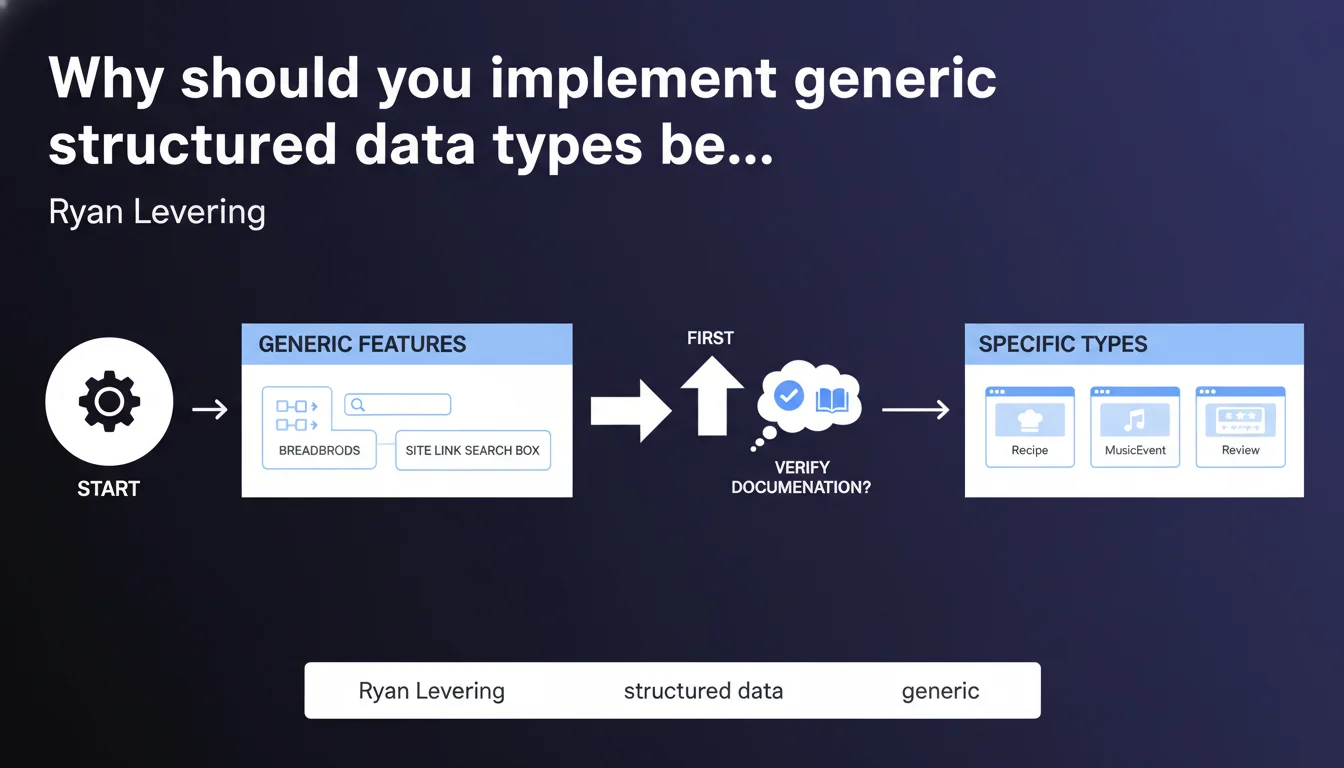
Ryan Levering from Google recommends beginning your structured data implementation with generic types (breadcrumbs, site search box) before moving on to specific types. This pragmatic approach helps you avoid scattered efforts and establish solid foundations for search engines to understand your site.
What you need to understand
Why should you prioritize generic structured data types first?
Google distinguishes between two categories of structured data: generic types that apply to almost all sites (breadcrumbs, site search box) and specific types linked to your industry (recipes, products, events, FAQs, etc.).
The logic is straightforward: start with universal foundations rather than spreading yourself thin across niche implementations. Breadcrumbs and search boxes provide Google with basic structural understanding of your site architecture and navigation features.
What does this approach reveal about Google's strategy?
This recommendation exposes a reality: too many sites implement complex structured data (Article, Product, Recipe) without laying the groundwork first. The result: inconsistencies, cascading errors, and wasted time in Search Console.
Google is implicitly telling you: learn to walk before you run. Generic types are your training ground — simpler, fewer validations to manage, fewer risks of blocking errors.
Which generic types must you absolutely master?
- Breadcrumbs: indicate navigation hierarchy and improve display in SERPs
- Site Search Box: allows Google to display a search field directly in results for certain branded queries
- Logo and organization information (Organization schema): consolidate your entity's identity in the Knowledge Graph
- These three types are universal, easy to validate, and deliver immediate benefits without requiring specific content
SEO Expert opinion
Is this progressive approach really relevant for all websites?
Let's be honest: Levering's recommendation is perfect for a standard corporate site or a generalist blog. But it becomes questionable for a pure e-commerce site or a recipe platform where Product or Recipe structured data is the heart of your SEO strategy.
In those cases, delaying the implementation of specific types makes no sense. You'd be missing critical rich snippets for your visibility. The real question: do you have the resources to implement properly from the start? If yes, go after specific types in parallel.
What isn't Google saying in this statement?
What's critically missing here: no data on the actual impact of breadcrumbs or search box on ranking. Google talks about "features," not "performance." [To verify] against your own data: did adding breadcrumbs change your CTR or positioning?
Another blind spot: Google doesn't mention the relative weight of different structured data types in its algorithm. We implement in the dark, hoping it counts — without knowing how much.
In which cases could this approach be counterproductive?
If you have a specialized site (recipes, real estate, jobs, events), waiting to implement specific types means letting your competitors occupy the rich results space. The window of opportunity closes fast.
Similarly, if your tech team has limited sprints, wasting time on a search box nobody will use while your product sheets lack Product structured data is a strategic mistake. Prioritize based on your business model, not generic Google advice.
Practical impact and recommendations
What's the best implementation sequence for my site?
If you're starting from scratch: definitely begin with breadcrumbs. They're simple, universal, and immediately improve the readability of your URLs in SERPs. That's the quick win par excellence.
Next, evaluate whether the site search box makes sense for your brand. If you don't have significant branded search volume, skip straight to specific types (Product, Article, FAQ, etc.) that match your content.
For an e-commerce or media site, this sequence is more relevant: breadcrumbs → Product/Article → Organization/Logo → FAQ if relevant → site search box last if branded query volume justifies it.
How can you avoid common implementation mistakes?
Mistake number one: implementing breadcrumbs that don't match your actual navigation. Google detects inconsistencies between the markup and visible architecture. Always test with the Rich Results Test tool before deploying to production.
Second pitfall: believing that more structured data = better ranking. It's not a direct ranking factor. Structured data activates features (rich snippets, Knowledge Graph) that can improve your CTR, but they don't magically boost your positions.
What should you do right now?
- Audit your current implementation in Search Console (Enhancements section)
- Prioritize breadcrumbs if you don't have them — it's the universal quick win
- Identify specific types relevant to your industry (Product, Recipe, Event, Article, etc.)
- Test each implementation with Google's validation tool before deployment
- Track the evolution of your rich results and CTR in Search Console over at least 3 months
- Don't scatter your efforts: 2-3 well-implemented types are better than 10 rushed ones
❓ Frequently Asked Questions
Les breadcrumbs sont-ils vraiment un facteur de ranking ?
Dois-je implémenter tous les types de structured data disponibles ?
Combien de temps faut-il pour voir l'impact des données structurées ?
La site search box dans les résultats Google est-elle utile pour tous les sites ?
Faut-il utiliser JSON-LD, Microdata ou RDFa pour implémenter les structured data ?
🎥 From the same video 13
Other SEO insights extracted from this same Google Search Central video · published on 07/04/2022
🎥 Watch the full video on YouTube →
💬 Comments (0)
Be the first to comment.