
Official statement
Other statements from this video 13 ▾
- □ Pourquoi Google préfère-t-il les données structurées au machine learning pour comprendre vos pages ?
- □ Faut-il encore se fatiguer avec les données structurées si le machine learning fait le boulot ?
- □ Les données structurées donnent-elles vraiment du contrôle aux webmasters sur l'affichage Google ?
- □ Google vérifie-t-il réellement l'exactitude de vos données structurées ?
- □ Pourquoi Google recommande-t-il de commencer par les données structurées génériques ?
- □ Pourquoi votre Schema.org valide peut être rejeté par Google ?
- □ Faut-il implémenter des données structurées même si Google ne les utilise pas encore ?
- □ Les données structurées sont-elles vraiment utiles si Google comprend déjà votre page ?
- □ Faut-il vraiment bourrer vos pages de données structurées pour mieux ranker ?
- □ Faut-il abandonner JSON-LD au profit de Microdata pour les données structurées ?
- □ Le JSON-LD externe pose-t-il vraiment des problèmes de synchronisation pour Google ?
- □ Les outils de test Google sont-ils vraiment fiables pour détecter vos données structurées manquantes ?
- □ Les données structurées doivent-elles systématiquement refléter le contenu visible de la page ?
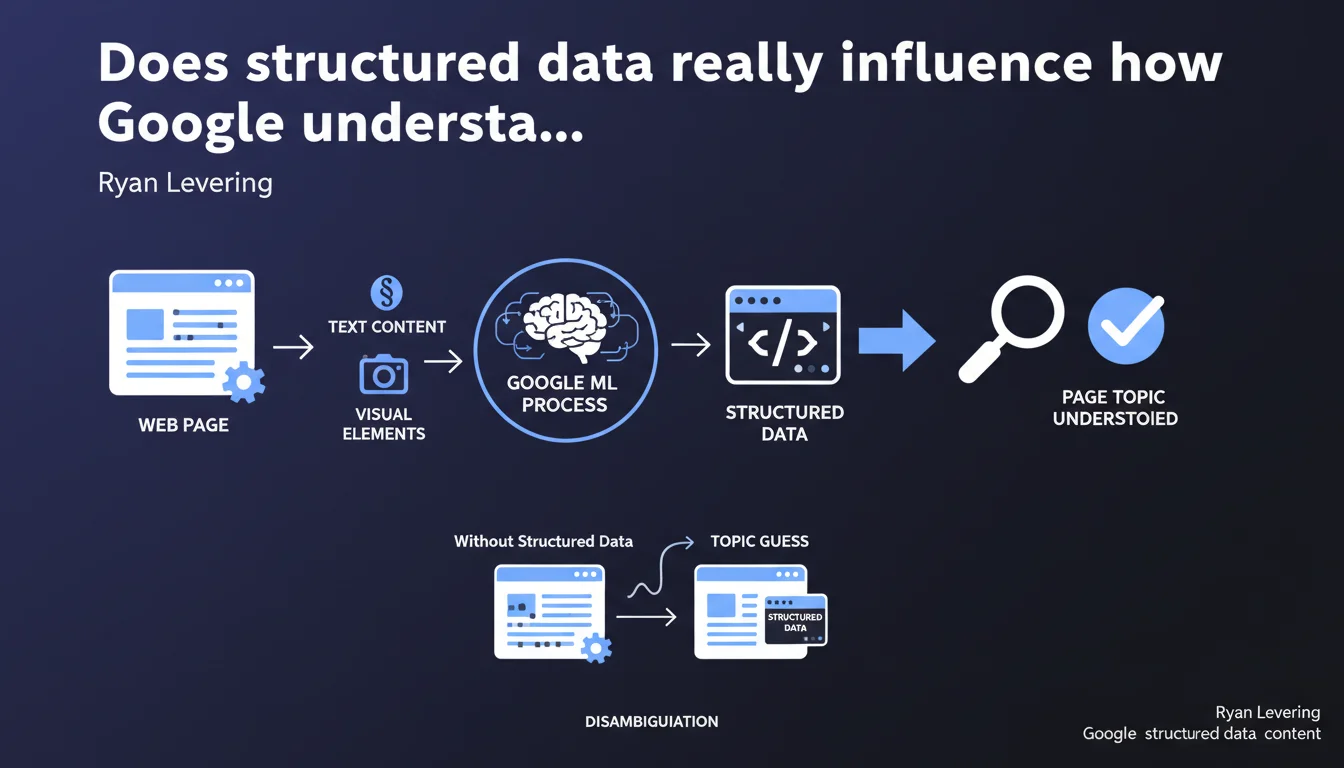
Google uses structured markup as an ML signal to understand a page's topic, just like text and other elements. In practice: structured data isn't just for generating rich snippets—it helps the algorithm resolve ambiguities about a page's actual content.
What you need to understand
Does Google treat structured data as just fancy rich display?
No. Ryan Levering is clear: structured data is part of the content understanding system, not just the display system. It serves as a signal to the machine learning model that determines what a page is about.
This means a page with properly implemented schema.org gives Google an extra clue to choose between multiple possible interpretations of the text. If your text is ambiguous—say, a recipe that mentions a "dish" without specifying the type—Recipe markup clarifies the intent.
What does Google mean by "disambiguating actual content"?
Disambiguation is the process that lets Google pick the right meaning when a word or page can have multiple senses. Classic example: the word "jaguar" can mean an animal, a car, or a sports team.
If your page discusses jaguars without other context, Google will cross-reference the text, images, internal links… and structured data. Marking it with Animal or Vehicle schema helps the engine decide quickly.
Are structured data a signal among many or a priority signal?
Levering makes it clear: one signal among many. They're neither dominant nor negligible. They integrate into an ML signal set where text remains the main pillar.
Practical translation: don't count on schema.org alone to save a poorly written page. But if your content is already solid, structured data can tip the scales in borderline cases.
- Structured data feeds the understanding model, not just rich result display.
- They're especially useful for clarifying content type ambiguity (recipe, product, event, article, etc.).
- They don't replace clear, well-written text content—they complement it.
- Schema.org markup serves as an ML signal just like link anchors or meta tags.
SEO Expert opinion
Is this statement consistent with what we observe in practice?
Yes. For years, we've seen that pages with structured data tend to rank better on ambiguous queries, even when they don't display a rich snippet. That's no coincidence.
Concrete example: an e-commerce page that switches from generic Article markup to Product sometimes sees position climbs on transactional queries, with no text changes. Google better understands the commercial intent.
One gray area remains: exactly what weight does Google give structured data versus text? Levering provides no numbers. [To verify]: we don't know if this signal weighs 5% or 20% in the overall equation.
Can you manipulate Google by lying in markup?
Technically, nothing prevents you from marking a product page as an Article or fake Recipe. But Google cross-checks signals—if the text discusses vacuums and you markup as Recipe, the engine detects the inconsistency.
Worse: inconsistent structured data can create noise and disrupt understanding rather than improve it. It's not a viable spam lever.
In what cases do structured data change nothing?
Let's be honest: on an ultra-clear page with explicit title, unambiguous content and obvious context, structured markup probably won't help understanding. Google already knows what you're talking about.
It's in the gray zones—multithematic content, polysemic vocabulary, hybrid pages—where schema.org makes the difference. A blog page discussing an event without clarifying if it's a recap or announcement: an Event markup resolves the doubt.
Practical impact and recommendations
What should you markup first to improve understanding?
Focus on content types where ambiguity is common: e-commerce products (Product), recipes (Recipe), events (Event), authored articles (Article), FAQs, job postings (JobPosting). These types help Google decide quickly.
Also markup entities: people (Person), organizations (Organization), locations (Place). If your page discusses a local business, LocalBusiness markup clarifies intent better than plain text.
How do you verify that your structured data actually helps Google?
Use Google's Rich Results Test to validate syntax—but that's not enough. Verify that the markup faithfully reflects what users see on screen.
Tip: compare performance of similar pages, some with schema.org, others without. If you see a position difference on ambiguous queries, you have your answer. No rich snippet needed to measure understanding impact.
What errors should you absolutely avoid?
Don't markup multiple contradictory types on the same page (ex: Product + Recipe). Google won't know which signal to prioritize. Choose the type most representative of main content.
Also avoid generic markup when specific types exist. Marking a product as Article when Product exists is wasting a clarification opportunity.
- Audit your strategic pages to identify those with potentially ambiguous content.
- Implement the most precise schema.org possible: Product for product pages, Recipe for recipes, Event for events.
- Test your tags with Rich Results Test and Search Console.
- Verify consistency between visible text and structured data—no hidden or false information.
- Prioritize markup types matching your target queries (ex: LocalBusiness for local SEO).
- Monitor impact via positions on queries where intent may be ambiguous.
Structured data is no longer an optional bonus reserved for rich snippets. It's an integral part of Google's understanding engine, especially in ambiguous contexts. Coherent, precise markup improves the odds that Google interprets your page correctly.
That said, implementing comprehensive schema.org across a multi-thousand-page site—with consistency, technical validity, and strategic alignment—requires specialized expertise. If your team lacks time or ML/SEO skills, partnering with a specialized agency can accelerate deployment and avoid costly mistakes.
❓ Frequently Asked Questions
Les données structurées améliorent-elles le ranking même sans rich snippet ?
Faut-il baliser toutes les pages ou seulement certaines ?
Peut-on utiliser plusieurs types de schema.org sur une même page ?
Google pénalise-t-il les erreurs de balisage structuré ?
Le balisage structuré remplace-t-il un contenu de qualité ?
🎥 From the same video 13
Other SEO insights extracted from this same Google Search Central video · published on 07/04/2022
🎥 Watch the full video on YouTube →
💬 Comments (0)
Be the first to comment.