
Official statement
Other statements from this video 13 ▾
- □ Pourquoi Google préfère-t-il les données structurées au machine learning pour comprendre vos pages ?
- □ Faut-il encore se fatiguer avec les données structurées si le machine learning fait le boulot ?
- □ Les données structurées donnent-elles vraiment du contrôle aux webmasters sur l'affichage Google ?
- □ Google vérifie-t-il réellement l'exactitude de vos données structurées ?
- □ Pourquoi Google recommande-t-il de commencer par les données structurées génériques ?
- □ Pourquoi votre Schema.org valide peut être rejeté par Google ?
- □ Faut-il implémenter des données structurées même si Google ne les utilise pas encore ?
- □ Les données structurées influencent-elles vraiment la compréhension du sujet d'une page par Google ?
- □ Les données structurées sont-elles vraiment utiles si Google comprend déjà votre page ?
- □ Faut-il abandonner JSON-LD au profit de Microdata pour les données structurées ?
- □ Le JSON-LD externe pose-t-il vraiment des problèmes de synchronisation pour Google ?
- □ Les outils de test Google sont-ils vraiment fiables pour détecter vos données structurées manquantes ?
- □ Les données structurées doivent-elles systématiquement refléter le contenu visible de la page ?
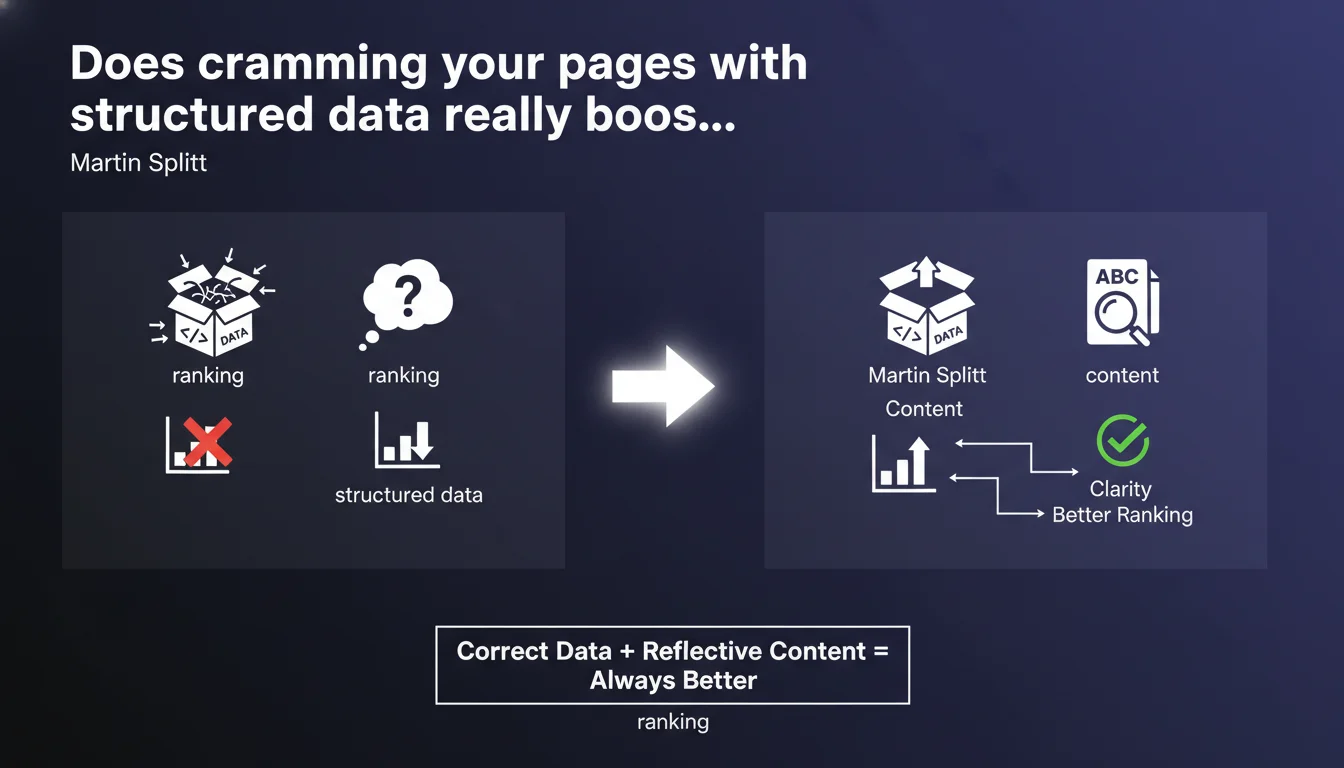
Martin Splitt argues that more structured data is always better — as long as it's accurate and reflects visible page content. In other words: enriching your Schema.org markup never hurts, provided you stay honest. But this blanket statement masks some important technical nuances.
What you need to understand
What does Google mean by "more data"?
Google is talking about structured data — the Schema.org markup that helps search engines understand page content. The idea: if you have a product, don't settle for the bare minimum (name, price). Add reviews, availability, variants, extra images.
Splitt drives home one point: this data must reflect what the user actually sees. No hidden markup, no 5-star rating if no reviews are displayed. The consistency between markup and visible content remains the hard line.
Why is Google pushing for this data explosion?
The more structured information you provide, the more varied rich snippets Google can generate — prices, images, FAQs, recipes, events. These enriched snippets boost CTR, thus user experience, thus (theoretically) your rankings.
But let's be honest: Google benefits too. Each structured data point = less interpretation work for the engine, and more opportunities for direct SERP display without clicks to your site.
Does this statement apply to all markup types?
In theory, yes. In practice, not all schemas are equal. Some (Product, Recipe, Event) have direct impact on SERP display. Others (Organization, WebSite) mainly serve internal understanding.
And here's the catch: Splitt doesn't clarify whether "always better" means "always displayed" or just "always considered". That distinction is crucial.
- More markup = more rich snippet opportunities, but no guarantee of display
- Data must absolutely match the content visible to the user
- Google doesn't penalize adding correct data, even in large volumes
- Different Schema.org types don't all have the same ROI in visibility
SEO Expert opinion
Is this claim consistent with what we see in practice?
Yes and no. In consulting, I've genuinely seen sites gain stars, carousels, or FAQ boxes after enriching their markup. Adding correct data never hurts — that's verified.
But "always better"? [To verify]. Some highly complete markups generate zero special display. Google chooses what it shows based on opaque criteria: relevance, competition, query type. Fully enriching a LocalBusiness or Organization schema sometimes yields nothing visible in SERP.
What risks does this blanket statement hide?
The main pitfall: confusing quantity with relevance. I've seen clients add 15 different schema types to a single page — result: noise, confusion, and sometimes cascading validation errors.
Another problem: maintenance burden. The more markup you add, the more you have to keep it current. An outdated price, a 404 image, a deleted review… and your "rich snippet" vanishes. Google never mentions that "more data" = more work to maintain.
In what cases does this rule NOT apply?
If your structured data contradicts visible content, you risk manual action for deceptive markup. If you mark a product as "in stock" when it isn't, "more data" becomes "more problems".
Similarly, some schemas — like SpeakableSpecification or Accessibility — are still experimental. Filling them may be "correct", but SEO impact is null or uncertain. Splitt makes no distinction between active and dormant schemas.
Practical impact and recommendations
Concretely, which structured data should you prioritize?
Start with schemas with direct SERP impact: Product (price, reviews, availability), Recipe (time, calories, rating), Event (date, location, price), FAQ, HowTo. These generate the most visible rich snippets.
Next, strengthen context schemas: Organization, BreadcrumbList, WebSite (sitelinks searchbox). They don't change display, but help Google understand your structure better.
Finally, if you have the bandwidth, enrich optional properties of your main schemas: additional images, product variants, article author with photo, etc. This is where "more data" really shines — but only after securing the basics.
What critical mistakes should you avoid?
Never mark what isn't visible. If you don't display reviews on the page, don't include them in the markup. Google compares structured data with rendered content — any inconsistency can result in rich snippet removal, or even a manual penalty.
Also avoid generic copy-paste markup. Every page has unique content, so unique markup. An Article doesn't get marked up like a Product, a LocalBusiness doesn't get marked up like a national Organization.
- Audit priority pages and identify missing or incomplete schemas
- Use Google's Rich Results Test tool to validate each markup
- Check for strict consistency between structured data and visible content
- Enrich progressively: first required properties, then recommended, then optional
- Monitor Search Console for markup errors and fix them immediately
- Automate markup generation if possible (CMS, plugin, script) to prevent manual errors
❓ Frequently Asked Questions
Peut-on être pénalisé pour avoir trop de données structurées ?
Tous les schemas Schema.org sont-ils utiles pour le SEO ?
Faut-il marquer chaque élément optionnel d'un schema ?
Le markup JSON-LD est-il toujours préféré par Google ?
Les données structurées influencent-elles directement le classement ?
🎥 From the same video 13
Other SEO insights extracted from this same Google Search Central video · published on 07/04/2022
🎥 Watch the full video on YouTube →
💬 Comments (0)
Be the first to comment.