
Official statement
Other statements from this video 13 ▾
- □ Can you manage multiple websites without triggering SEO penalties?
- □ Does the dash vs underscore distinction in URLs really impact your SEO rankings?
- □ Does noindex follow really guarantee that Google will explore your internal links?
- □ Does Google Really Ignore URL Fragments with # for SEO Rankings?
- □ Do short 503 errors really impact your site's crawl rate?
- □ Why is noindex more effective than robots.txt for hiding a site from Google?
- □ Does switching web hosting really hurt your search engine rankings?
- □ Is the Indexing API really restricted to job postings and events only?
- □ Should you really ban text embedded directly in images?
- □ Does having duplicate burger menus in your DOM hurt your SEO rankings?
- □ Can you really target multiple countries with a single page using hreflang?
- □ Do external 404 errors really hurt your Google rankings?
- □ Do you really need a sitemap.xml to rank well on Google?
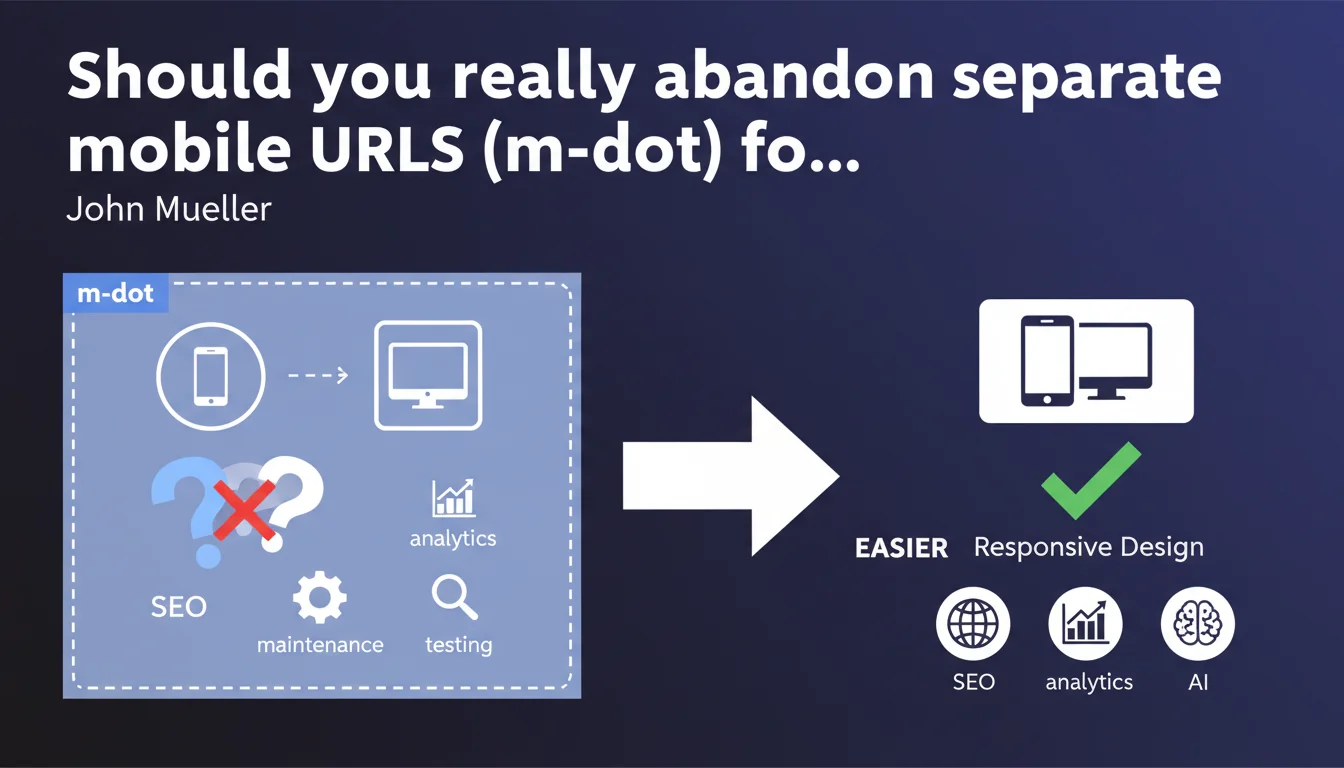
Google claims that maintaining distinct URLs for mobile and desktop versions unnecessarily complicates SEO, analytics, and maintenance. Responsive design remains the officially recommended solution. This position aims to simplify the web ecosystem, even though some high-traffic sites continue to successfully use separate URLs.
What you need to understand
This statement is part of a simplification strategy that Google has been pushing since the arrival of the Mobile-First Index. The goal? To reduce technical configurations that generate problems with duplication, canonicalization, and signal fragmentation.
Mueller isn't saying that separate URLs (m-dot) are penalized — he's saying they complicate things. An important distinction.
Why is Google so insistent about this issue?
Because m-dot configurations generate recurring errors: misconfigured canonical tags, incorrect redirects, missing or inverted rel=alternate/canonical annotations. Googlebot must crawl two versions of the site, which doubles the technical load and the risk of inconsistencies.
For Google, every technical complication is a potential source of poor indexation. And when you multiply that across millions of sites, the search engine loses efficiency.
What does this actually change for an existing site?
If your site already uses separate URLs and everything is working correctly — crawling, indexation, rankings — you're not forced to migrate tomorrow. Google continues to support this configuration.
The message is rather aimed at new projects or redesigns: don't start with this architecture without a valid reason.
- Separate URLs (m-dot) remain technically supported by Google
- They complicate SEO technical aspects: canonicalization, annotations, redirects
- Responsive design simplifies management and reduces configuration errors
- Google doesn't penalize m-dot — it discourages it for practical reasons
- Analytics and A/B testing become more complex with two distinct URLs
SEO Expert opinion
Is this statement consistent with practices observed in the field?
Yes and no. In principle, Mueller is right: m-dot configurations are objectively heavier to maintain. But saying it's "unnecessary" is a shortcut.
Sites like Amazon, eBay, or Wikipedia still use separate URLs in certain regions. Why? Because they have complex legacy infrastructures, specific performance constraints, or separate teams managing mobile and desktop. For them, a migration to responsive would represent a massive project with real business risks.
In what cases doesn't this rule necessarily apply?
If you have a radically different user experience between mobile and desktop — not just a rearrangement of columns, but distinct business logic — separate URLs can still be justified. Typically: a desktop-first B2B platform with a dedicated mobile app serving a simplified user journey.
[To verify]: Google provides no figures on the actual impact of well-configured m-dot versus responsive. We're talking about "complication," but without quantitative data on any potential SEO performance gap. My field experience shows that correctly implemented m-dot suffers no visible disadvantage in terms of rankings.
What are the real reasons behind this recommendation?
Let's be honest: Google pushes responsive because it simplifies their own work. Less crawling, fewer configuration errors to manage, less support to provide. This is a recommendation that serves Google as much as webmasters.
Practical impact and recommendations
What should you do if you're launching a new site today?
Go straight for responsive design. No debate. Modern frameworks (Next.js, Nuxt, even WordPress with a good theme) handle this natively. You avoid all the technical complexity of annotations, user-agent-based redirects, and duplicate canonicals.
If you have extreme performance needs, consider a server-side adaptive approach (SSR with device detection) instead of separate URLs.
What if you already have a site with separate URLs?
Evaluate the cost-benefit of migration. If your current configuration works without errors — check Search Console for canonical issues, crawl problems, indexation issues — don't touch anything unless you have a redesign planned.
However, if you notice inconsistencies (non-indexed mobile pages, duplication, missing annotations), this is the time to plan a migration to responsive.
How can you verify that your current configuration isn't penalizing you?
- Audit Search Console: look for canonical errors, non-indexed mobile pages, annotation warnings
- Verify that each desktop URL points to its mobile version via rel=alternate
- Make sure each mobile URL returns to desktop via rel=canonical
- Test redirects: a mobile user-agent on the desktop URL should redirect to m-dot (and vice versa for desktop on m-dot)
- Compare mobile vs desktop indexation rate in your server logs and Google Search Console
- Monitor crawl time: if Googlebot spends twice as much time as necessary, it's a sign of sub-optimal configuration
Responsive design is the recommended path for any new project. For existing m-dot sites, migration is justified only if you're encountering recurring technical problems or if a redesign is already planned.
These technical decisions and associated SEO migrations require specialized expertise to avoid traffic losses. If you're considering a redesign or your current configuration shows signs of weakness, support from a specialized SEO agency can save you time and secure the transition, particularly on critical aspects of redirects and signal consolidation.
❓ Frequently Asked Questions
Google pénalise-t-il les sites avec URLs mobiles séparées (m-dot) ?
Dois-je migrer mon site m-dot vers du responsive immédiatement ?
Le responsive design est-il toujours plus performant en termes de SEO ?
Quels sont les pièges principaux d'une configuration m-dot ?
Peut-on combiner responsive et URLs séparées sur un même site ?
🎥 From the same video 13
Other SEO insights extracted from this same Google Search Central video · published on 18/04/2024
🎥 Watch the full video on YouTube →
💬 Comments (0)
Be the first to comment.