
Official statement
Other statements from this video 9 ▾
- □ Does Google's new Search Status Dashboard really eliminate the need to monitor Twitter for search outages?
- □ Which incidents does Google officially communicate on its status dashboard?
- □ Why doesn't Google inform you about all of its technical incidents?
- □ What are the two hidden channels Google uses to detect search engine incidents?
- □ Should you really sit tight when Google reports an incident on the dashboard?
- □ Does Google really guarantee regular updates on its search incidents?
- □ Why did Google technically separate its Search Status Dashboard from google.com?
- □ Should you subscribe to the Search Status Dashboard RSS feed to anticipate Google incidents?
- □ Why doesn't Google consider a single site's ranking drop as a system-wide incident?
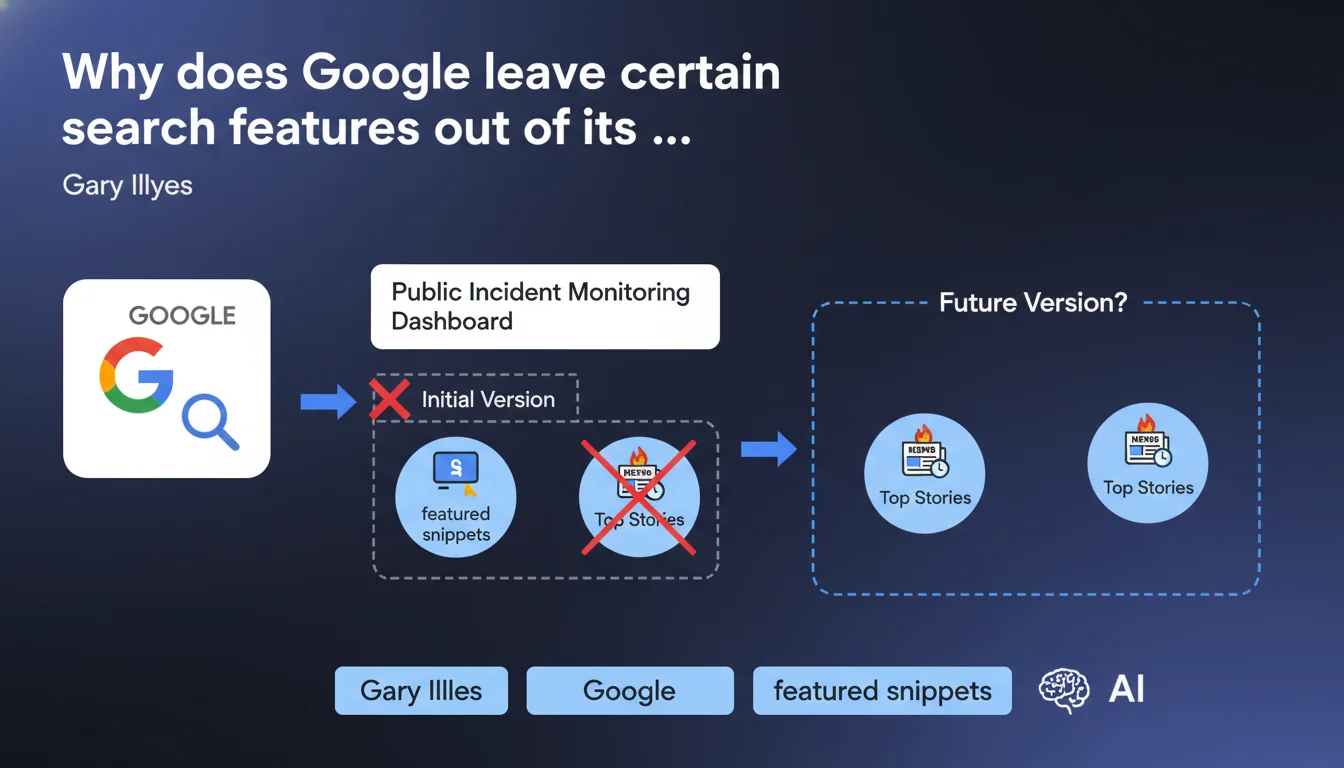
Google does not yet monitor incidents specific to Featured Snippets, Top Stories, or other search features in its public dashboard. Only issues affecting classic organic search results are currently documented there. SEO professionals must therefore monitor the availability of these strategic elements themselves.
What you need to understand
What exactly is this dashboard we're talking about?
Google launched a public status dashboard designed to inform webmasters about technical incidents affecting its search engine. The goal: prevent every indexing bug or unexplained traffic drop from triggering a collective panic on Twitter.
Except this dashboard only covers general malfunctions — those that impact indexing, crawling, or organic results as a whole. Specific search features? Not in the initial scope.
Which features are excluded from monitoring?
Gary Illyes explicitly mentions Featured Snippets and Top Stories, but the list is likely longer. We can reasonably add People Also Ask, Rich Results (recipes, events, FAQs), Local Packs, and even Knowledge Panels.
Yet these elements represent a growing share of organic traffic for some sites — sometimes more than 30% of clicks on informational queries.
Why this limitation in the initial version?
Google doesn't justify this narrow scope, but two hypotheses emerge. First possibility: technical complexity. Monitoring the availability of a Featured Snippet at global scale means tracking thousands of queries, across dozens of languages, with geolocalized variations.
Second hypothesis — more cynical: Google may not necessarily want to publicly document every algorithmic adjustment affecting these features. A Featured Snippet that disappears could result from a bug... or a deliberate test the company prefers not to discuss.
- Google's dashboard only covers general indexing and crawling incidents
- Featured Snippets, Top Stories, and other rich results are not publicly monitored
- This limitation could be lifted in a future version, with no guarantee of timeline
- SEO professionals must therefore maintain their own monitoring tools for these strategic features
SEO Expert opinion
Is this statement consistent with observed practices?
Absolutely. For years, SEO professionals have noticed unexplained disappearances of Featured Snippets or massive fluctuations in Top Stories — without ever obtaining official confirmation from Google. Silence was the norm, so this announcement doesn't change much on the ground.
What's new is the explicit admission that these features don't benefit from the same level of transparency as classic organic results. Google implicitly acknowledges that a site can lose 20% of its traffic via a Featured Snippet that vanishes... without that being documented anywhere. [To verify]: it's impossible to know whether this asymmetry results from technical constraints or a deliberate strategic choice.
What risks does this lack of transparency pose to SEO strategies?
The problem is straightforward: how can you effectively diagnose a traffic drop if Google doesn't document incidents affecting the features that generate your clicks? A lost Featured Snippet could be due to a Google bug, an algorithm change, or a regression in your content — but without visibility, you're navigating blind.
Even worse: some sites build their entire editorial strategy around obtaining Featured Snippets. If these elements disappear massively due to an undocumented bug, SEO teams will waste hours looking for the cause on their site... when the problem is at Google.
In what cases might this limitation evolve?
Gary Illyes mentions a possible expansion of the dashboard in the future, but without any timeline commitment. Let's be honest: Google faces no external pressure to document these incidents. Webmasters will continue using Search Console and third-party tools, as they always have.
Evolution could occur if massive bugs affecting Featured Snippets or Top Stories generate too much media noise. But as long as Google can manage these incidents quietly, it has no incentive to publicly commit to resolving them.
Practical impact and recommendations
How do you monitor these critical features yourself?
Since Google won't do the work, you must deploy your own monitoring tools. Several solutions exist, depending on your budget and technical skills.
For Featured Snippets, use tools like SEMrush Position Tracking or Ahrefs Rank Tracker by configuring SERP features tracking. These platforms detect appearances and disappearances of snippets on your strategic keywords. If you have the resources, develop an in-house script using Puppeteer or Selenium to capture your priority queries' SERPs daily.
For Top Stories, complexity increases — these results fluctuate based on real-time news. Effective monitoring involves tracking not only your presence in these carousels, but also your competitors'. Specialized news SEO tools (NewsWhip, Spike) can help, but expect a significant cost.
What metrics should you prioritize monitoring?
Don't just count your Featured Snippets — measure their actual traffic impact. Create a Google Analytics 4 segment isolating traffic from queries where you own a snippet, then track its weekly evolution.
Also monitor cannibalization rate: a Featured Snippet can reduce your classic organic clicks if users get their answer directly in the SERP. Compare the average CTR of your pages with and without an associated snippet.
- Set up a rank tracking tool that includes monitoring of SERP features (Featured Snippets, People Also Ask, Top Stories)
- Create dedicated analytics segments to measure traffic generated by each feature type
- Implement automatic alerts if a Featured Snippet disappears on your strategic queries
- Document observed fluctuations to identify patterns (days of the week, seasonality, algorithm updates)
- Diversify your organic traffic sources to never depend on a single search feature
What strategy should you adopt in the face of this uncertainty?
The short answer: never bet everything on a feature. Featured Snippets are a bonus, not a foundation. First, build a solid SEO strategy on classic organic results, then optimize for features as a complement.
Next, accept that some disappearances are inexplicable and temporary. If you lose a Featured Snippet overnight without changing the content, wait 48-72 hours before overhauling everything. Google bugs sometimes resolve themselves.
❓ Frequently Asked Questions
Le dashboard Google Search Status documentera-t-il un jour les Featured Snippets ?
Comment savoir si la perte d'un Featured Snippet est due à un bug Google ou à mon contenu ?
Les outils de rank tracking détectent-ils tous les types de SERP features ?
Dois-je contacter Google si je perds tous mes Featured Snippets d'un coup ?
Les Top Stories sont-elles vraiment stratégiques pour tous les sites ?
🎥 From the same video 9
Other SEO insights extracted from this same Google Search Central video · published on 14/12/2022
🎥 Watch the full video on YouTube →
💬 Comments (0)
Be the first to comment.